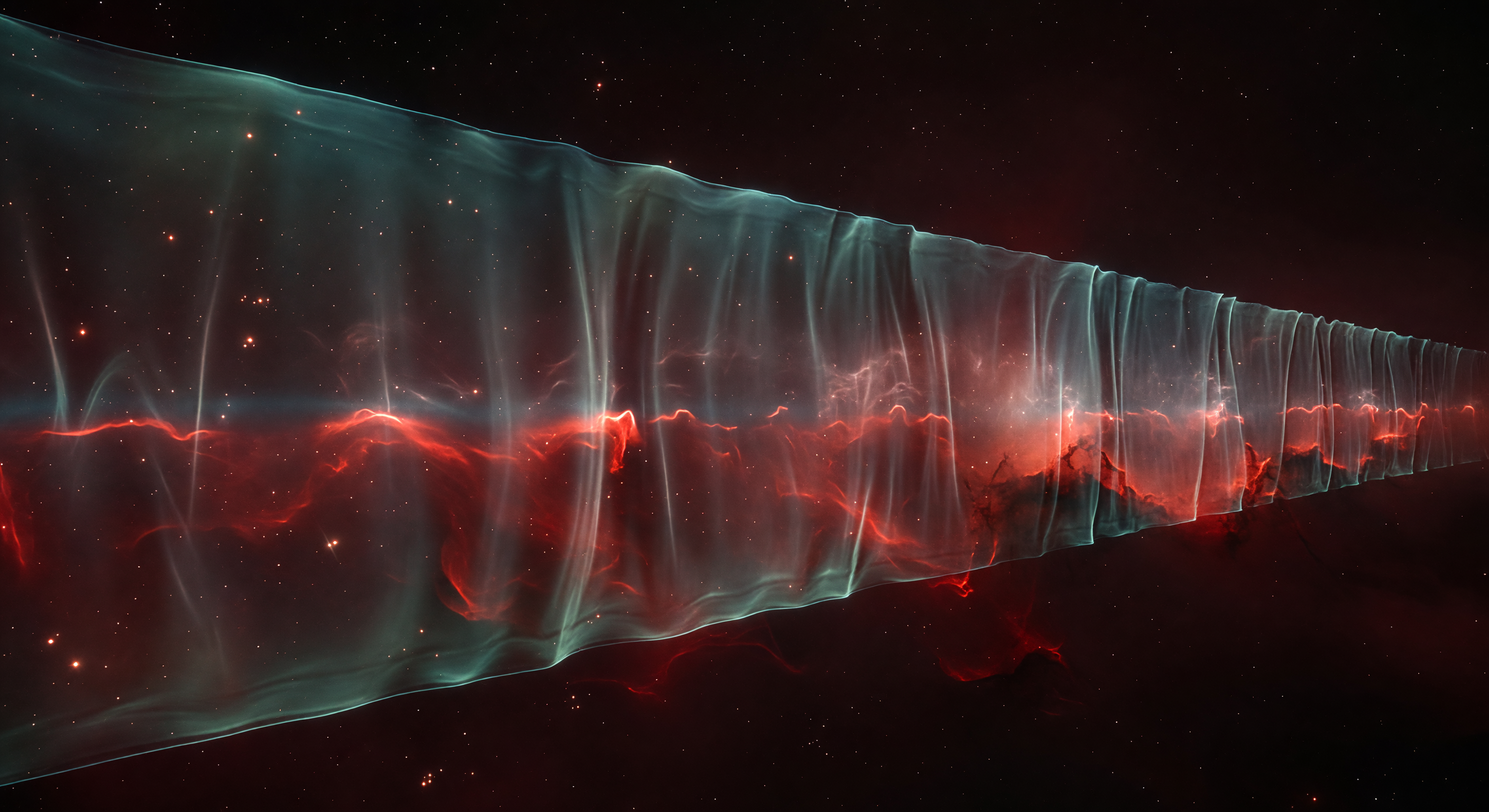
The entire visual field is consumed by a wall of gas that has no beginning and no ceiling — an advancing shock front from a supernova remnant, caught edge-on in the instant before it swallows everything ahead of it. The leading edge burns with forbidden oxygen emission in a razor-thin stripe of electric blue-green, a color with no terrestrial equivalent, produced when gas heated to nearly a million Kelvin radiates through quantum transitions unavailable under any earthly pressure; immediately behind it, hydrogen recombination paints a band of deep arterial crimson, and further back still, a scarlet fringe of sulfur emission marks the trailing margin where denser clumps of gas have lagged behind the front. The curtain is geometrically thin — a few astronomical units through its depth — yet translucent enough that background stars ghost through it as amber-muted points, their light reddened by the intervening column of hot ionized plasma, a haunting reminder that this luminous wall spans hundreds of light-years of sky in every direction. Rayleigh-Taylor instabilities have corrupted the boundary into slow vertical folds, each ridge glowing fractionally brighter where compression peaks, giving the entire structure the quality of living blown glass — a thermodynamic membrane of nuclear chemistry advancing in absolute silence across the dark.
Other languages
- Français: Voile Nébuleux de Choc Frontal
- Español: Cortina de Choque Nebular de Canto
- Português: Véu Nebular de Choque de Perfil
- Deutsch: Schleier Nebel Schockfront Kantensicht
- العربية: ستارة صدمة سديم الحجاب
- हिन्दी: वेल नेबुला शॉक पर्दा किनारा
- 日本語: ヴェール星雲衝撃波カーテン正面
- 한국어: 베일 성운 충격파 커튼 측면
- Italiano: Nebulosa Velo Curtain d'Urto di Taglio
- Nederlands: Sluier Nevel Schokgordijn Randaanzicht