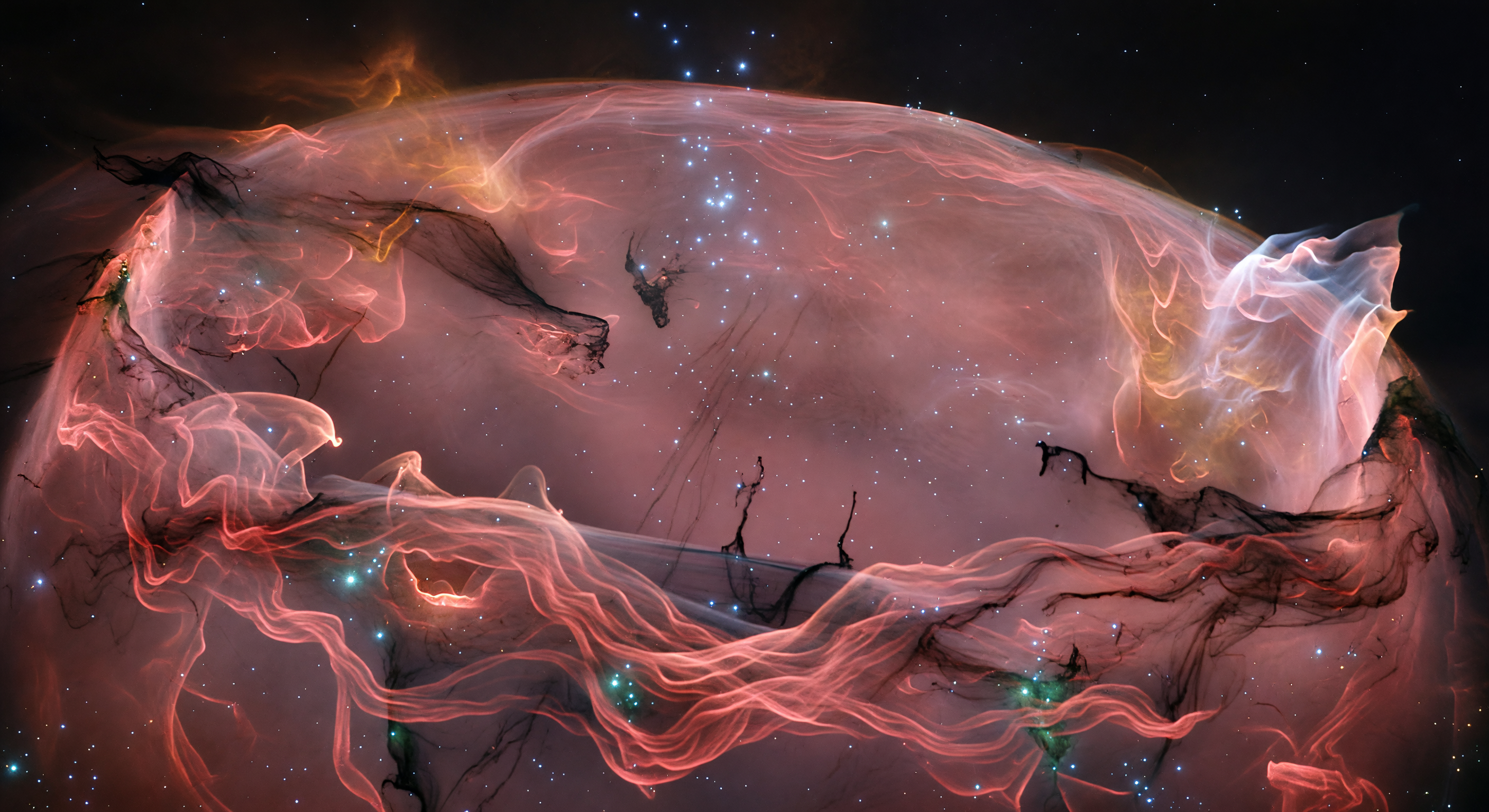
You are standing at the center of a wound that light has not yet finished escaping — a 500-light-year cavity whose walls stretch across every direction like the shattered interior of a cathedral built from plasma, shaped over millions of years by the overlapping deaths of massive stars. The shell before you is not a surface but a ruin: braided filaments of crimson Hα emission lace through collapsed arches and torn membranes, interrupted by cold molecular streamers pushing inward like dark fingers against the luminous curtain, their sunward edges hazing amber where ultraviolet is slowly eating them alive, while hard cyan-green knots of forbidden oxygen emission mark the shock fronts where the blast wave still churns the densest compressions. Dozens of blue-white OB stars drift through the tenuous interior — one particle per cubic centimeter of ionized hydrogen sustaining its faint rose translucence over hundreds of light-years of accumulated depth — their collective ultraviolet output the only reason this cavity glows at all rather than collapsing back into cold dark. At the right edge of everything, the shell is simply gone: a ragged chimney where the superbubble has ruptured entirely, gas streaming upward in luminous sheets of hot white and pale violet into an absolute extragalactic darkness that carries no structure, no warmth, no return — the last membrane between the ignited interior and the void, failed at exactly one point, and through that point, the light pours out forever.
Other languages
- Français: Paroi Éclatée de la Superbulle
- Español: Muro Roto de la Superburbuja
- Português: Parede Fraturada da Superbolha
- Deutsch: Gebrochene Hülle der Superblase
- العربية: جدار الفقاعة العظمى المنفجر
- हिन्दी: सुपरबबल की टूटी कोश दीवार
- 日本語: 破裂した超空洞の殻壁
- 한국어: 초거품 파열된 껍질 벽
- Italiano: Parete Spezzata della Superbolla
- Nederlands: Gebarsten Schaalwand Superbubbel