Scientific confidence: High
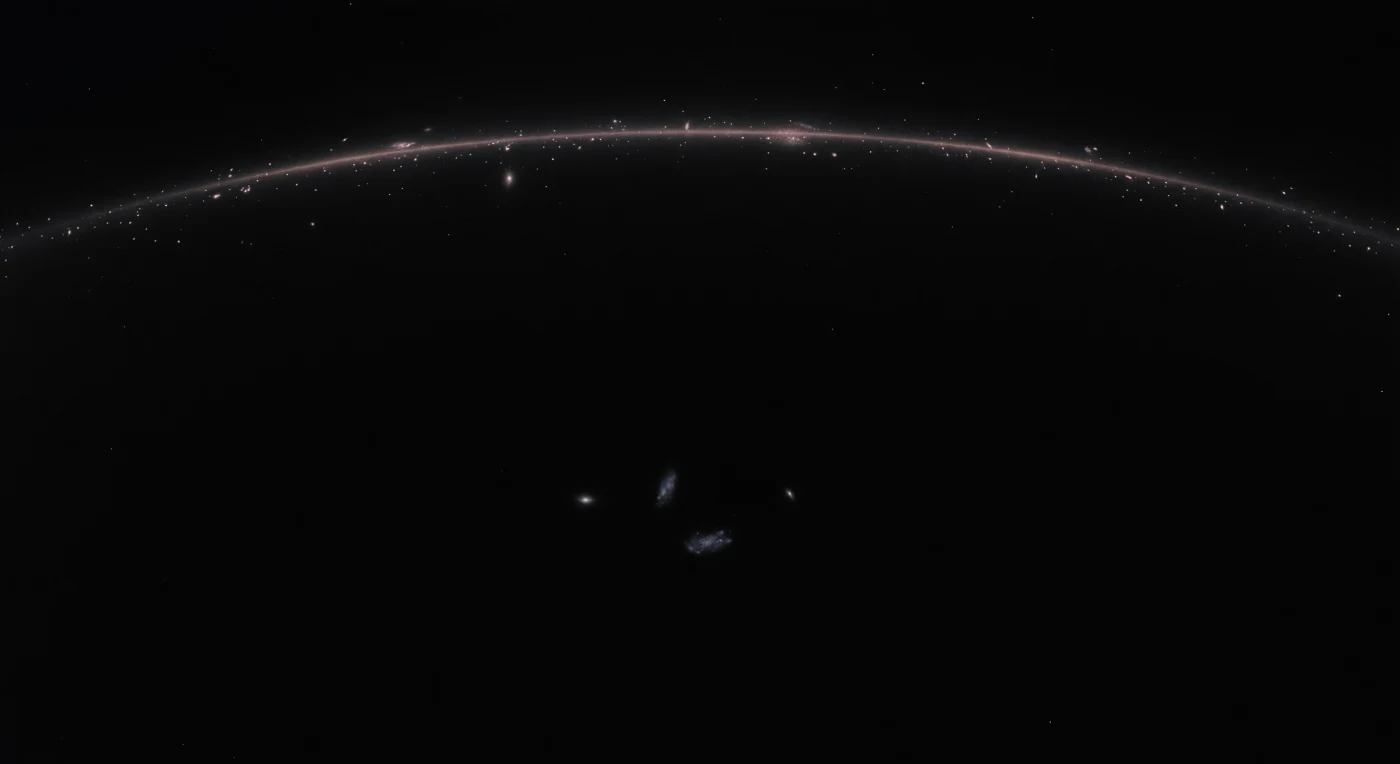
You are suspended at the geometric center of the Boötes Void, one of the largest known supervoids in the observable universe, a spherical absence roughly 330 megaparsecs across whose interior holds so few galaxies that cosmologists still debate whether its emptiness is statistically explicable. In every direction, the darkness is not the ordinary black of interstellar space but something denser and more total — the cosmic microwave background permeates the sphere as a faint, perfectly uniform thermal whisper, its infrared warmth so diffuse it reads less as light than as the residual heat signature of a universe that was once far hotter and far smaller, while three dwarf irregular galaxies drift in the foreground like torn fragments of luminous tissue, their blue-violet star-forming knots the only specific texture in hundreds of millions of light-years of near-absolute vacuum. The intergalactic medium here is so rarefied that a cubic meter of this space contains fewer atoms than the finest laboratory vacuum achievable on Earth, a density so low that matter has effectively ceased to be a meaningful category, and the dominant constituent of the volume is dark energy, the same accelerating pressure that is actively preventing this void from ever being reclaimed by the large-scale structure surrounding it. At the very limit of perception, curving continuously around the entire horizon in every direction, the bounding filament walls of the void announce themselves as an extraordinarily faint warm arc — amber bleeding into dusty rose, the smeared collective glow of tens of thousands of galaxies compressed by hundreds of millions of light-years of distance into a thin, unbroken rim, less an edge than the memory of a structure so vast that the mind can hold its geometry only in the abstract.
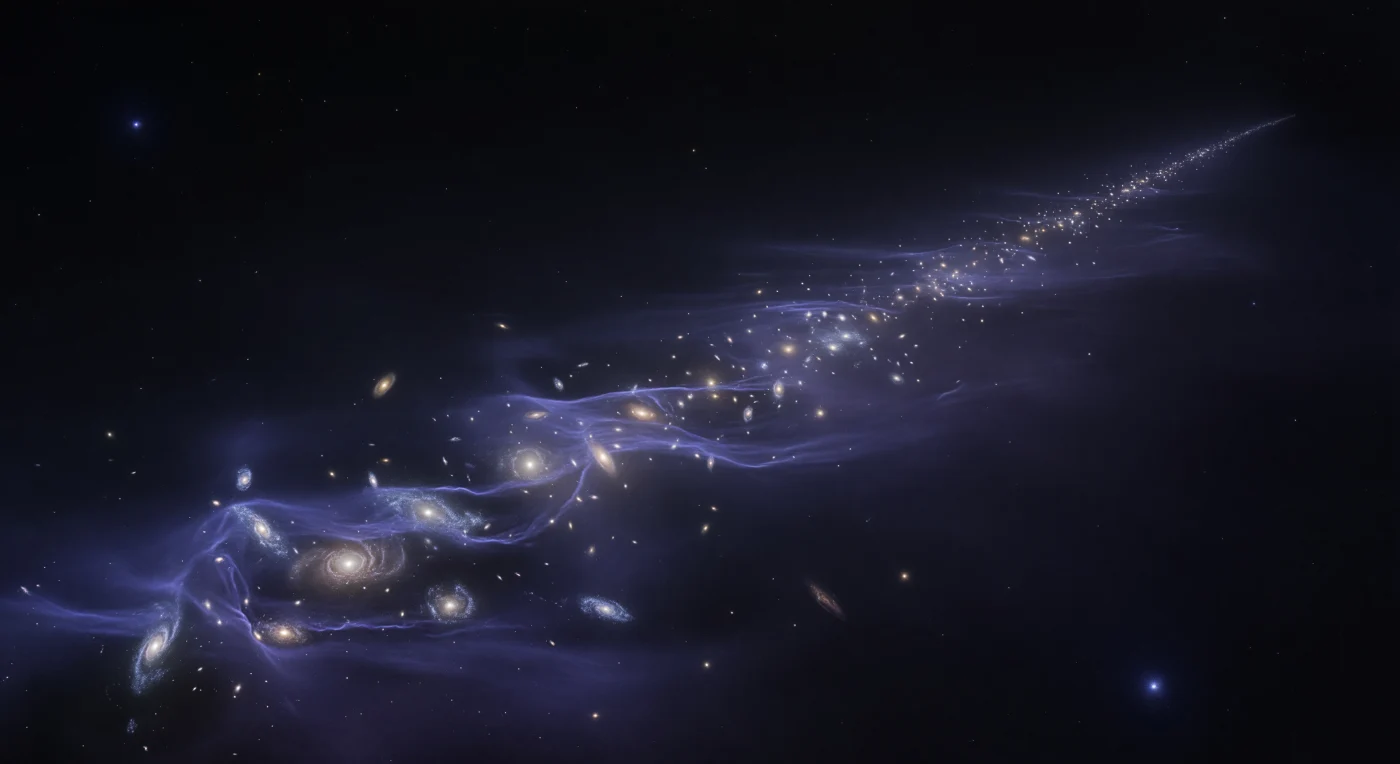
You are suspended along the luminous spine of a cosmic filament, and stretching pole-to-pole across every degree of sky, an unbroken river of galaxies pours from horizon to horizon — blue-white spiral disks tilted at oblique angles, their star-forming arms trailing faint wisps, and warm gold lenticular ellipticals glowing like banked embers, their halos dissolving softly into the surrounding dark. With distance, these island universes compress through sheer perspective into a single continuous thread of amber and silver light, thinning to an impossibly fine seam at the vanishing point, where the light reaching you left its source when the universe was measurably younger than the space immediately around you. Between each galaxy, the warm-hot intergalactic medium — the WHIM, a plasma of ionized hydrogen at temperatures between one hundred thousand and ten million kelvin — suffuses the filament corridor with a ghostly ultraviolet-violet luminescence, too tenuous to obscure yet present enough to scatter the collective ultraviolet output of a trillion stellar nurseries into a spectral, opalescent haze of faint braids and sheets. Off the filament axis in every lateral direction, the universe drops away into the oceanic blackness of the great voids, so volumetrically dominant that the entire luminous structure you inhabit feels like a single illuminated thread suspended inside a cathedral whose walls have long since passed beyond sight — and here and there at the extreme periphery, solitary blue dwarf galaxies drift in the dark like bioluminescent creatures in a deep ocean, achingly pure against the silence.
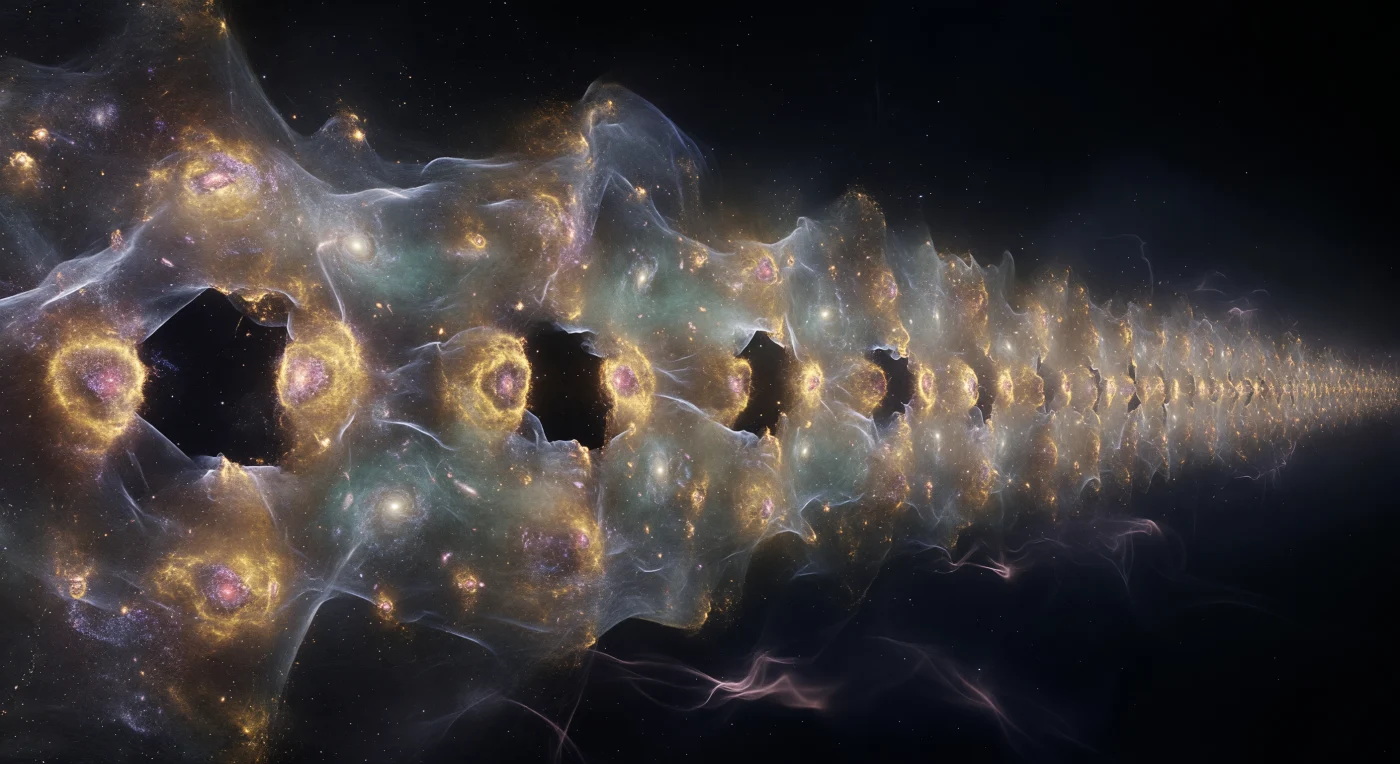
From twenty megaparsecs out, the view forward is consumed entirely by a structure that defies any familiar sense of boundary — a titanic curtain of galactic light stretching laterally without end, rising overhead and plunging below the plane of vision with no perceptible curvature, its surface alive with amber-gold cluster nodes and cooler blue-white sheets of spiral-rich intergalactic material woven between them like iridescent silk. Each warm knot concentrated along the wall's midplane is a galaxy cluster in its own right, hundreds of galaxies compressed into a smoldering elliptical-dominated core surrounded by the keV X-ray glow of fully ionized intracluster plasma at temperatures exceeding tens of millions of kelvin, while the translucent filamentary regions bridging them carry the warm-hot intergalactic medium — that elusive reservoir of partially ionized baryons at 10⁵ to 10⁷ kelvin that accounts for much of the universe's ordinary matter. Punched through the luminous fabric at irregular intervals are abrupt black fenestrations, cosmic voids whose edges are paradoxically outlined by a slight excess of galaxy concentration, as though the wall's own structure is compressed and brightened by the emptiness pressing against it from the other side. The entire scene is self-illuminated, the light not arriving from any single direction but emanating from the wall itself across five hundred megaparsecs of extent, a structure so vast that the light reaching this vantage from its farthest visible regions departed when the universe was nearly two billion years younger than it appears at the nearest nodes.
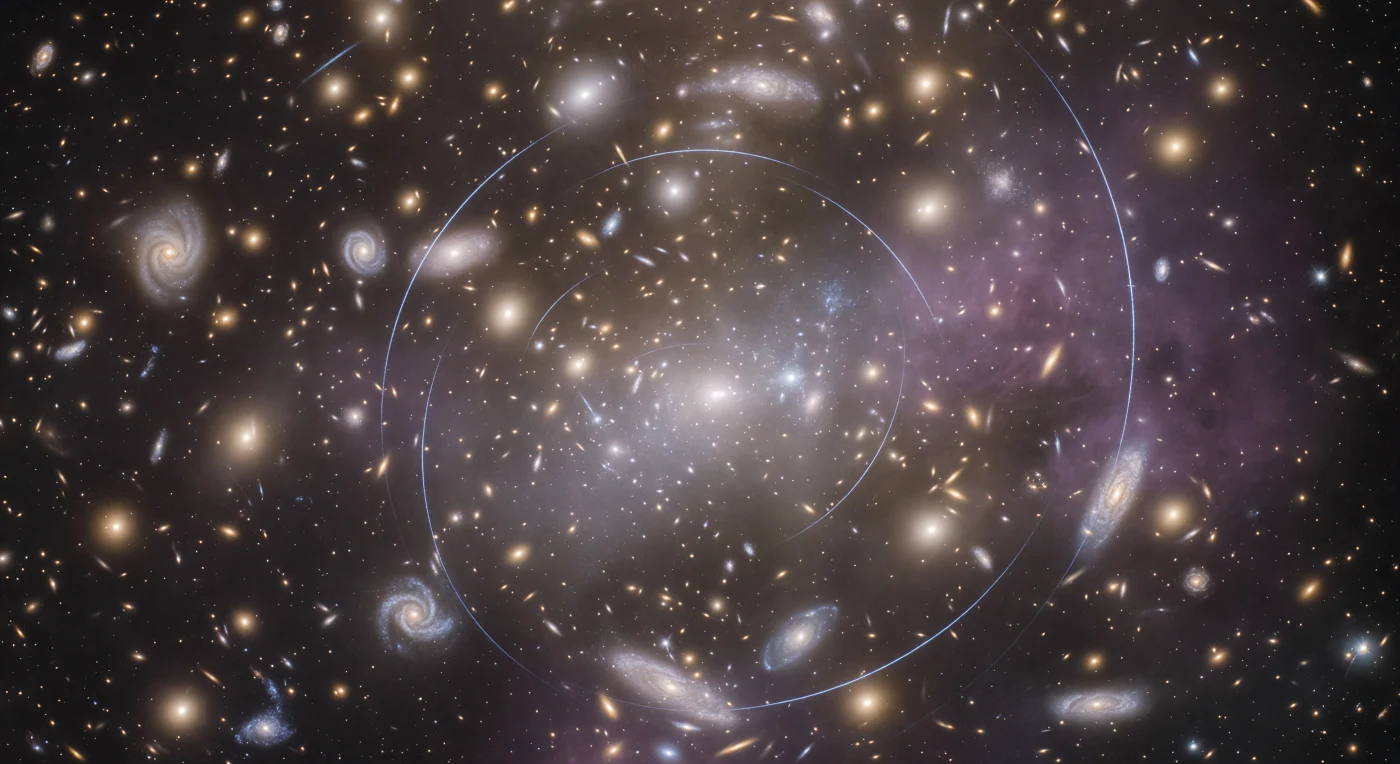
The view ahead is a cathedral without walls or ceiling — thousands of elliptical galaxies packed so densely across every direction that darkness finds no purchase between them, only the graduated amber, ivory, and pale gold of stellar populations billions of years old, each galaxy spanning hundreds of thousands of light-years yet compressed by distance into luminous pearls suspended in a warm, ancient light. At the center, the Brightest Cluster Galaxy dominates like a frozen detonation, its stellar mass so extreme that it offers no clean boundary, dissolving outward into intracluster light — the diffuse silver mist of billions of stars stripped from their home galaxies across eons of gravitational violence, bleeding across tens of degrees of apparent sky like luminous fog over still water, the visible record of collisions played out across cosmological time. Threading through this amber sea, razor-thin arcs of electric blue curve with knife-precise edges between the galaxies: gravitational lensing signatures, light from objects a billion light-years deeper into the universe bent into crescents and near-complete Einstein rings by the trillion solar masses of concentrated dark matter that holds this entire structure together. Behind and between everything, a faint violet-rose haze suffuses the near-vacuum — the intracluster medium, a fully ionized plasma heated to one hundred million degrees by the gravitational compression of infalling matter, detectable only as a gentle chromatic shift tinting the deepest background an otherworldly mauve, the X-ray-luminous thermal glow of matter in a state that barely resembles gas. Depth here becomes geological: foreground galaxies sharp and textured, mid-field objects dissolving into soft smears of blended starlight, the most distant members merging indistinguishably with the intracluster light itself, every photon arriving from a universe billions of years younger than the one that emitted it.
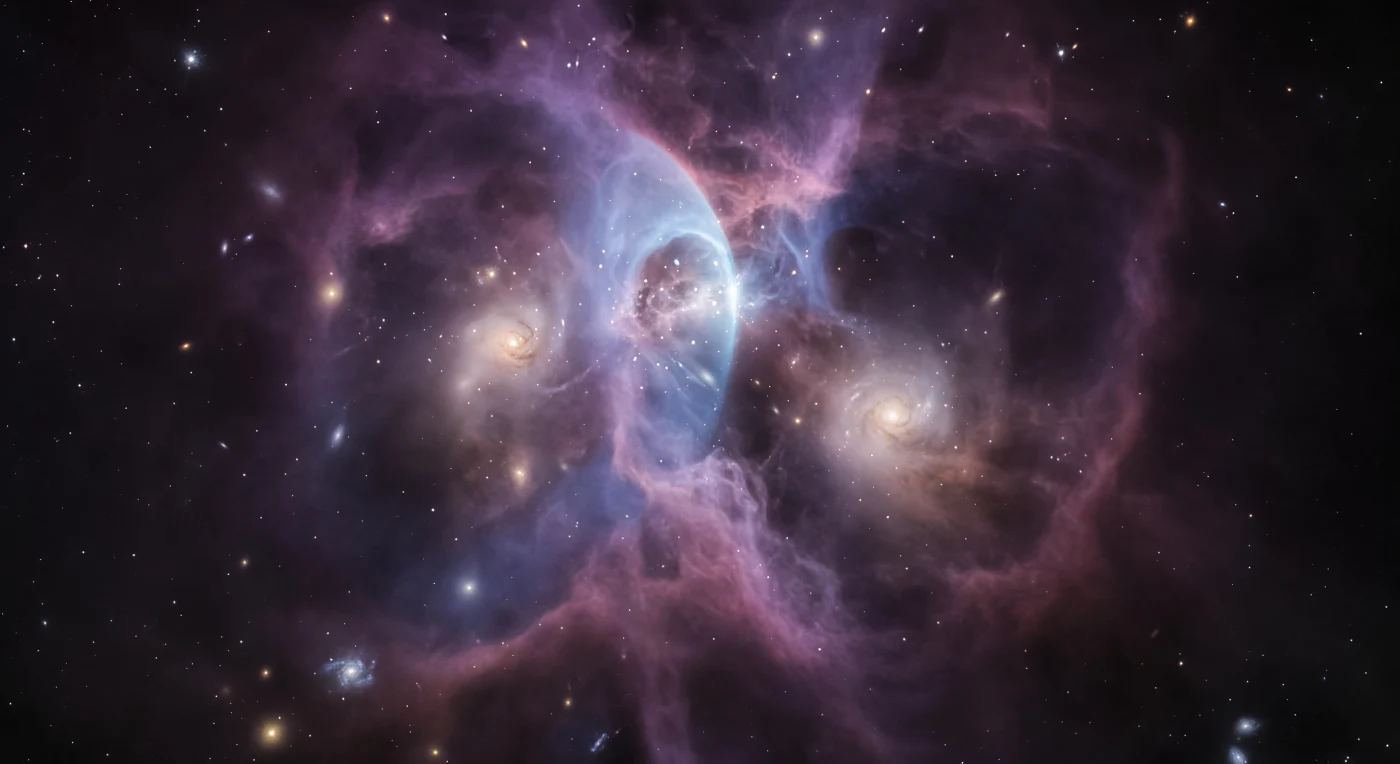
You float ten megaparsecs from the collision axis, and the entire merger fills your field of view like a detonation caught mid-frame — two vast populations of ancient elliptical galaxies, amber and pale gold, visibly displaced on opposite sides of the central zone, their dark matter halos having passed clean through each other while the baryonic gas was wrenched violently apart. Between them, a bow shock arc blazes in cyan-white incandescence, the compressed intracluster plasma driven forward into a bullet-shaped cone at thousands of kilometers per second, its thermal emission peaking deep in the X-ray band at temperatures exceeding tens of millions of degrees — a direct, luminous proof that ordinary matter and dark matter have been forcibly decoupled by the collision. Surrounding the shock front, the wounded intracluster medium spreads in every direction as a diffuse bruised haze of purple and deep magenta, the two cluster gas halos now smeared across the merger corridor in overlapping washes of shocked plasma, no longer anchored to the galaxies that passed through without slowing. Fainter still, background spirals and distant ellipticals show through the thinning outer plasma, their light filtered to ghostly pastels that lend impossible depth to a scene already spanning hundreds of millions of light-years, while the geometry of displacement — galaxies here, gas there, the wound between — makes the physics of the collision legible at a single glance across the void.
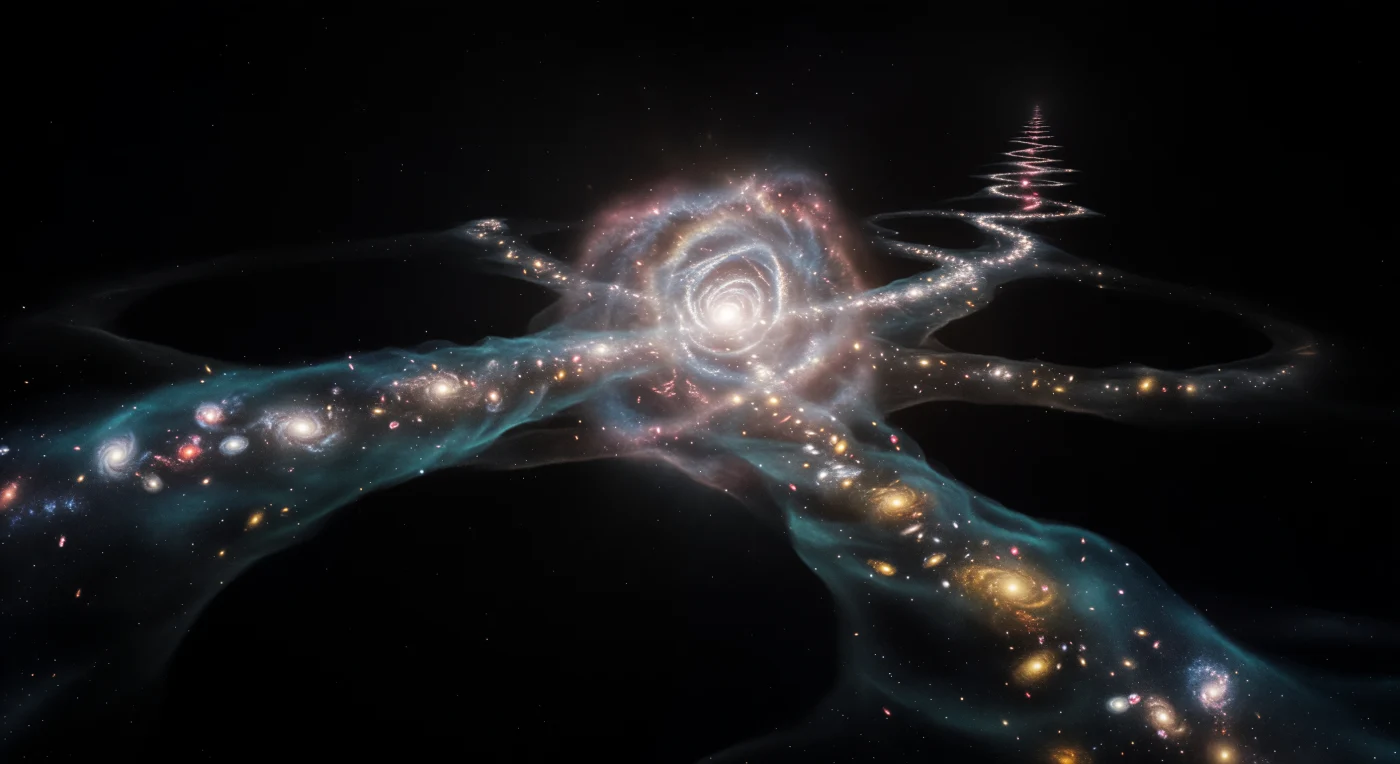
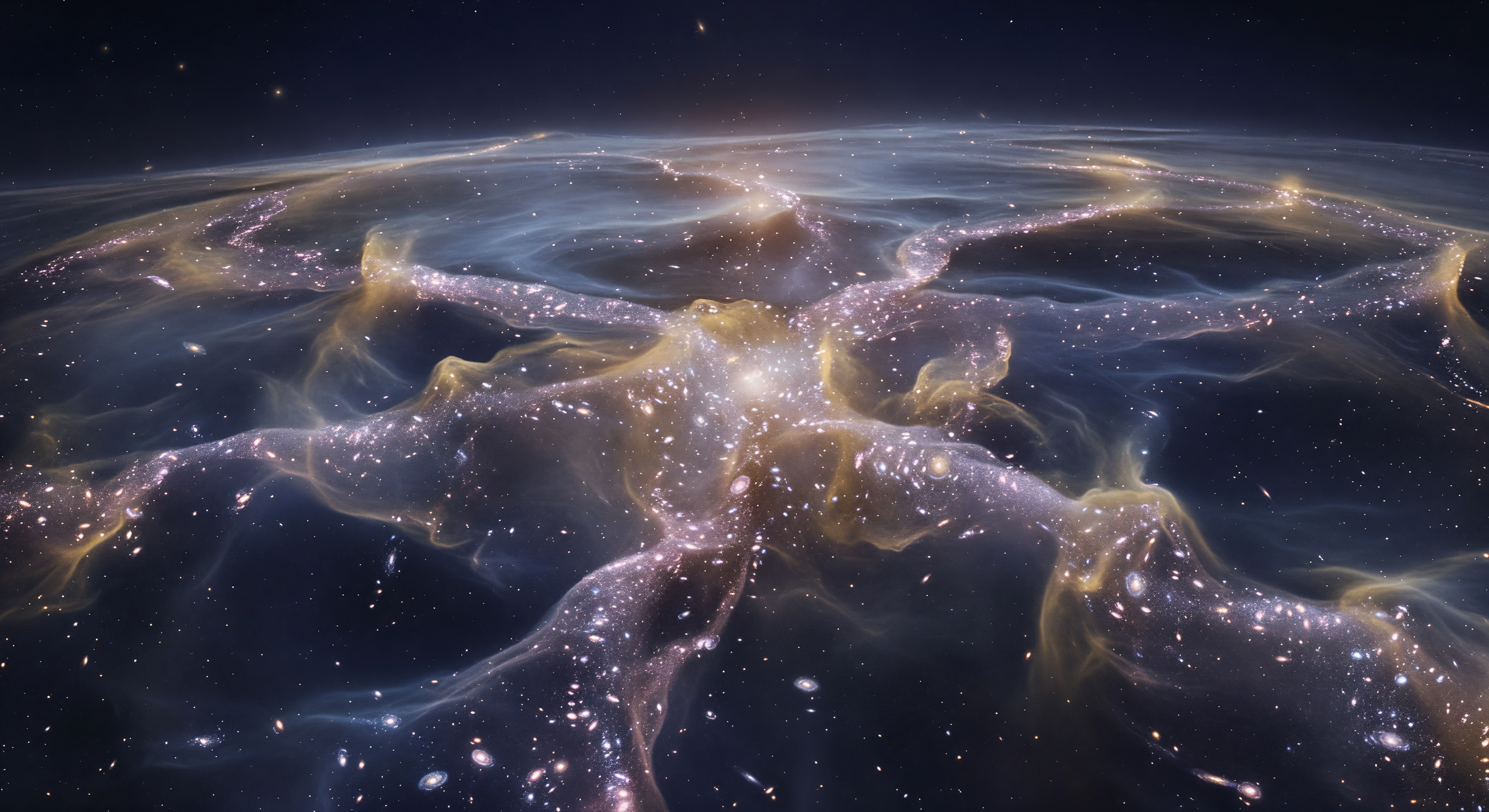
From a vantage ten megaparsecs above the convergence, three vast filamentary arms of the cosmic web reach outward from a single blazing node, each one a loosely braided rope of thousands of galaxies strung along invisible dark matter scaffolding that spans hundreds of millions of light-years — and yet the node itself, containing the compressed light of entire galaxy clusters, resolves to little more than a fierce white-gold ember at this remove. The node's heart is a fully ionized intracluster medium glowing at temperatures exceeding one hundred million degrees, its X-ray plasma bleeding outward through halos of champagne and rose before surrendering to the deep wedge-shaped voids that occupy most of the visible volume, volumes so architecturally empty that the absence of even a single galaxy across billions of cubic light-years reads as a structural feature in itself. Each filament carries its own character: one braided with blue-white spirals still forming stars and threaded by warm-hot intergalactic gas fluorescing at ultraviolet wavelengths, another richer in amber ellipticals whose stellar populations have aged and cooled over billions of years, a third foreshortened along the line of sight into a diminishing corridor of redshifted fire. What holds this geometry in place is not the gravity of any visible matter but the far greater mass of dark matter halos whose scaffolding preceded the galaxies themselves, while between the arms dark energy quietly continues its work — pulling the supercluster's outer reaches apart even as the node at its heart draws everything inward.
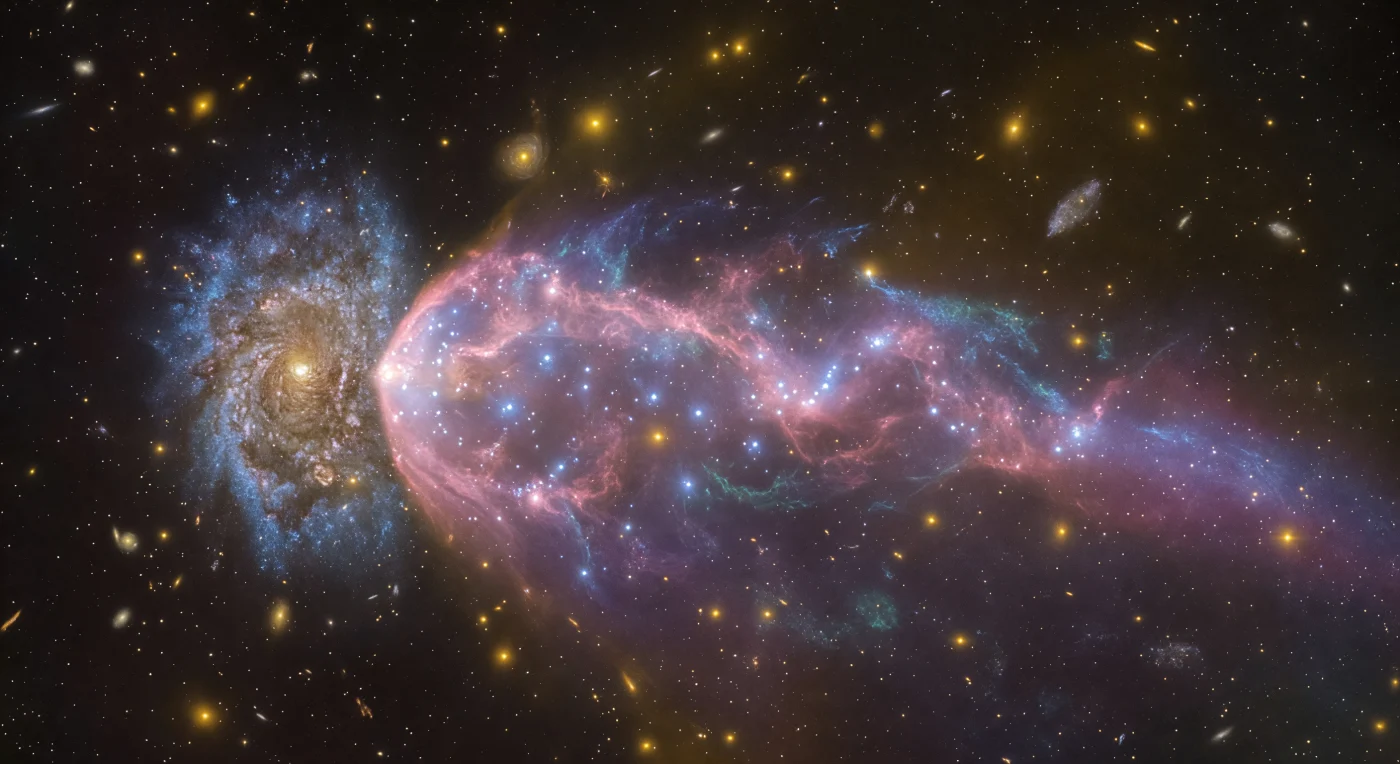
Ahead of you, a spiral galaxy in full face-on glory occupies the left expanse of the visual field, its golden core smoldering with the accumulated light of billions of aged stars while cobalt and teal arms still ignite with furious star formation — dust lanes pressed in dark ribbons between luminous arcs, H II regions scattered like embers, every structural detail resolved with brutal clarity. But this galaxy is not at rest: plunging into the cluster at over a thousand kilometers per second, it meets the intracluster medium — a fully ionized plasma heated to tens of millions of degrees — which tears at its interstellar gas and sculpts it into a comet tail half a megaparsec long, a cascading streamer of electric pink hydrogen-alpha emission threaded with blue-green doubly ionized oxygen filaments, narrowing from a blunt shock front at the galaxy's disk edge into a tapering luminous plume that dissolves into deep violet as stripped plasma cools and disperses. Within that tail, ram pressure itself becomes a creative force: dozens of blue-white stellar knots, compact star-forming clumps compressed into existence by the shock, burn like bonfires strung along a river of glowing fog, each one haloed in pale sapphire where its ultraviolet radiation reionizes the surrounding stripped gas. The background offers no relief — hundreds of amber and old-ivory elliptical galaxies crowd every direction, their warm thermal glow diffusing through the intracluster plasma like light through an impossibly vast amber glass, the contrast between their ancient quiescence and the spiral's violent blue youth written across the sky in half a million light-years of irreconcilable collision.
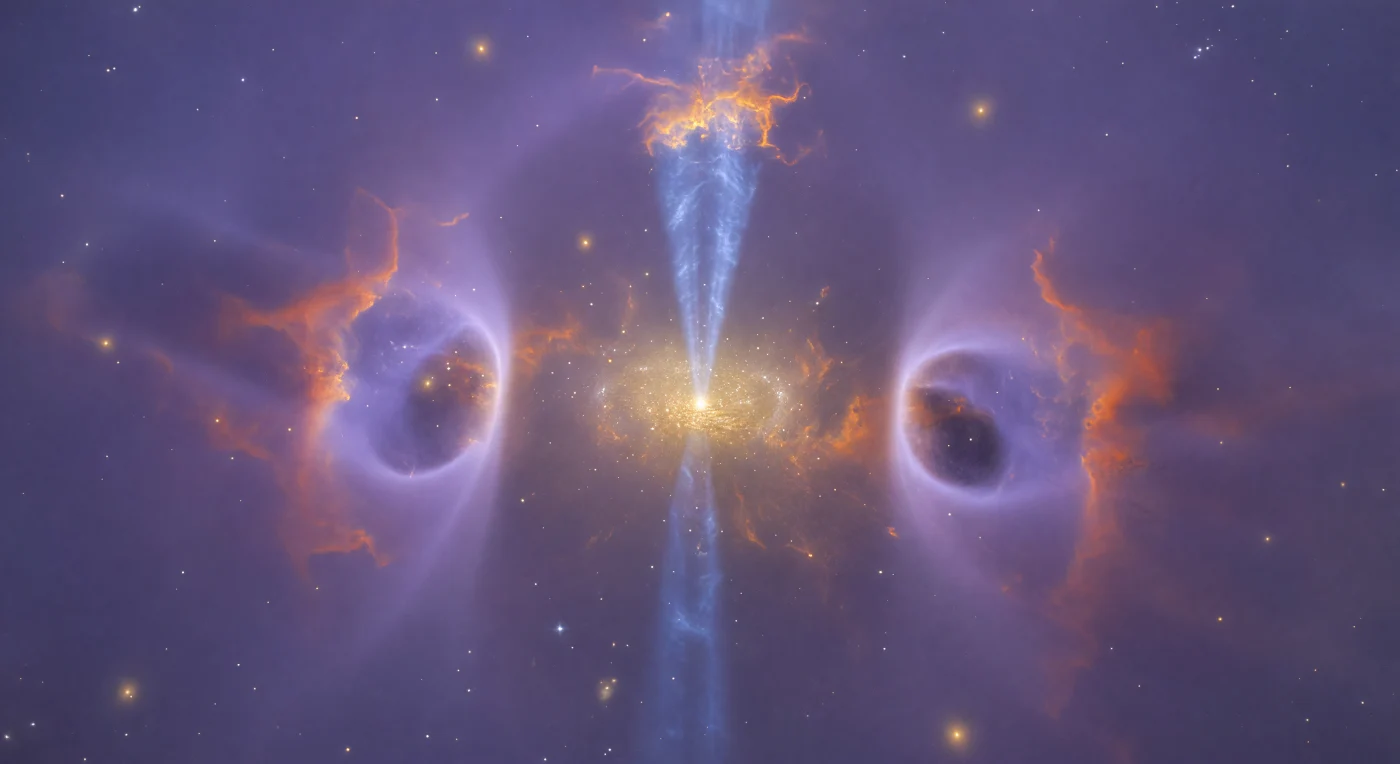
One megaparsec out from the nucleus, the scene is dominated by the galaxy's blazing golden core, its elliptical body dissolving at the edges into the faint violet-purple luminescence of the intracluster medium — a fully ionized plasma at tens of millions of degrees, so tenuous it would register as hard vacuum by any terrestrial measure, yet glowing continuously in X-ray frequencies across volumes larger than entire galaxy groups. From that warm nucleus, twin jets of relativistic plasma — electrons and magnetic fields wound together and accelerated by the supermassive black hole's accretion disk — knife outward in perfectly collimated blue-white columns, products of one of the most energetic continuous processes in the known universe, each carrying mechanical power equivalent to trillions of solar luminosities and suppressing star formation across the entire cluster by injecting energy into the surrounding ICM for hundreds of millions of years. Where the jets finally exhaust their collimation and thermalize against the resisting intracluster medium, they inflate into enormous orange-red radio lobes — structures spanning distances comparable to the separation between the Milky Way and the Andromeda Galaxy — their interiors filled with aging relativistic electrons radiating away their energy through synchrotron emission as the color shifts from electric orange at the shock front to deep rust further inward. Flanking the nucleus, the dark X-ray cavities — physical excavations carved by repeated jet outbursts over cosmic time — press ghostly ovoid shadows into the surrounding ICM glow, their soft pressure boundaries and concentric ghost rings of compressed, brightened plasma recording a history of episodic mechanical feedback written in the medium itself.
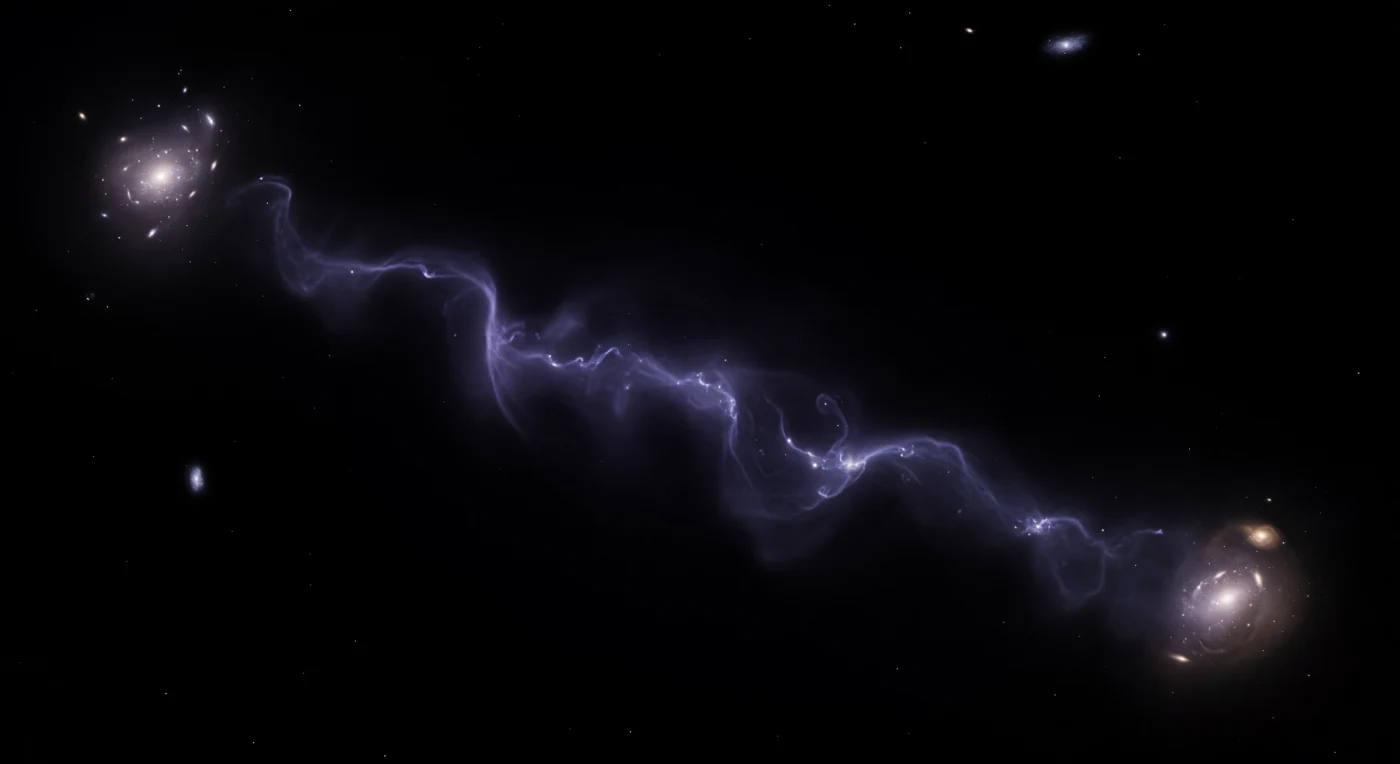
Suspended mid-crossing between two galaxy clusters separated by fifty megaparsecs, you look out into a darkness so total that the faint luminous breath of the cosmic filament barely registers as real — a gossamer bridge of warm-hot intergalactic medium, the WHIM, so tenuous that its density is nearly indistinguishable from the void it threads through, yet whose sheer column depth across hundreds of millions of light-years conjures a translucent fog of ultraviolet violet at its cooler periphery, shifting to pale electric blue where hotter pockets of ionized plasma pulse with soft X-ray emission along the dark matter scaffolding beneath. This is the cosmic web made visible at its most elusive: partially ionized baryonic gas at temperatures between one hundred thousand and ten million Kelvin, estimated to contain thirty to fifty percent of all ordinary matter in the universe and yet so diffuse — mere fractions of a particle per cubic meter — that it evaded direct detection for decades. Far ahead and far behind, the two cluster anchors resolve as warm amber halos, entire metropolises of thousands of galaxies suspended in superheated plasma, their collective glow bleeding into incandescent pools at the filament's endpoints like coastlines glimpsed across an ocean of absolute nothing. The filament between them breathes in slow organic curves, its luminosity pooling in subtle dark-matter-guided thickenings, and the overwhelming quality of this environment is emptiness so profound that the filament's faint violet light reads, paradoxically, as extravagant abundance — matter present, warm, and faintly alive against the ontological dark.
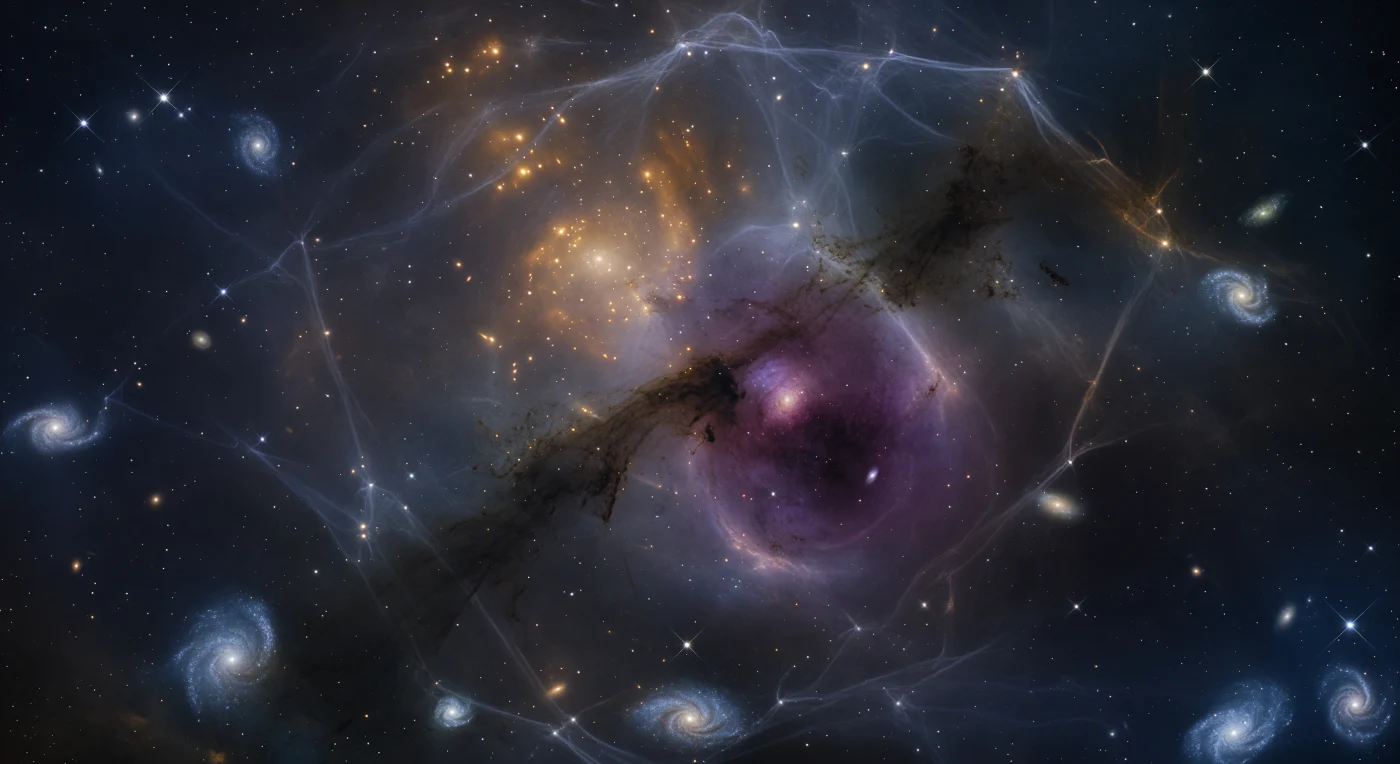
From the Milky Way's own position deep within Laniakea, the view opens across hundreds of millions of light-years of faintly luminous cosmic architecture — the Virgo Cluster burning amber-gold some sixteen megaparsecs ahead, its thousands of ancient elliptical galaxies compressed into a warm node whose ochre halo bleeds slowly into the silver-blue haze of ionized filaments stretching across the foreground like moonlight caught in the thinnest possible gauze. These filaments are not decoration but the structural skeleton of the supercluster itself — warm-hot intergalactic plasma threading between galaxy concentrations along pathways carved by dark matter's gravitational scaffolding, channeling entire rivers of mass toward nodes of convergence over timescales that dwarf the age of the solar system. A thick diagonal band of galactic-plane dust cuts across the scene in deep umber and russet, absorbing and reddening everything behind it, concealing the Norma Cluster and allowing only bruised violet and smoldering magenta glimpses of the Great Attractor — a gravitational convergence so massive that the Milky Way itself, along with hundreds of thousands of other galaxies, flows toward it at roughly six hundred kilometers per second, a drift so vast and so slow it will take billions of years to resolve, and may never fully do so before dark energy tears the supercluster apart. Blue spiral galaxies populate the nearer periphery like luminous pinwheels caught at every angle, each one an island of billions of stars, their presence a reminder that this incomprehensible ocean of matter is not abstract but inhabited — a structure we do not observe from outside, but from within.
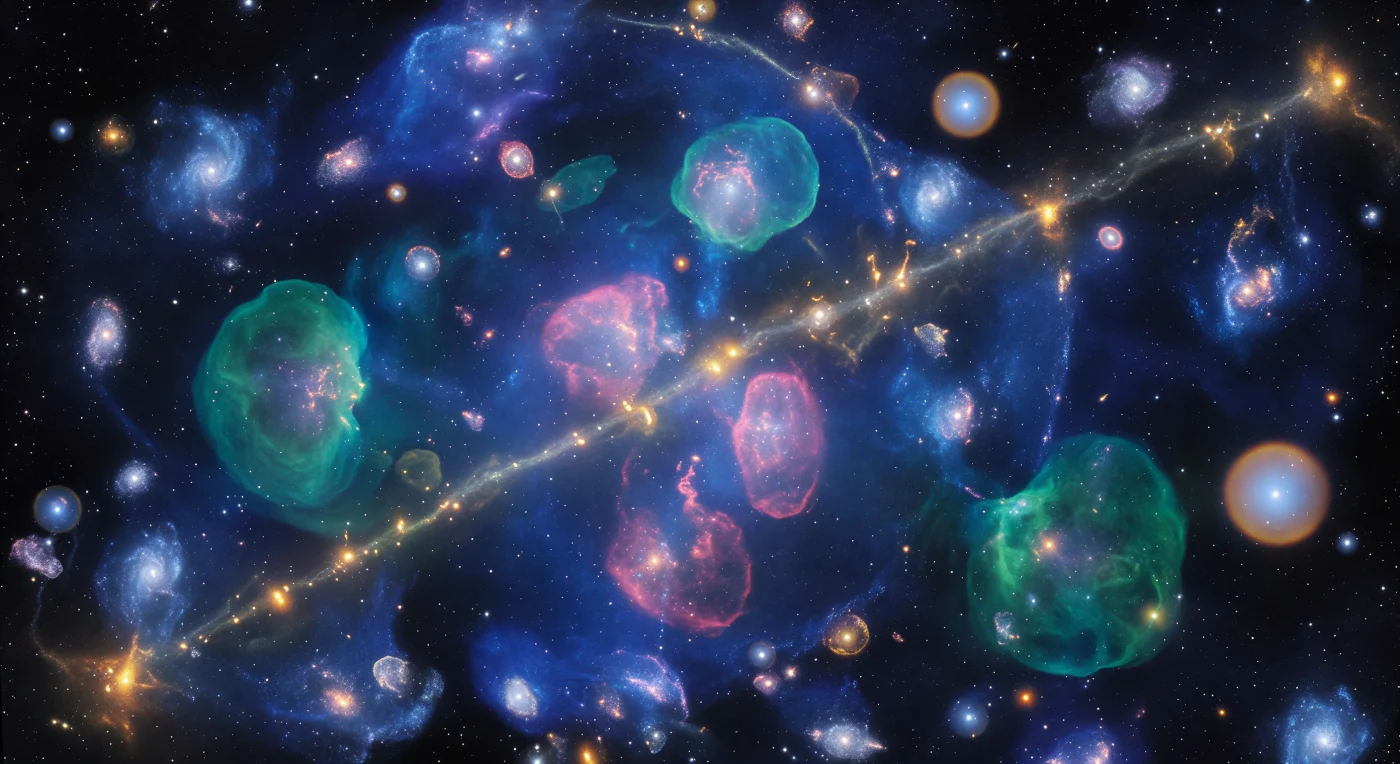
You drift weightless inside a protosupercluster at cosmic noon, when the universe was barely four billion years old and compressed to a fraction of its present volume, and in every direction the sky is shattered with raw, clumpy galaxies — not the elegant spirals of a mature cosmos but asymmetric archipelagos of blue-white fire, their star-forming knots erupting in ultraviolet cascades that spill into the surrounding intergalactic medium as luminous turquoise mist. Several quasar point sources burn like captive suns at the hearts of spherical ionized halos, their combined radiation flooding the entire field with a pervasive blue-violet glow that leaves no shadow unlit, while enormous Lyman-alpha blobs — colossal reservoirs of gas hundreds of kiloparsecs across — billow in slow teal and seafoam volumes, lit from within by embedded starbursts and AGN engines and backlit at their edges by amber quasar glare. The cosmic web filaments anchoring this system are visible as columns of diffuse warm-gold haze, their interiors strung with loose chains of irregular proto-galaxies whose overlapping halos and braiding tidal streams betray a density utterly unlike the ordered large-scale structure that will one day settle into place. This is the universe mid-construction, every cubic megaparsec seething with the violent, overcrowded energy of a cosmos still assembling the filaments, walls, and voids that will define all structure billions of years hence.
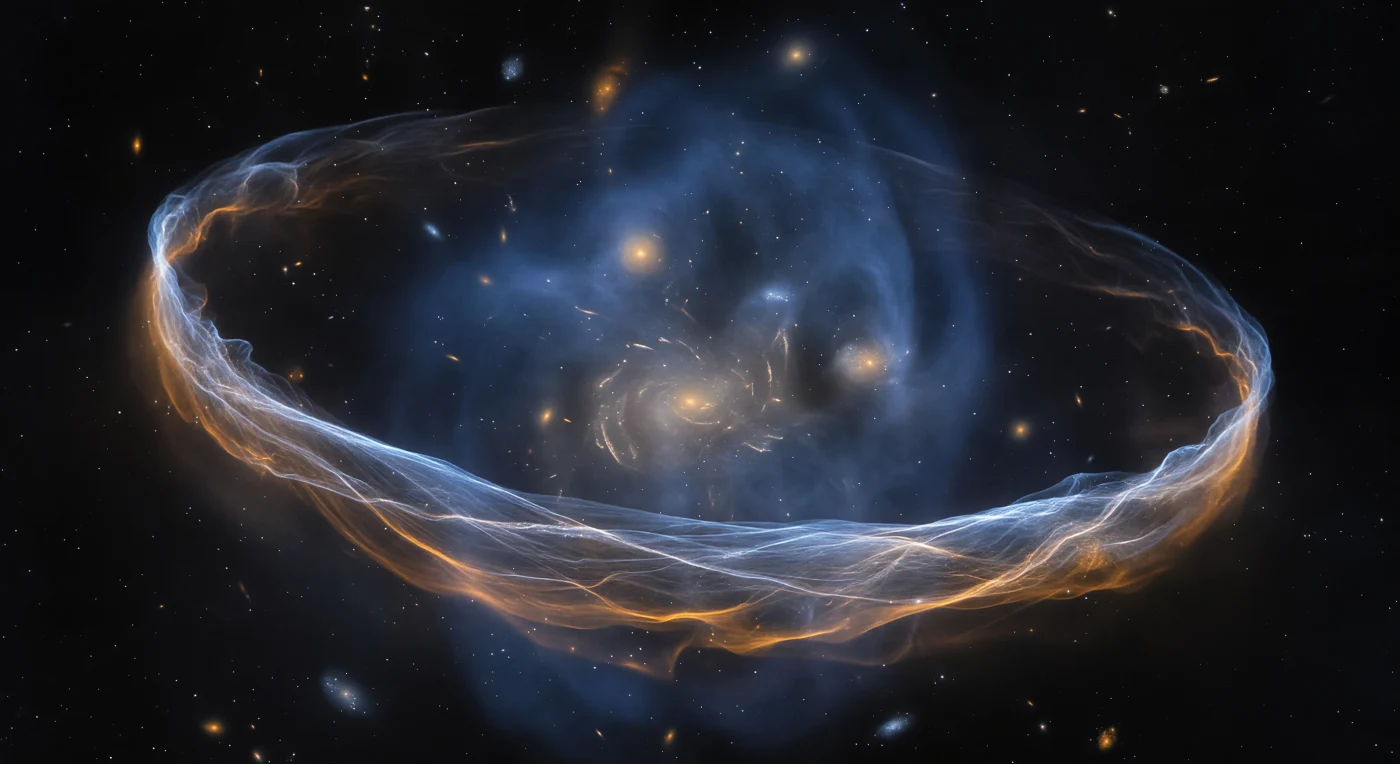
You float five megaparsecs from the gravitational wreckage of two merged galaxy clusters, suspended in a vacuum so close to absolute that the only matter around you is a whisper of ionized plasma too thin to register yet wide enough to arch three megaparsecs across the sky in a single luminous crescent. That arc — the radio relic — curves before you like a breaking ocean wave caught at the peak of its height, its leading edge blazing in cold electric blue where the merger shockfront has swept and compressed magnetic field lines into near-parallelism, forcing relativistic electrons into synchrotron emission along subtly braided filaments each a few kiloparsecs thick; moving inward, the blue cools through ice-white threads into deep amber-orange where the shock has already passed and the plasma has begun to drain its energy, the color gradient reading like the inner surface of a luminous translucent shell curving gently away at a scale that reduces entire galaxies to amber smudges drifting through the diffuse blue radio halo filling the cluster's interior volume behind it. That halo — a vast, even fog of re-energized turbulent plasma — softens the background like ground glass, its cold synchrotron luminescence interrupted only by the warm lenticular presences of settled elliptical galaxies whose ancient stellar populations glow in gold-shifted tones, carrying in their amber light the record of star formation that ended billions of years before this merger ever began. The foreground shimmers faintly with the warm-hot intergalactic medium threading through the surrounding supercluster filament, a haze so tenuous it approaches transparency yet still scatters the relic's photons into a soft spectral mist at its nearest edge, while beyond the cluster the background universe recedes in every direction as bluing, fragmenting galaxy smudges embedded in absolute black.
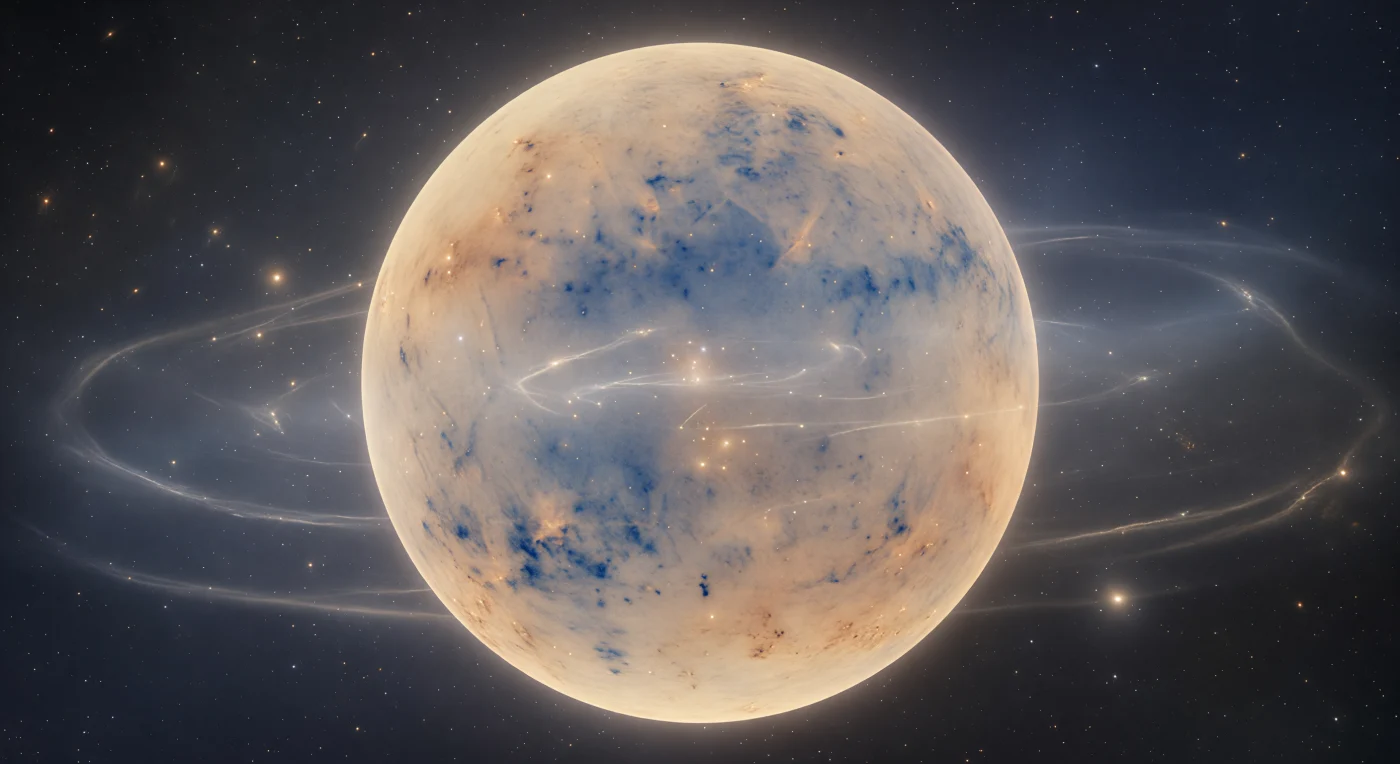
You are suspended at the geometric heart of the observable universe, wrapped on all sides by the oldest light in existence — the cosmic microwave background's last scattering surface, a luminous shell of thermal radiation released when the universe was just 380,000 years old, its photons traveling 13.8 billion years to converge simultaneously upon this single point of witnessing. The sky is not black but suffused with a breathing cream-gold warmth, omnidirectional and borderless, the interior of an unimaginably vast furnace seen from its precise center, every direction indistinguishable from every other. Across this perfect luminous sphere, temperature fluctuations of a few parts in a hundred thousand paint the entire celestial surface in the subtlest imaginable palette — warm amber and dusty terracotta blooming across one-degree acoustic oscillation scales, the fingerprints of primordial sound waves frozen at the moment of recombination, each warm patch the embryonic seed of a supercluster, each cobalt-indigo cold spot the future address of a cosmic void. Between you and that thermal horizon, the full depth of large-scale structure recedes in ghostly superimposition — faint filaments of the cosmic web threaded across hundreds of millions of light-years, galaxy clusters reduced to pale smears of composite starlight nearly indistinguishable from the background glow, the entire architecture of superclusters, walls, and voids rendered gossamer by sheer distance. This is the universe's oldest self-portrait, and it surrounds every observer in the cosmos equally, without exception.
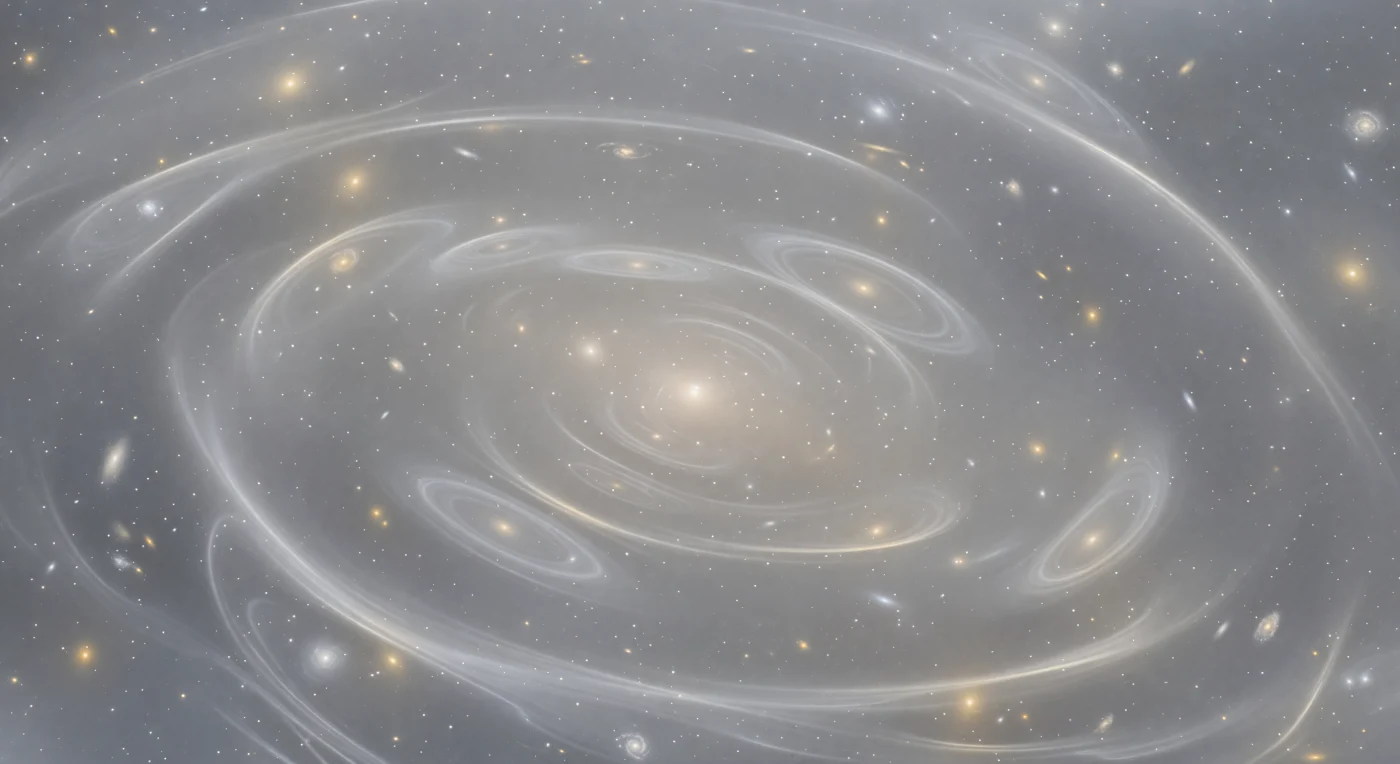
You drift suspended within an ocean of stolen starlight half a megaparsec from the heart of the cluster, immersed in an intracluster light so faint it hovers at the threshold of perception yet so vast it fills a volume measured in hundreds of thousands of light-years — the accumulated glow of billions of stars stripped from their parent galaxies over ten billion years of gravitational violence, smeared by tidal disruption into a continuous pewter-silver luminosity that casts no shadows and originates from no single direction. The brightest cluster galaxy ahead offers no clear boundary where it ends and the stellar sea begins, its ivory-gold nucleus brightening only imperceptibly toward center before bleeding without edge into the surrounding diffuse medium, the distinction between galaxy and intergalactic space erased by the same merging events recorded in the long fossil tidal streams that arc across the field of view — translucent ribbons of fractionally elevated stellar density curving over tens of kiloparsecs, their feathered margins tracing the orbital paths of galaxies consumed and dispersed across geological timescales. Concentric shell structures interrupt the silver smoothness in broad elliptical arcs, interference patterns frozen into the stellar medium by merger events three billion years past, each arc spanning tens of kiloparsecs and recording a separate ancient catastrophe in slightly elevated brightness against the universal glow. Above and around this phosphorescent ocean, intact cluster galaxies — amber ellipticals and blue-tinted spirals — float like islands at great depth, their own stellar halos already beginning to dissolve into the intracluster light that will eventually claim them too.
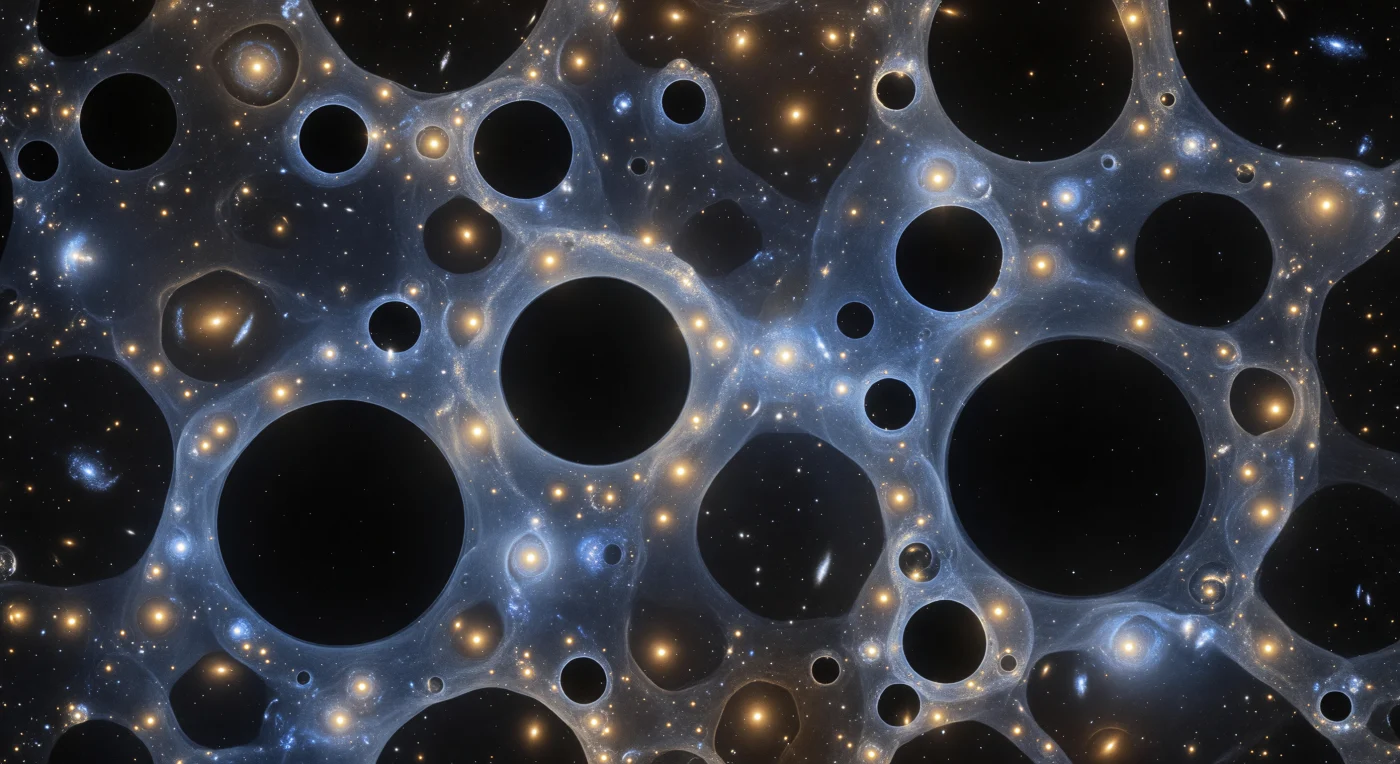
You are suspended at the gravitational null between two superclusters, and the entire observable universe wraps around you in every direction as a self-luminous foam of extraordinary geometric precision — brilliant blue-white and amber nodes blaze at every filament junction, each one compressing thousands of galaxies into a single burning pearl surrounded by a faint electric corona of ten-million-Kelvin intracluster plasma glowing in soft X-ray frequencies rendered visible by sheer accumulated depth. Between the nodes, filaments of warm-hot intergalactic gas at temperatures no terrestrial vacuum can replicate stretch as luminous threads that thicken to rope near each cluster and taper to gossamer blue-gray wisps at their void-facing midpoints, their glow the barely-detectable signature of the WHIM — the universe's largest reservoir of ordinary matter, dispersed across distances that make light itself seem slow. The voids are the revelation: not merely dark but architecturally, geometrically dark, perfectly spherical negative-space bubbles whose smooth curved interiors are legible only by the luminous filament rims encircling them, bubble pressing against bubble in every direction with shared walls of galaxy sheets and junction points of blazing cluster fire, a foam topology that self-similarly repeats from the immediate surround down to the finest resolvable tendril at the limit of vision. The light from the nearest bright node departed before complex multicellular life arose on Earth, and the faint red-orange warmth suffusing the deepest layers of your visual field is the cosmic microwave background itself — the thermal afterglow of the early universe arriving here in the null, in the silence between structures, in a darkness paradoxically filled with a billion years of accumulated stellar fire.