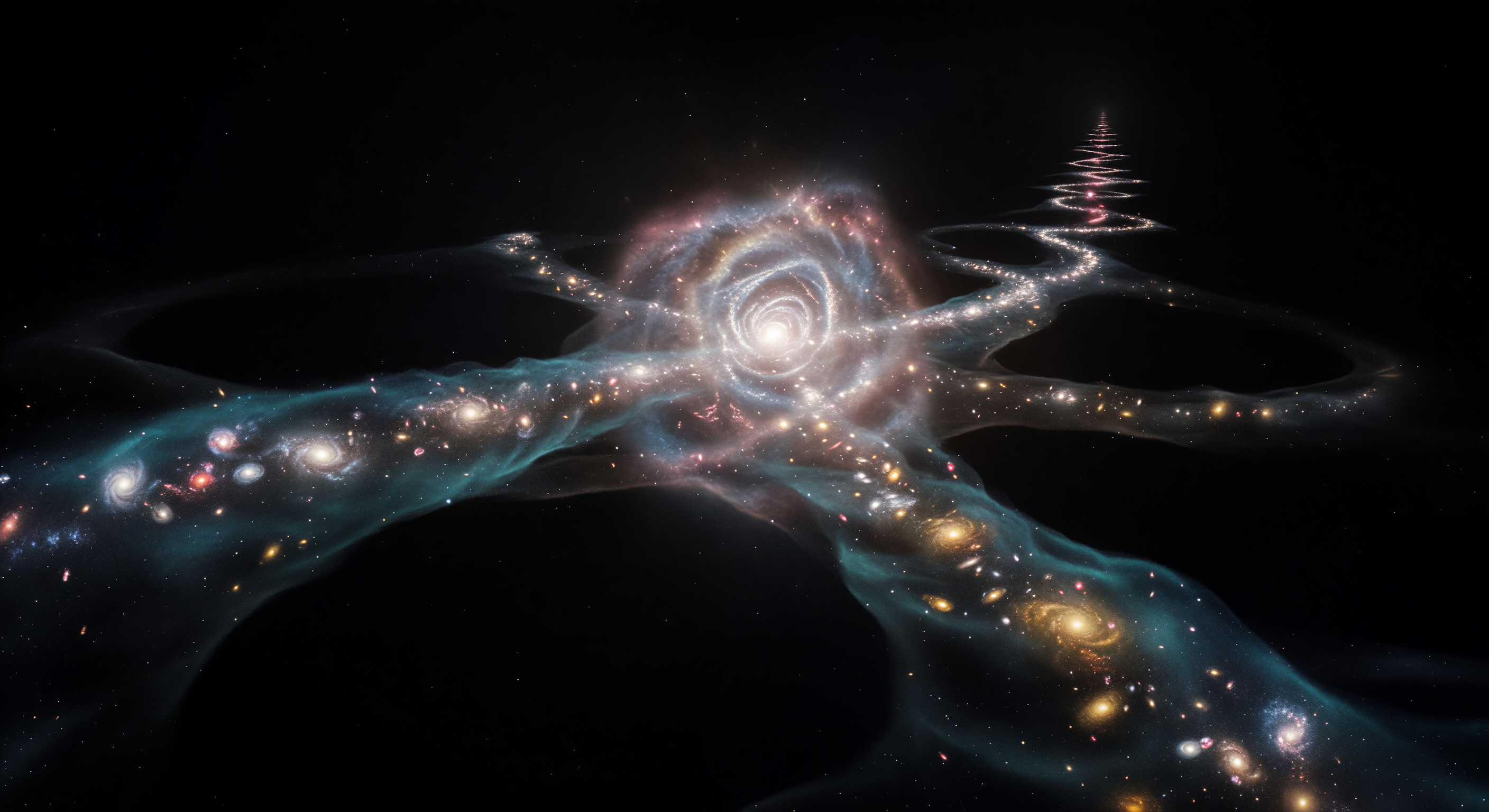
From a vantage ten megaparsecs above the convergence, three vast filamentary arms of the cosmic web reach outward from a single blazing node, each one a loosely braided rope of thousands of galaxies strung along invisible dark matter scaffolding that spans hundreds of millions of light-years — and yet the node itself, containing the compressed light of entire galaxy clusters, resolves to little more than a fierce white-gold ember at this remove. The node's heart is a fully ionized intracluster medium glowing at temperatures exceeding one hundred million degrees, its X-ray plasma bleeding outward through halos of champagne and rose before surrendering to the deep wedge-shaped voids that occupy most of the visible volume, volumes so architecturally empty that the absence of even a single galaxy across billions of cubic light-years reads as a structural feature in itself. Each filament carries its own character: one braided with blue-white spirals still forming stars and threaded by warm-hot intergalactic gas fluorescing at ultraviolet wavelengths, another richer in amber ellipticals whose stellar populations have aged and cooled over billions of years, a third foreshortened along the line of sight into a diminishing corridor of redshifted fire. What holds this geometry in place is not the gravity of any visible matter but the far greater mass of dark matter halos whose scaffolding preceded the galaxies themselves, while between the arms dark energy quietly continues its work — pulling the supercluster's outer reaches apart even as the node at its heart draws everything inward.
Superclusters