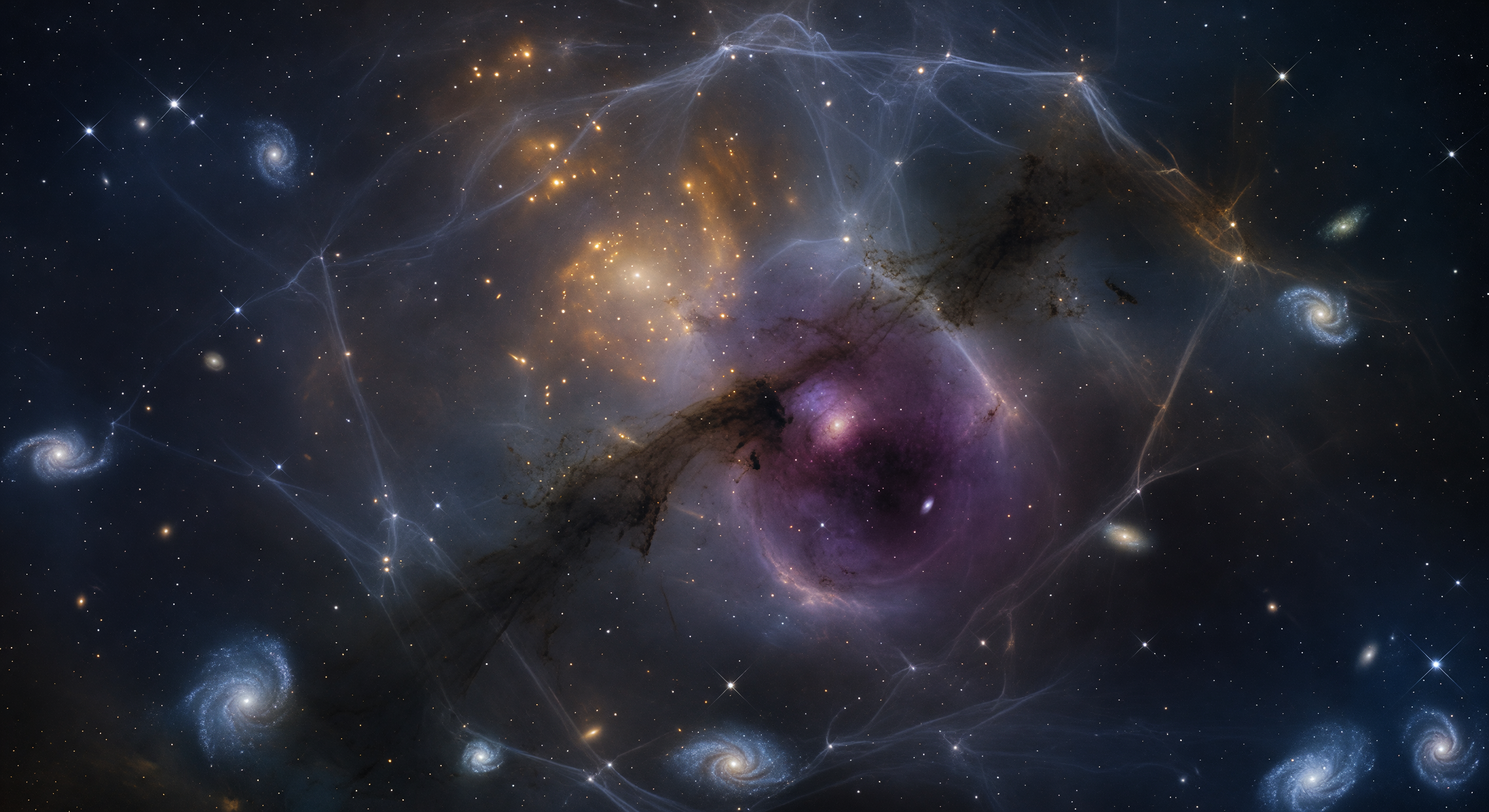
From the Milky Way's own position deep within Laniakea, the view opens across hundreds of millions of light-years of faintly luminous cosmic architecture — the Virgo Cluster burning amber-gold some sixteen megaparsecs ahead, its thousands of ancient elliptical galaxies compressed into a warm node whose ochre halo bleeds slowly into the silver-blue haze of ionized filaments stretching across the foreground like moonlight caught in the thinnest possible gauze. These filaments are not decoration but the structural skeleton of the supercluster itself — warm-hot intergalactic plasma threading between galaxy concentrations along pathways carved by dark matter's gravitational scaffolding, channeling entire rivers of mass toward nodes of convergence over timescales that dwarf the age of the solar system. A thick diagonal band of galactic-plane dust cuts across the scene in deep umber and russet, absorbing and reddening everything behind it, concealing the Norma Cluster and allowing only bruised violet and smoldering magenta glimpses of the Great Attractor — a gravitational convergence so massive that the Milky Way itself, along with hundreds of thousands of other galaxies, flows toward it at roughly six hundred kilometers per second, a drift so vast and so slow it will take billions of years to resolve, and may never fully do so before dark energy tears the supercluster apart. Blue spiral galaxies populate the nearer periphery like luminous pinwheels caught at every angle, each one an island of billions of stars, their presence a reminder that this incomprehensible ocean of matter is not abstract but inhabited — a structure we do not observe from outside, but from within.
Other languages
- Français: Chute de Laniakea vers l'Attracteur
- Español: Caída de Laniakea hacia el Atractor
- Português: Queda de Laniakea ao Atrator
- Deutsch: Laniakea Einfall zum Attraktor
- العربية: انهيار لانياكيا نحو الجاذب
- हिन्दी: लानियाकेआ का आकर्षक की ओर पतन
- 日本語: ラニアケアの引力天体への落下
- 한국어: 라니아케아의 어트랙터 향한 낙하
- Italiano: Caduta di Laniakea verso l'Attrattore
- Nederlands: Laniakea Inval naar de Aantrekker