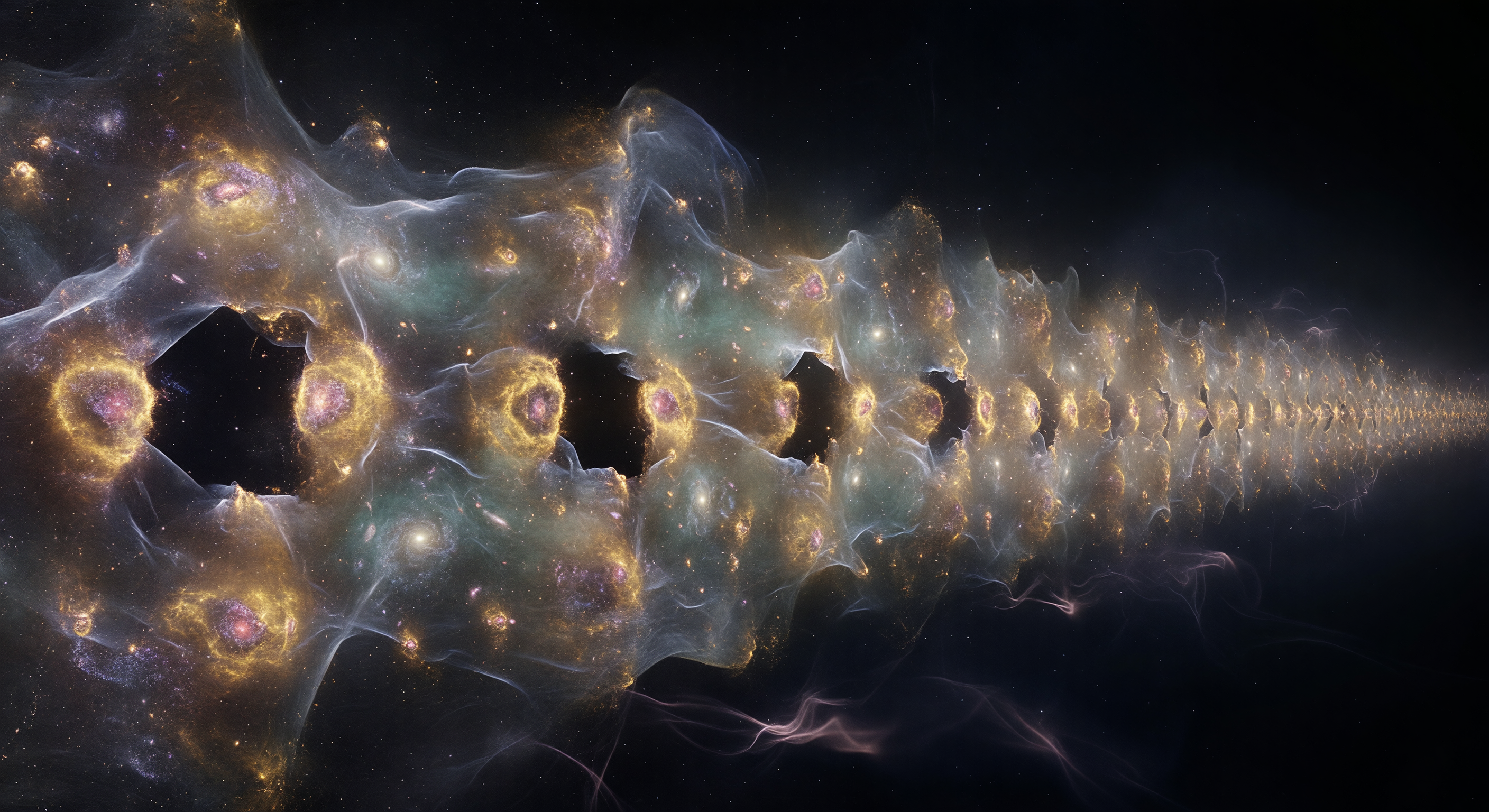
From twenty megaparsecs out, the view forward is consumed entirely by a structure that defies any familiar sense of boundary — a titanic curtain of galactic light stretching laterally without end, rising overhead and plunging below the plane of vision with no perceptible curvature, its surface alive with amber-gold cluster nodes and cooler blue-white sheets of spiral-rich intergalactic material woven between them like iridescent silk. Each warm knot concentrated along the wall's midplane is a galaxy cluster in its own right, hundreds of galaxies compressed into a smoldering elliptical-dominated core surrounded by the keV X-ray glow of fully ionized intracluster plasma at temperatures exceeding tens of millions of kelvin, while the translucent filamentary regions bridging them carry the warm-hot intergalactic medium — that elusive reservoir of partially ionized baryons at 10⁵ to 10⁷ kelvin that accounts for much of the universe's ordinary matter. Punched through the luminous fabric at irregular intervals are abrupt black fenestrations, cosmic voids whose edges are paradoxically outlined by a slight excess of galaxy concentration, as though the wall's own structure is compressed and brightened by the emptiness pressing against it from the other side. The entire scene is self-illuminated, the light not arriving from any single direction but emanating from the wall itself across five hundred megaparsecs of extent, a structure so vast that the light reaching this vantage from its farthest visible regions departed when the universe was nearly two billion years younger than it appears at the nearest nodes.
Other languages
- Français: Rideau de la Grande Muraille
- Español: Cortina del Gran Muro Cósmico
- Português: Cortina da Grande Muralha
- Deutsch: Große Wand als Lichtervorhang
- العربية: ستارة الجدار العظيم
- हिन्दी: महाभित्ति का ज्योति पर्दा
- 日本語: 宇宙大壁の輝くカーテン
- 한국어: 거대 장벽의 빛나는 장막
- Italiano: Sipario della Grande Muraglia
- Nederlands: Gordijn van de Grote Muur