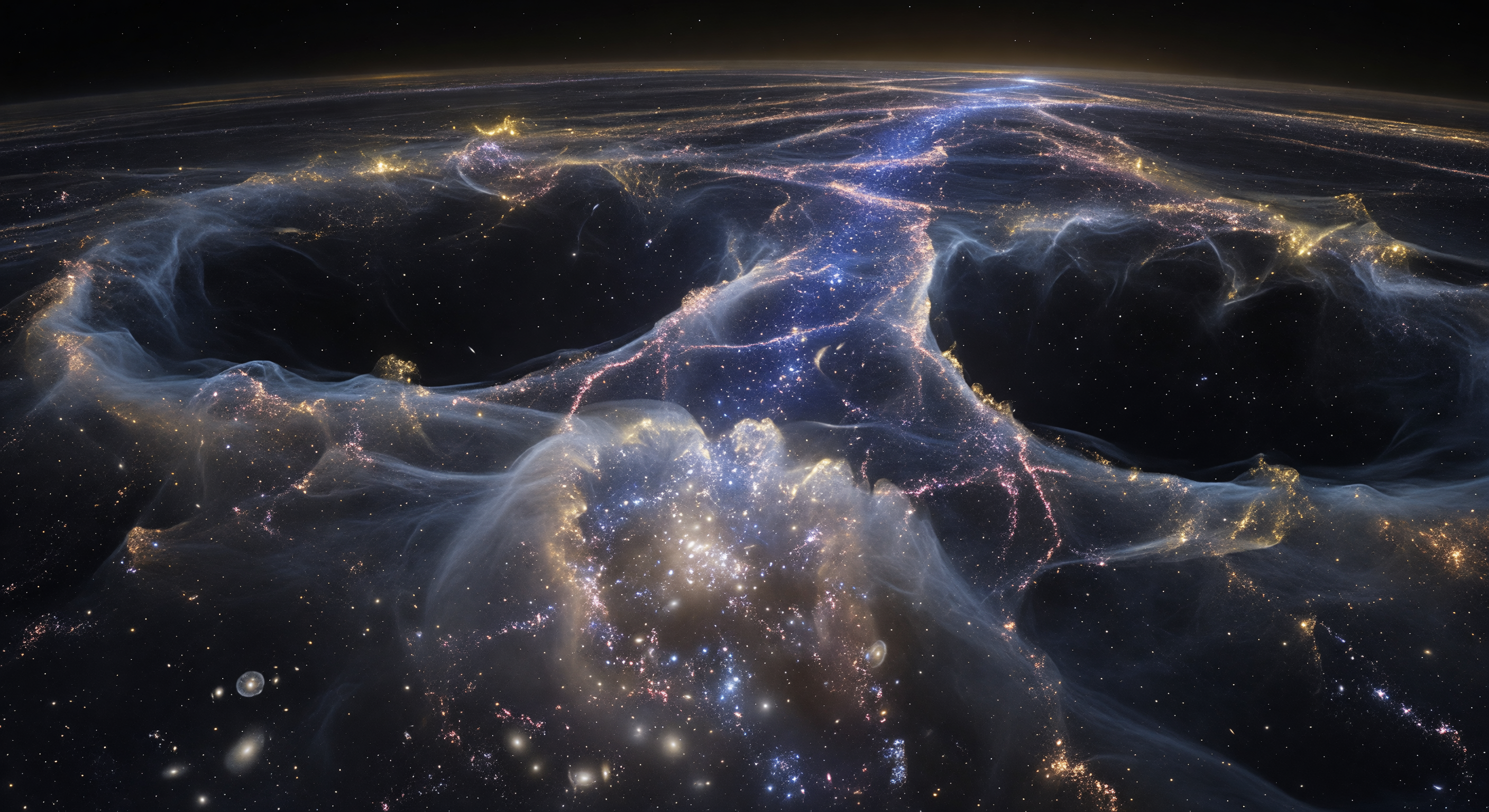
Scientific confidence: Medium
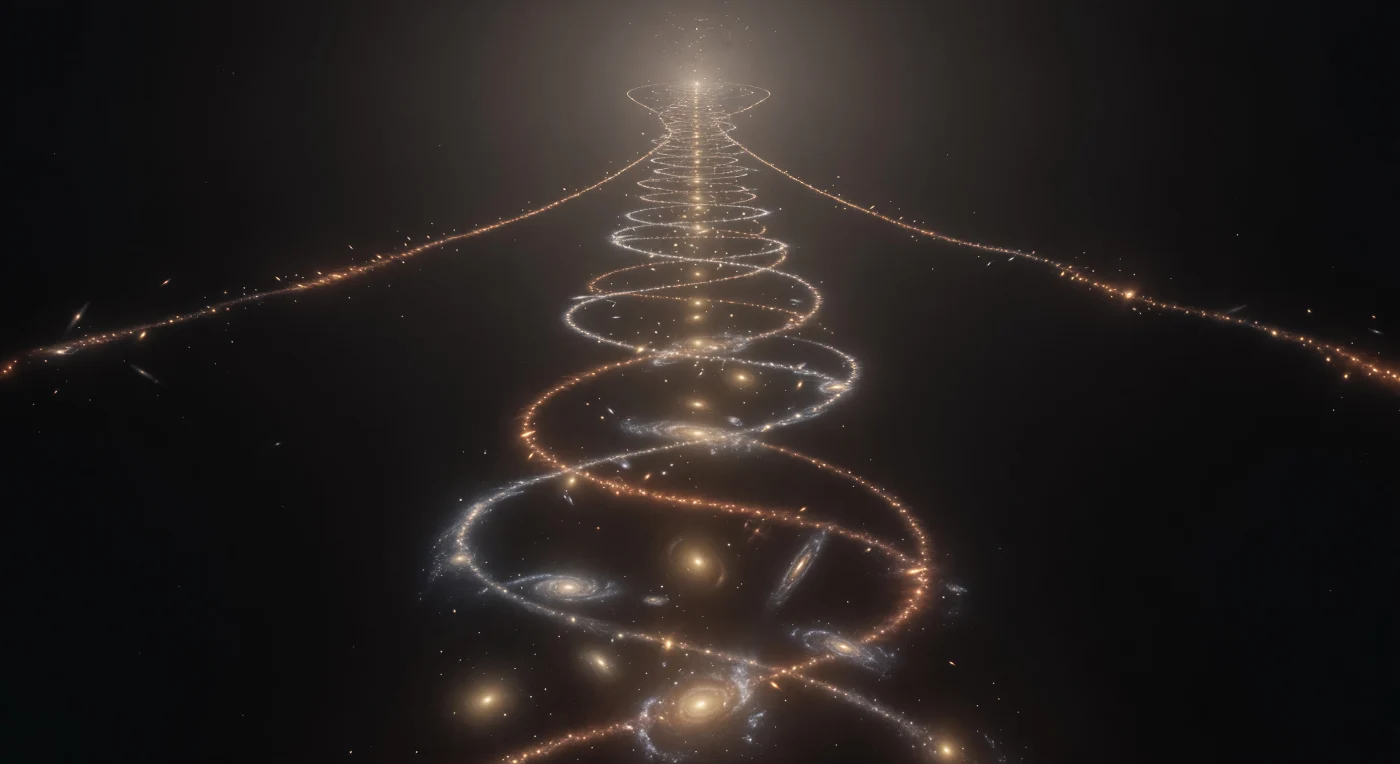
You are suspended within the luminous spine of a structure so vast that its full length would take light hundreds of millions of years to traverse — an intergalactic filament of the cosmic web, one of the universe's great load-bearing threads, woven from dark matter scaffolding and traced by warm plasma too tenuous to be called gas in any earthly sense, yet deep enough across its accumulated tens of millions of light-years to radiate a ghostly amber warmth. Looking along the filament's axis, galaxy chains resolve into sweeping arcs of honeyed ellipticals and cool blue spirals strung like luminous beads, their tidal bridges — pale gold shading to silver, spun across billions of years by gravitational patience — catching light with a translucence no solid material possesses, while the corridor narrows toward a distant supercluster nexus blazing gold-white at the vanishing point of this immense architectural tunnel. On both flanks, orthogonal filaments cross the background as rust-colored ropes dissolving into voids whose darkness is not merely the absence of light but the physical presence of a hundred-million-light-year emptiness, the large-scale structure's counterpoint to every node and thread. Pressing in from the outermost periphery of vision, a barely perceptible ash-white warmth traces the horizon of the knowable — the cosmic microwave background, light from 380,000 years after the Big Bang, redshifted to a temperature of 2.7 Kelvin, giving even absolute void a floor it cannot fall below.
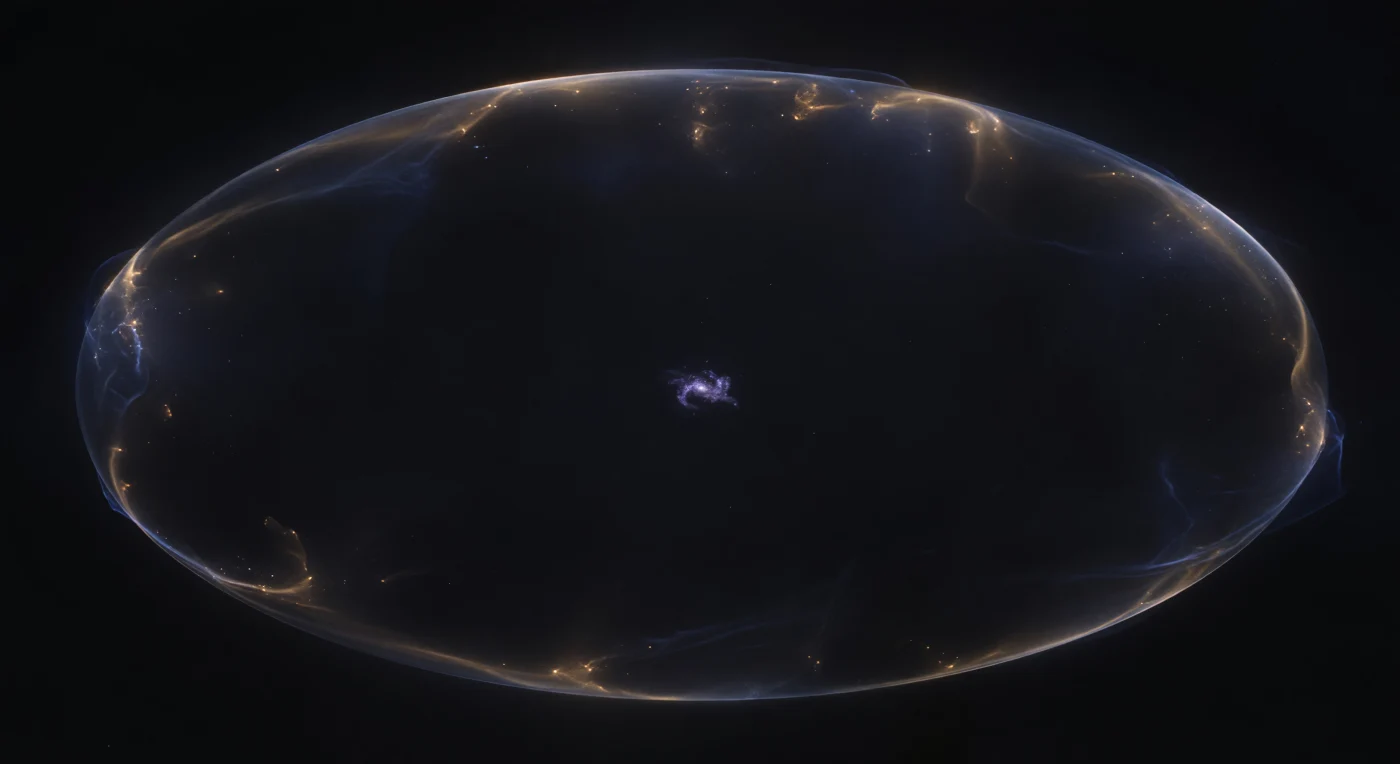
At the geometric heart of the Boötes Void, the overwhelming impression is not darkness as absence but darkness as substance — a three-dimensional blackness stretching 250 million light-years in every direction that presses against perception like a physical medium, unbroken by any star, dust lane, or gas cloud except for the most tenuous imaginable veil of ultra-diffuse intergalactic matter hovering at the threshold of visibility as a pewter whisper barely distinct from nothing. Far at the periphery, hundreds of millions of light-years away and compressed by perspective into a continuous curved membrane, the surrounding galaxy walls of the cosmic web resolve into a warm amber and copper-gold luminous skin — the iridescent inner surface of a supervoid boundary, tracing the spherical geometry of one of the largest known underdensities in the universe, where the large-scale structure of dark matter filaments and baryonic plasma has simply failed to collapse, leaving this vast evacuated basin in the cosmic foam. Improbably alone in the foreground, a single void dwarf galaxy burns electric blue-violet, its unobstructed star formation fed by pristine hydrogen untouched by galactic neighbors, its cold sharp light casting no glow on anything because there is nothing nearby to receive it. Coating the entire visual field with perfect isotropy, an almost imperceptible cool blue-gray luminous undercoat — the cosmic microwave background radiation at 2.7 Kelvin, a thermal relic of recombination some 380,000 years after the Big Bang — presses evenly against every direction at once, the oldest light in the universe reduced to a barely perceptible whisper of cold radiance lining the inside of the cosmos itself.
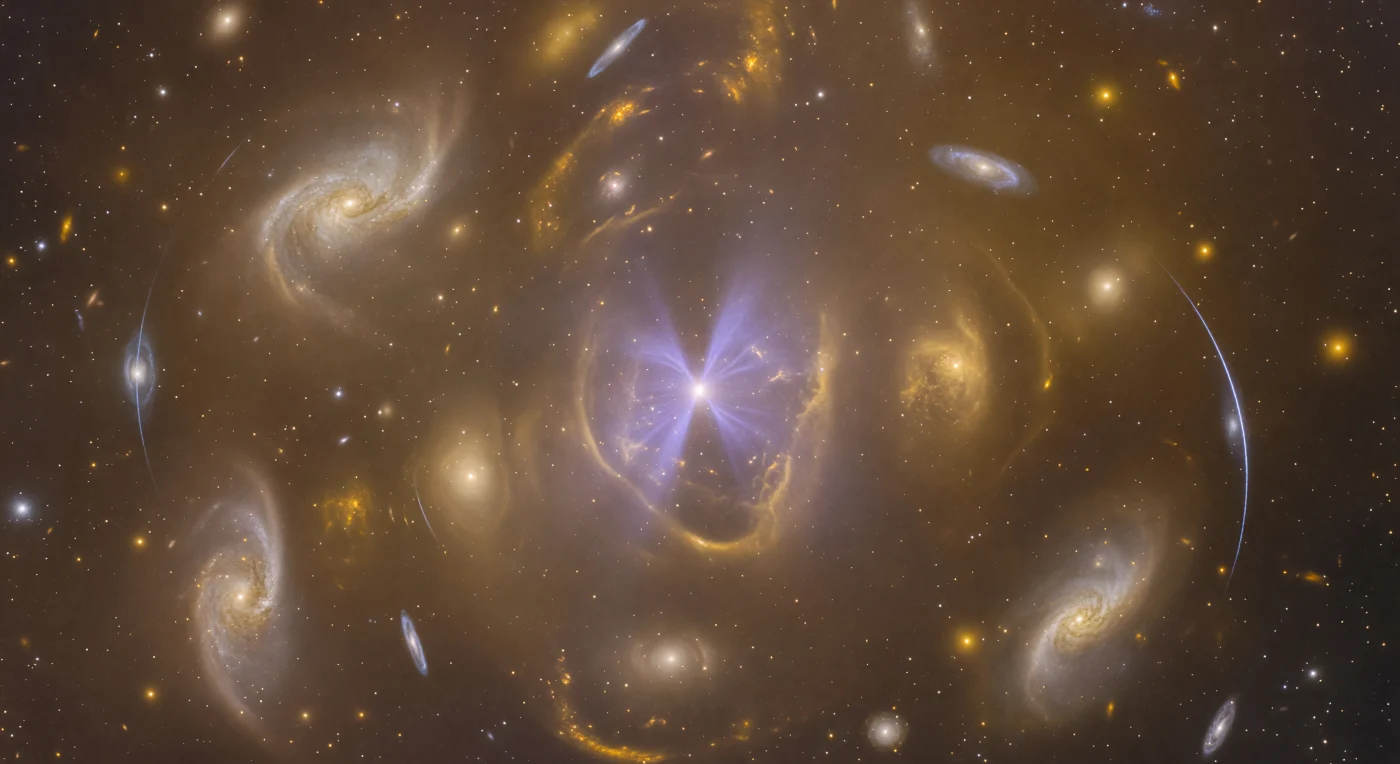
You are suspended at the gravitational core of a Coma-class galaxy cluster, surrounded in every direction by massive elliptical galaxies whose diffuse cD halos bleed outward through successive shells of intracluster light, suffusing the entire volume with a warm amber-gold fog of ancient, stripped stellar material accumulated across billions of years of galactic merging and tidal stripping. From the brightest cluster galaxy directly ahead, two collimated jets of synchrotron-radiating plasma lance outward in electric violet-white, their concentrated indigo cores fraying into vast asymmetric radio lobes that carve subtle X-ray cavities in the surrounding intracluster medium — a hot, invisible thermal plasma at tens of millions of degrees whose pressure confines and sculpts the AGN outflow. Threading across the midground, brilliant blue-white gravitational arcs curve in partial Einstein rings around the nearest foreground ellipticals, each arc the gravitationally lensed image of a far more distant background galaxy whose light has been bent and amplified by the cluster's immense collective mass, which is dominated not by the visible stellar material but by dark matter comprising roughly eighty percent of the total. The scene encodes, simultaneously, the physics of relativistic jet launching, thermal plasma dynamics, gravitational lensing, and the long slow cannibalism by which the central galaxy has assembled itself from hundreds of consumed predecessors, its pale champagne halo a fossil record of every merger stretching back across cosmic time.
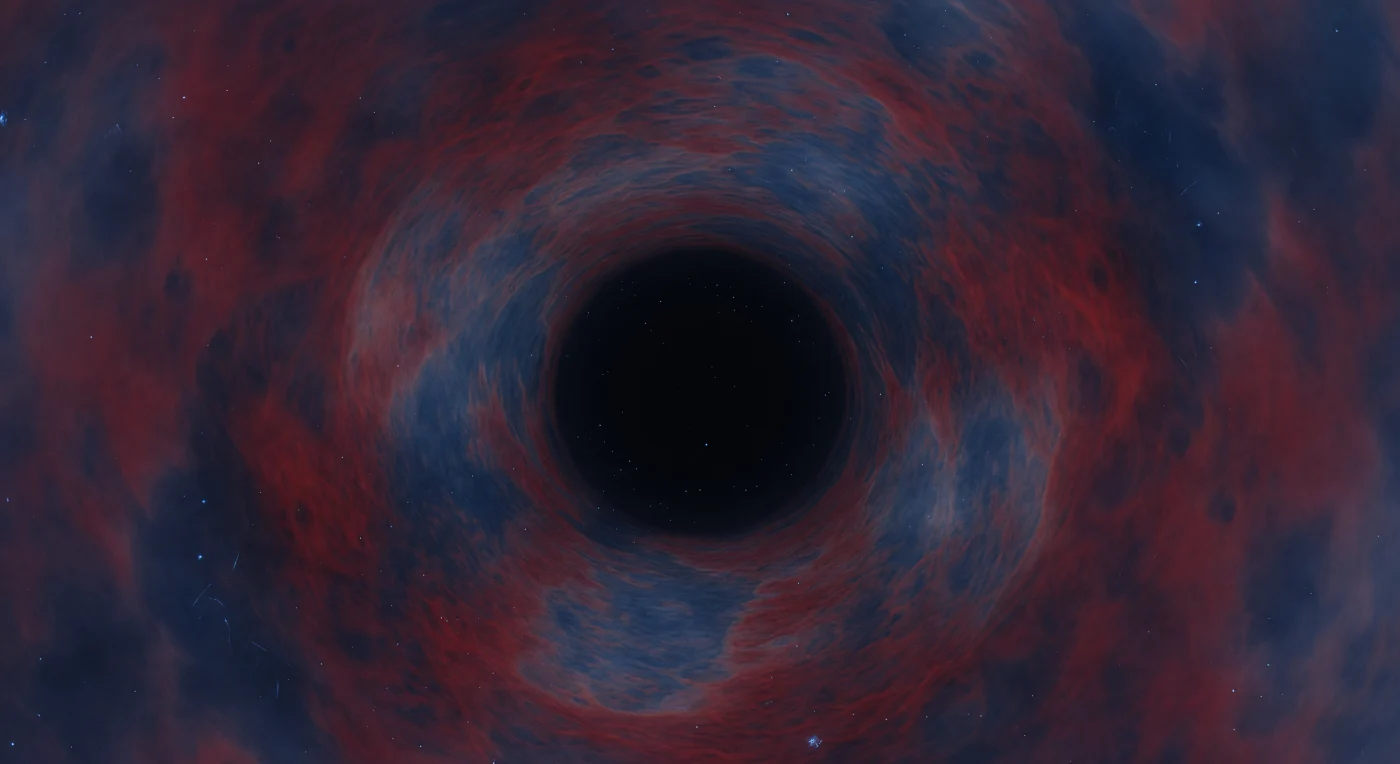
The view from this vantage point reveals the interior of the largest structure a human mind can meaningfully hold: the last-scattering surface, a continuous spherical shell enclosing the observer in every direction, its skin painted in the desaturated ochre-rust of warm plasma patches and the bruised indigo of cooler regions—temperature fluctuations of no more than one part in one hundred thousand, frozen into a softly luminous fresco at the moment recombination released the universe's first free photons, approximately 380,000 years after the Big Bang. These mottled undulations—broad continental warmths bleeding into cold polar bays, with finer textures nested within—record the primordial acoustic oscillations of a baryon-photon plasma, the seeds from which all subsequent gravitational structure would eventually grow. Between the observer and that receding shell, scattered across an intervening darkness of billions of light-years, faint electric-blue pinpoints betray the earliest protogalactic concentrations at redshifts around ten, their light compressed and dimmed almost to invisibility, clustering in thin filamentary wisps that hint at the first stirrings of the cosmic web. No matter where one looks, the dome maintains exactly the same apparent distance—neither floor nor ceiling nor wall but all of them simultaneously—because this horizon is defined not by a surface one could approach but by the finite speed of light itself meeting the age of the cosmos. The isotropic warmth pressing inward from every direction casts no shadow and acknowledges no preferred axis, filling the enclosed space with the quiet, all-surrounding glow of fossilized light from the universe's earliest legible moment.
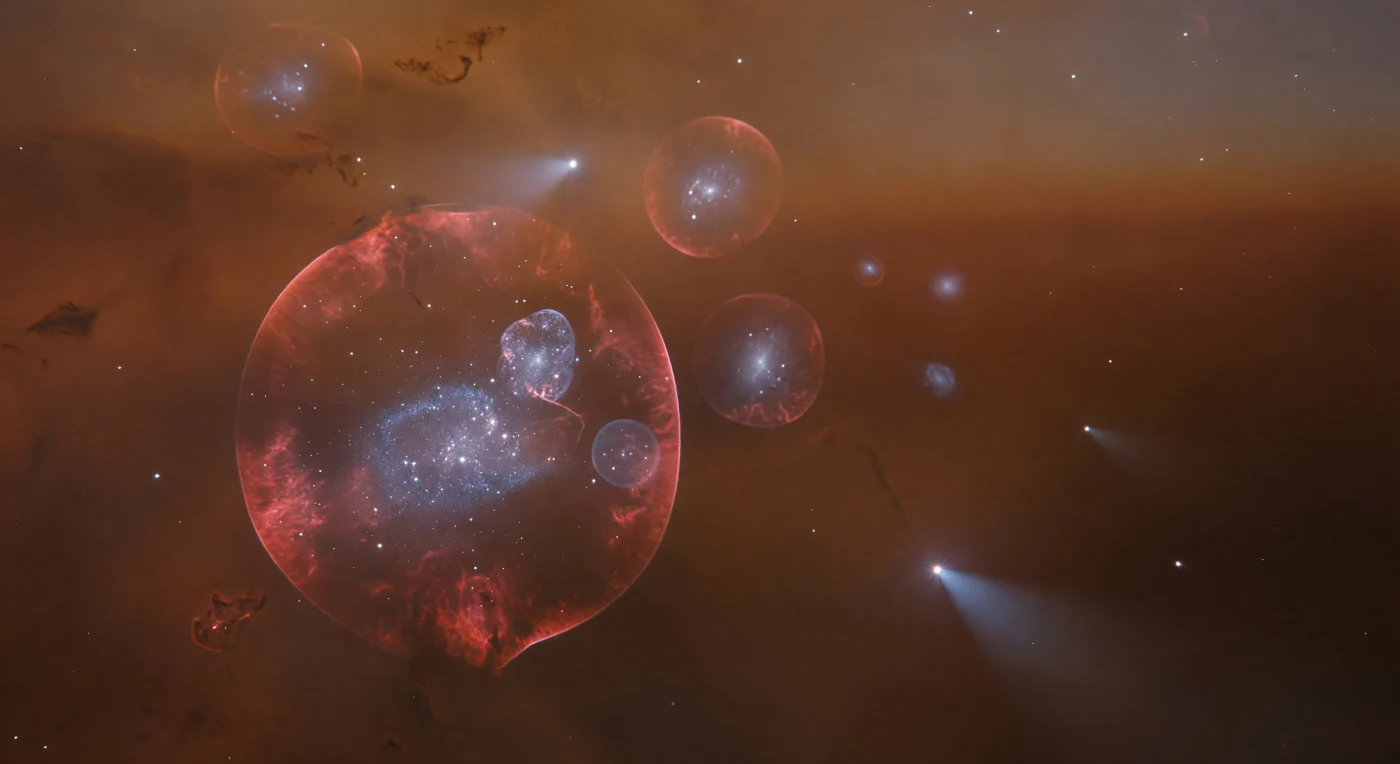
You are suspended inside the intergalactic medium at cosmic dawn, roughly one billion years after the Big Bang, enveloped in a rust-brown murk of neutral hydrogen that absorbs and reddens nearly all light attempting to cross it. The scene is dominated by the war between opacity and illumination: young proto-galaxies burn with savage ultraviolet intensity, each one a dense smear of Population II and III stars compressed into irregular knots, their radiation carving spherical pockets of ionized transparency — reionization bubbles — out of the surrounding fog, with the perimeter of each bubble glowing as a thin, crimson Lyman-alpha shell where outbound UV photons collide with intact neutral hydrogen at the ionization front and force it into re-emission. Quasar point sources drive this process further still, their luminosity so extreme it overwhelms the ambient medium in narrow cones, cutting electric-blue ionized corridors through the rust-colored gas like slow-motion searchlights, each cone edged with its own faint crimson fringe where the ionizing front meets unprocessed hydrogen. The universe here is not empty but choked and gravid, its gas still cooling from its primordial state, threaded with density knots and filamentary structure inherited from quantum fluctuations amplified over a billion years — a cosmos on the precise threshold between opacity and transparency, being burned open from the inside by its own first light.
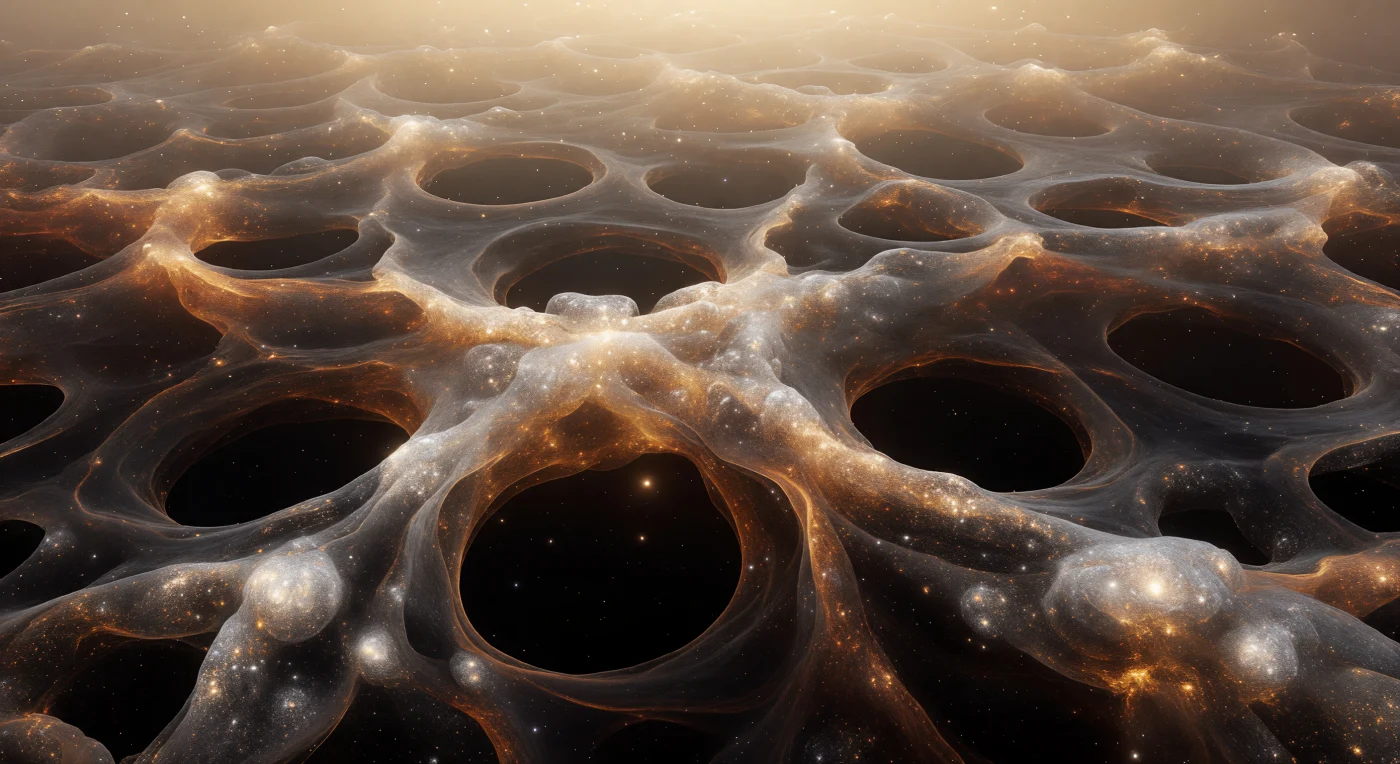
You are suspended in a vantage point no instrument can truly occupy, looking out across a self-luminous lacework that fills every direction with the same endlessly repeated geometry: filaments of cream-white incandescence at their thickest junctions, where galaxy clusters blaze with the collective X-ray glow of intracluster plasma heated to tens of millions of degrees, tapering outward through amber and rust as matter thins along the threads before dissolving into the surrounding dark. Between those threads, enormous spherical voids — some stretching three to four hundred million light-years across — press against one another and against the filaments in a topology indistinguishable from frozen foam, their interiors a dimensional obsidian holding only the faintest scatter of wandering photons, their curved walls backlit by the filament glow beyond them. This structure is not random noise but the direct gravitational imprint of quantum density fluctuations seeded in the first fraction of a second after the Big Bang, amplified across 13.8 billion years of dark-matter-driven collapse into the web you now see cascading in every direction without floor, ceiling, or preferred axis. At the farthest perceptible reach, beyond the last resolvable layer of structure, the scene closes in an isotropic amber-cream warmth — the cosmic microwave background, light released 380,000 years after the Big Bang when the universe first became transparent, now enclosing the entire observable cosmos like the luminous inner surface of an immeasurable sphere.
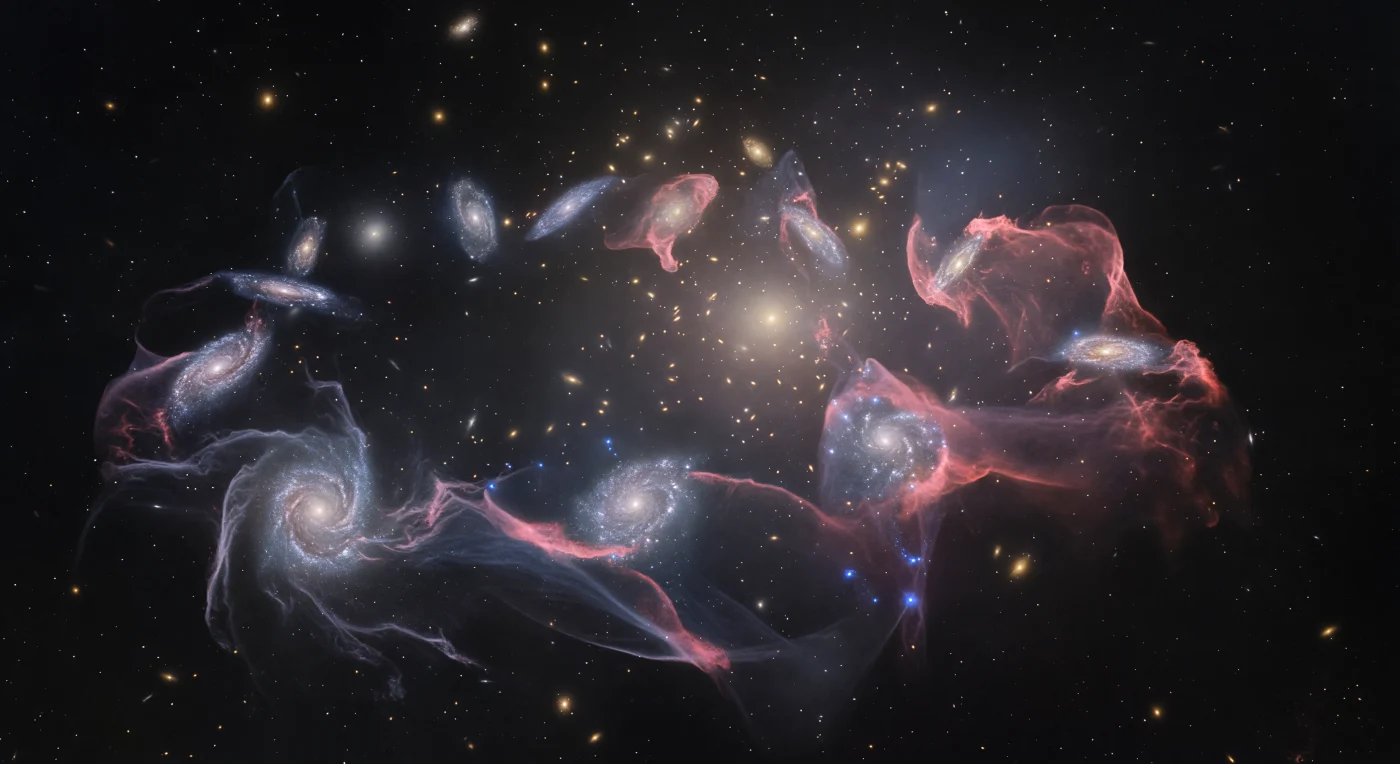
You are suspended in the rarefied outskirts of a massive galaxy cluster, drifting through intergalactic medium so tenuous it is felt only as an asymmetric thermal pressure — the invisible ram-pressure wind radiating outward from the cluster's vast hot corona of X-ray-emitting plasma at tens of millions of degrees. Ahead of you, a loose procession of spiral galaxies descends along the gravitational gradient toward a diffuse golden furnace glow deep in the background — the merged light of thousands of elliptical and lenticular galaxies crowded into the cluster core, their combined luminosity bleeding into a warm amber haze shot through with brighter nuclei. The nearest spirals in the chain trail long, diaphanous tidal streamers of pale blue-white stars and gas, arms unwound into gossamer threads by differential gravity, while the galaxies closest to the core have been transformed into something more violent and more beautiful: their windward faces still show tight blue spiral arms spangled with active star-forming knots, but from their leeward flanks, curtains of ionized hydrogen billow outward in vivid coral-pink and crimson jellyfish tails — Hα-bright filaments hundreds of thousands of light-years long, filigreed at their tips with compact cobalt clumps where ram-pressure compression has triggered new bursts of star formation. This is the observable signature of the intracluster medium stripping disk gas from infalling galaxies, a slow asymmetric violence that redistributes baryons across intergalactic space and quenches star formation on timescales of billions of years, inscribed here in the luminous contrast between hard stellar blue and soft biologic pink dissolving into the ambient dark.
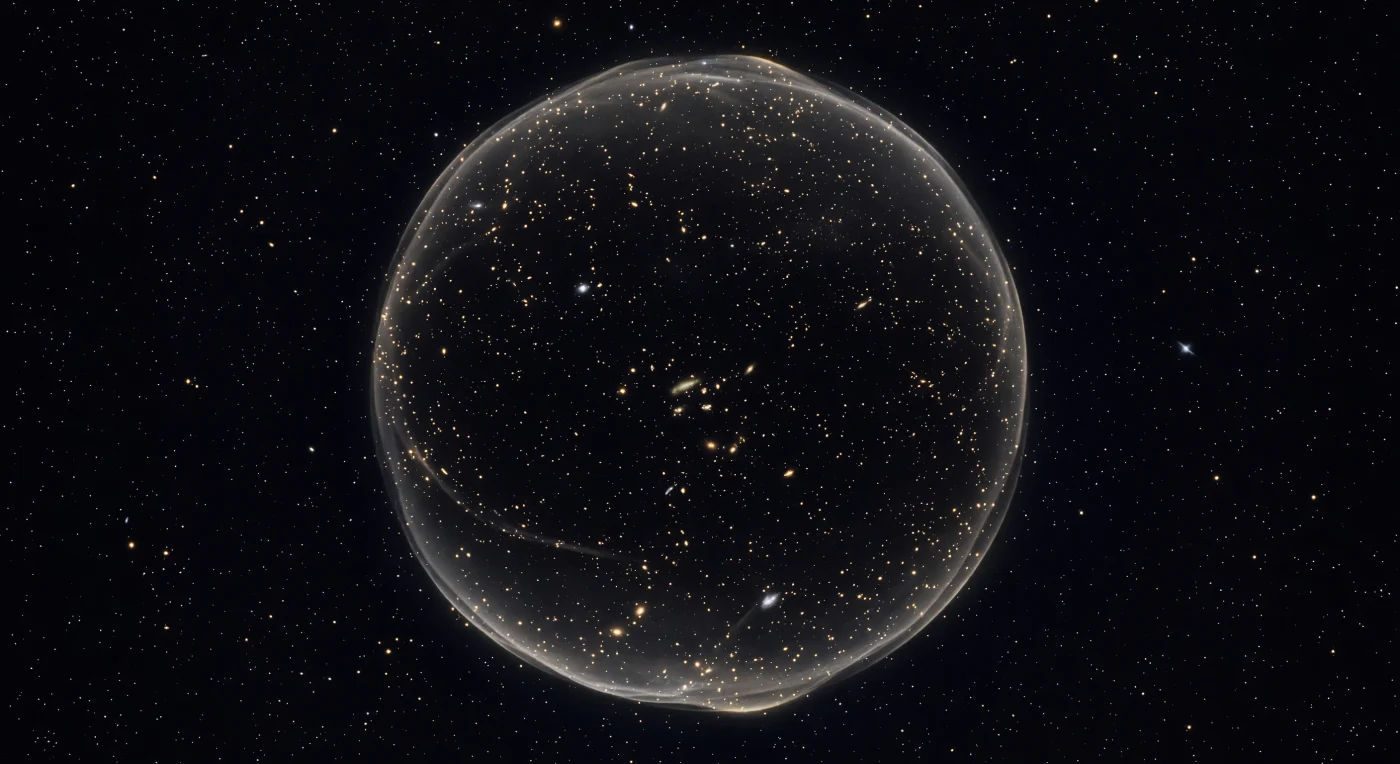
In every direction from this vantage at the statistical heart of the volume, the same scene unfolds: a three-dimensional fog of warm amber points suspended in deep indigo-black, each one a galaxy or cluster of galaxies, their collective light arriving orange-shifted by billions of years of cosmic expansion, assembling in the eye as something that first reads as randomness — the way fireflies appear uniform before pattern emerges from the dark. Then the full hemisphere registers, and at a consistent perceived radius in all directions simultaneously, the scatter very subtly thickens into a ghostly translucent shell, pale champagne and cold ivory against the cosmic black, not a wall but a whisper of heightened presence, a spherical overdensity barely distinguishable from background yet unmistakably there: the frozen acoustic horizon, a pressure wave that propagated through the plasma of the infant universe for its first 380,000 years and then locked into place as matter decoupled from radiation, its preferred scale of 147 megaparsecs now encoded into the statistical arrangement of a trillion galaxies across nearly a billion light-years of volume. Where the shell intersects the filamentary skeleton of the cosmic web, it brightens fractionally — warm ochre deepening toward tarnished bronze, phosphorescent beads gathered at the crests of invisible waves — because the underlying density ridges of dark matter provided the scaffolding along which the sound wave preferentially froze. The observer inhabits the exact interior of a sphere whose curvature is simultaneously intimate and incomprehensible, a 13.8-billion-year-old sound made visible in the geometry of everything.
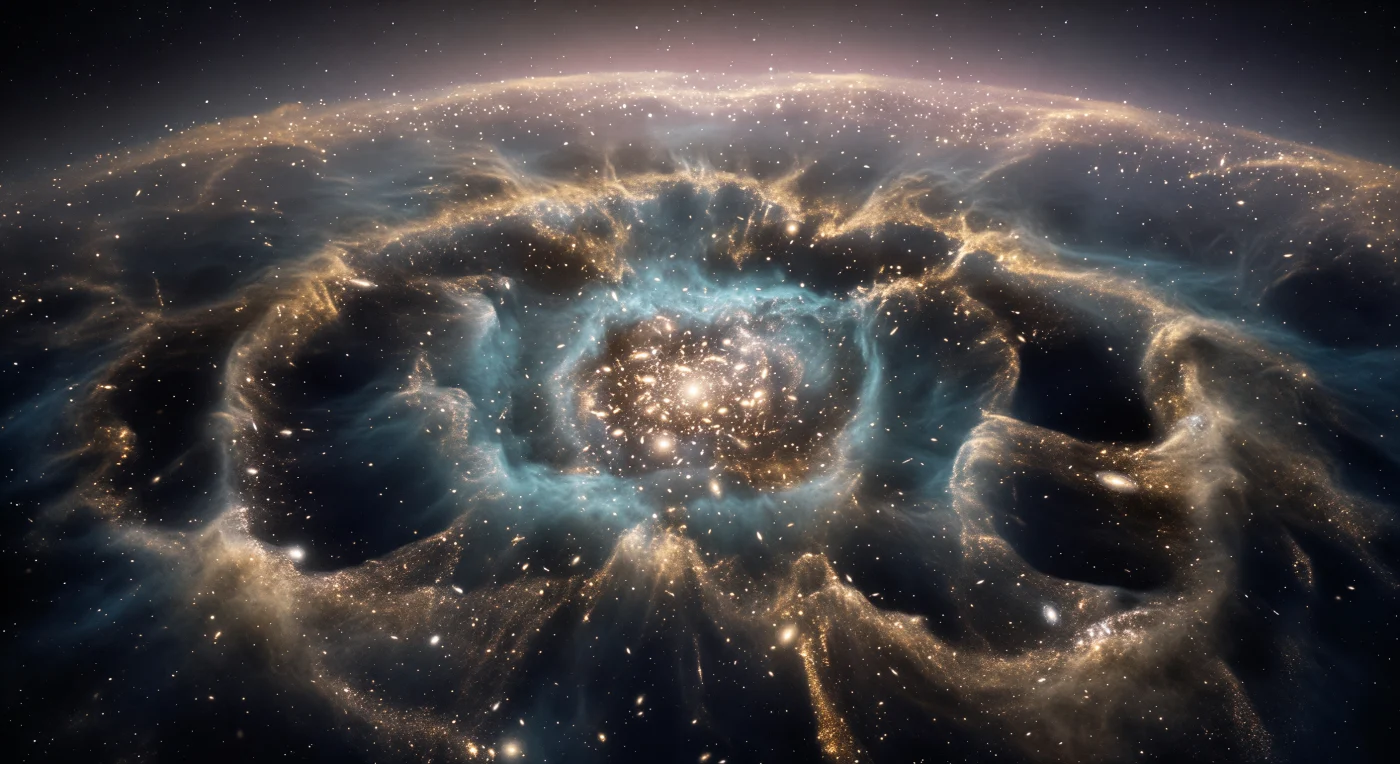
You are suspended at the gravitational heart of the Great Attractor convergence zone, where filaments of warm amber and antique gold — each a river of massed elliptical galaxies several million light-years thick — arc inward from every direction like the spokes of an inconceivably vast wheel, their edges dissolving into hazes of ionized intergalactic gas while the intervening voids drop to a deep, saturated indigo-black of nearly absolute emptiness. At the center of this convergence, the Norma Cluster blazes as a densely packed knot of hundreds of galaxies whose combined starlight fades from ivory at the core outward through pale champagne and gold, enveloped in a mottled cyan-teal fog of intracluster plasma heated to tens of millions of degrees — the X-ray-emitting ICM that betrays, through its turbulence and brightness gradients, the shock-heating signature of matter that has been falling inward for billions of years. Blue velocity-flow streamlines curve inward from all directions, tracing the invisible gravitational funnel generated by a mass concentration so dominant it deflects the Hubble flow across hundreds of millions of light-years, pulling the Milky Way and its neighbors toward this region at roughly 600 kilometers per second. In the far background, the Shapley Supercluster glows as a diffuse horizon of pale gold and rose light — too distant to resolve into individual galaxies, it becomes a luminous coastline, a deeper reservoir of mass behind the attractor itself, its gravity layered onto the convergence like a second, slower tide. The full panorama is a nested succession of cosmic architecture in which every scale of structure — cluster, filament, supercluster wall, void — is simultaneously visible, each layer more ancient in its light than the last, the silence of the dark gulfs between the glowing spokes making the scene feel at once intimate and vertiginously immense.
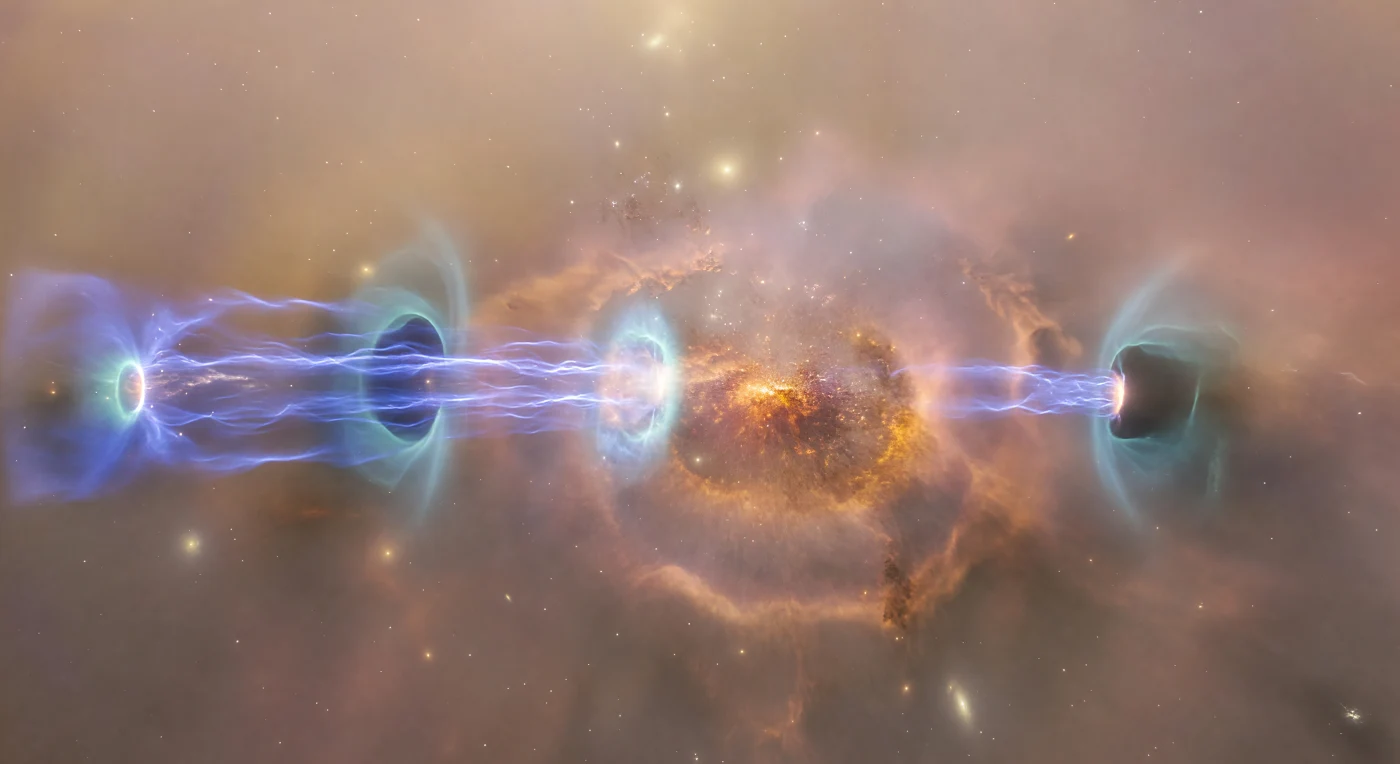
Suspended half a megaparsec off the equatorial plane of a colossal elliptical galaxy, the viewer takes in a structure of almost incomprehensible bilateral symmetry: two electric-blue jets lance outward from a smoldering amber nucleus, each traveling roughly a megaparsec before slamming into the surrounding intracluster medium in brilliant hotspot shocks—compact, near-white knots of frozen violence where the jet's kinetic energy converts instantaneously into broadened plasma flares. These are Fanaroff-Riley Class II radio jets, among the most energetic sustained phenomena in the known universe, born from the accretion disk of a supermassive black hole and confined by magnetic fields into columns so tightly wound they appear almost solid at their base before fraying at the edges into vast lobes of faded burnt orange and dusty mauve—magnetized relativistic plasma spread across volumes larger than the host galaxy cluster itself. Flanking the jets, dark ellipsoidal X-ray cavities mark where that plasma has physically evacuated the hot intracluster medium, their charcoal interiors rimmed in cold cyan where compressed gas glows at tens of millions of Kelvin—direct evidence that a single active nucleus is reshaping the thermal structure of an entire cluster. The intracluster medium itself hangs as a faintly luminous gold-rose haze filling all available volume, its glow the product of thermal bremsstrahlung from diffuse ionized plasma, turning what might otherwise be featureless intergalactic void into something unmistakably inhabited and alive.
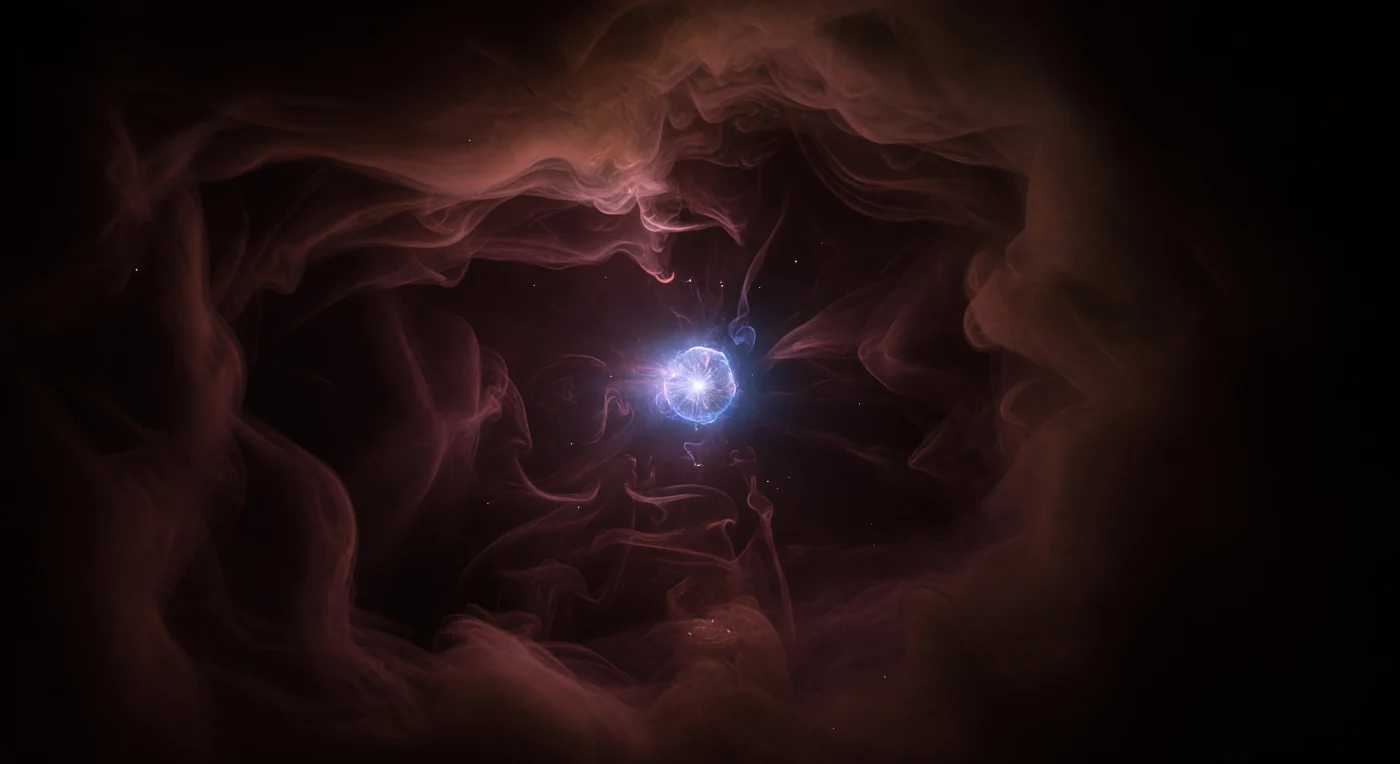
You drift within the outer envelope of a collapsing primordial halo, suspended perhaps two or three light-years from the only fusion fire that has ever burned in this universe — a hypermassive Population III protostellar core, blazing blue-white at tens of thousands of Kelvin, its hard ultraviolet radiation the first coherent photon flood in a cosmos that has known only darkness and the cooling whisper of expansion. Around it, a Strömgren sphere expands with crystalline precision: a sharp ionization front rendered in electric cyan and translucent violet, the boundary between a newborn HII region swept nearly transparent inside and the surrounding primordial cloud — dense, amber-brown, folded in slow convective curtains of pure hydrogen and helium — that remains utterly unchanged beyond. There is no dust to scatter the light, no carbon, no silicon, no oxygen anywhere in this scene; the photons travel perfectly clean through ionized space, giving the bubble an impossibly hard-edged clarity that no later nebula will ever possess, because every nebula that follows will be built from the ash this star is about to forge. At the very edge of perception, the CMB sky at roughly 54 Kelvin suffuses the outermost gas sheets with a barely-there crimson warmth — not light from any source, but the thermal memory of the universe itself, reluctantly yielding its monopoly on energy to the singular, savage eye now opening at the center of everything.
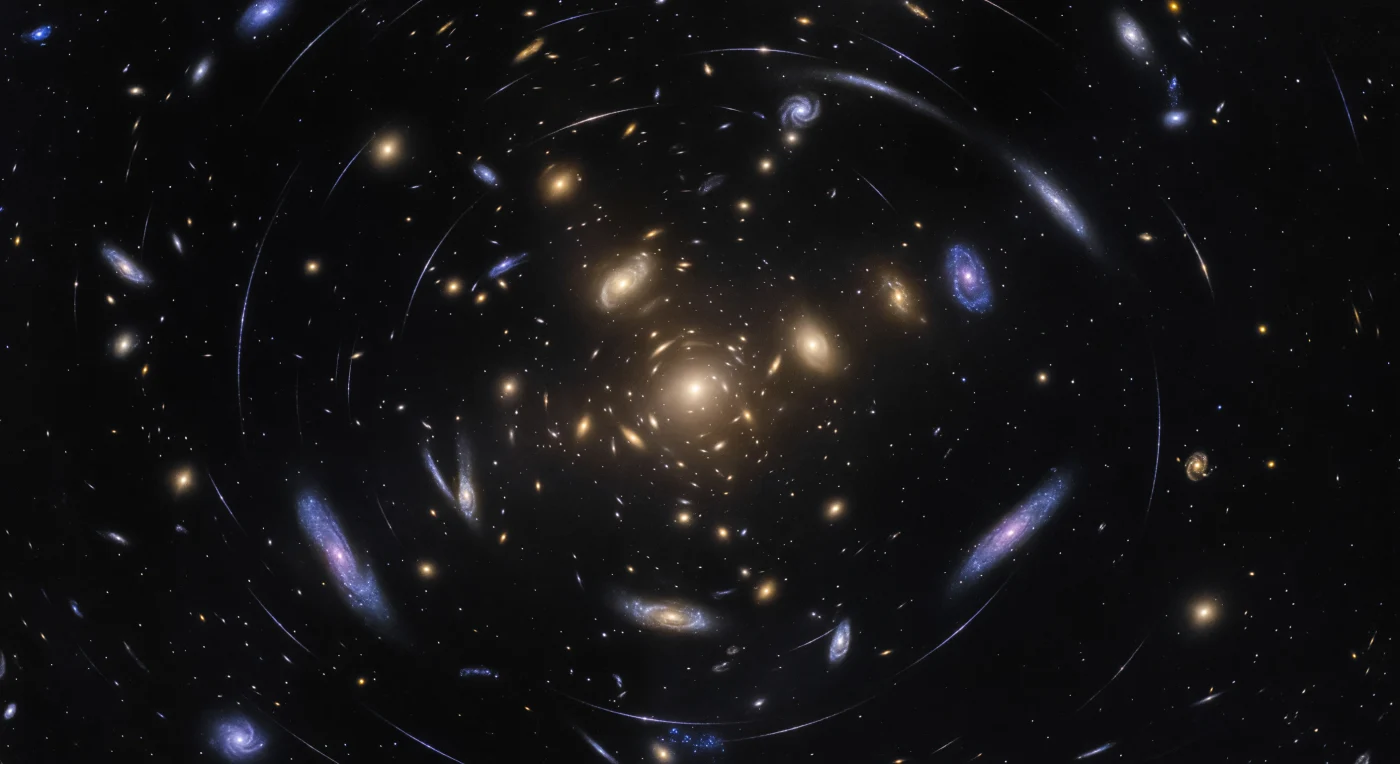
The observer hangs in the intergalactic void roughly one hundred million light-years from a massive galaxy cluster whose gravitational field has become the organizing principle of the entire visible sky. Directly ahead, hundreds of ancient elliptical galaxies merge perceptually into a single warm amber mass, their old stellar populations bleeding together through diffuse intracluster light — a fog of unbound stars stripped across billions of years of tidal interaction, pooling between galaxies like embers settling into ash. Around this golden core, the background universe has been geometrically dismantled: light from star-forming galaxies at redshifts near three, galaxies that existed when the universe was barely two billion years old, arrives at this position along multiple paths bent by the cluster's mass concentration, reconstructing itself as thin electric-blue arcs, closed Einstein rings, and repeated mirror images of the same spiral resolved clearly enough that individual star-forming knots can be matched across positions separated by vast angular distances — the same moment of cosmic time, the same patch of a young universe, delivered simultaneously by entirely different routes through curved spacetime. Pulling awareness outward to the wider field, a quieter signature of the same mass becomes legible: background disk galaxies at every intrinsic orientation have been statistically torqued, their apparent shapes curving tangentially around the cluster center in a faint coherent shear, too subtle to read in any single galaxy but unmistakable as a texture across the full field, the gravitational imprint of dark matter made visible only through the distorted testimony of billions of light-years of background structure.
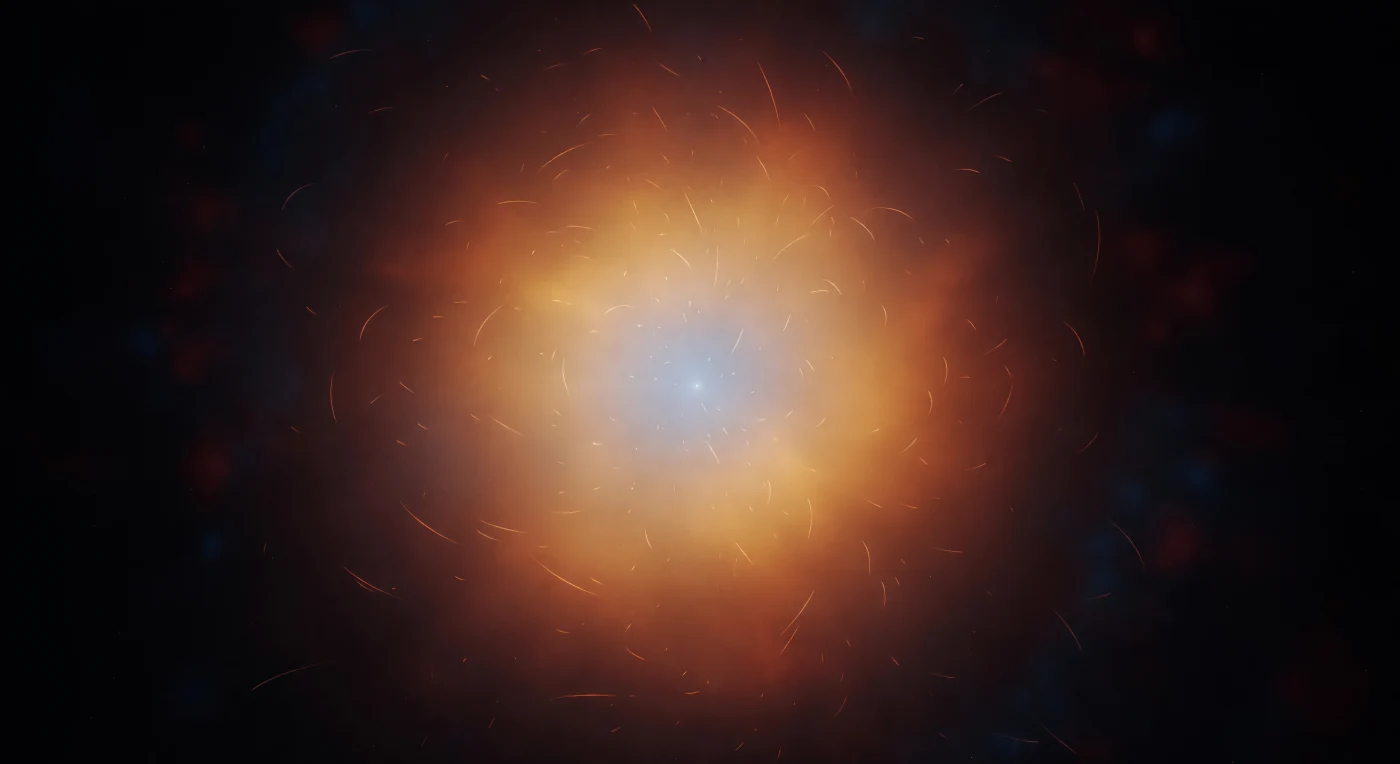
Standing at the conceptual center of all observation, you face a spherical enclosure that closes around you in every direction simultaneously — not a surface you can approach, but a geometry that enfolds, the particle horizon pressing inward from all sides like the interior of a slowly brightening furnace. The darkness nearest to you is threaded with the faintest mottling of the cosmic microwave background, those burgundy and cobalt temperature fluctuations representing photons released at redshift z ≈ 1089, some 380,000 years after the Big Bang, their wavelengths stretched by cosmic expansion until they carry the thermal energy of liquid helium, the oldest light that can exist. Beyond this veil, the vacuum itself thickens — not metaphorically but structurally — as you approach the last-scattering surface where photon mean free path collapsed to zero and the early universe became a plasma so dense that light could not travel freely, its opacity a physical condition rather than an obstruction, the boundary between a transparent cosmos and a radiating fireball of ionized hydrogen and helium at temperatures exceeding 3,000 Kelvin. The blue-white core of that enclosure does not flicker or pulse; it is a frozen record of causal finality, every direction yielding the same blazing closure, the point where information ends not because something blocks the view but because the universe had not yet become the kind of place where vision was possible.
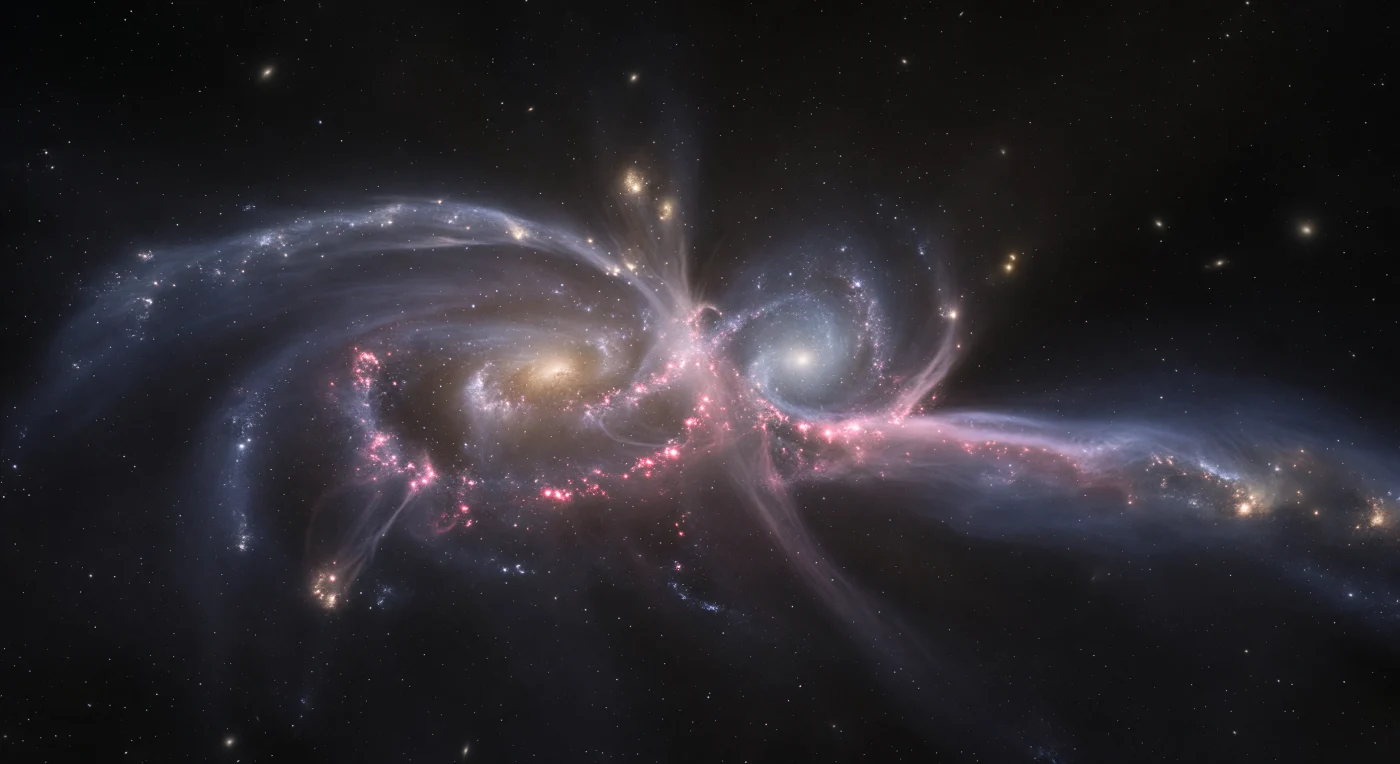
The field of view is overtaken by two massive spiral galaxies locked in their final gravitational embrace, their once-orderly disk structures torn into sweeping arcs of tidal debris that extend hundreds of kiloparsecs outward — blue-white chains of O- and B-type supergiants tracing the outer tidal tails while older stellar populations dissolve into amber and cream hazes at the trailing edges. Between the two still-distinct nuclei, one warm gold and one cooler blue-white, a luminous tidal bridge of stars and ionized hydrogen glows faintly pink where gas compression along the interpenetrating disk planes has ignited a furious corridor of starburst activity — dense HII knots each containing tens of thousands of newly formed stars blazing through their natal molecular clouds with torrents of ultraviolet radiation. This type of major merger event drives some of the most intense star formation rates in the universe, with gas inflows toward the coalescing nuclei capable of sustaining star formation rates hundreds of times that of a quiescent spiral, ultimately destined to produce a single elliptical remnant once the two supermassive black holes inspiral and merge on timescales of hundreds of millions of years. Off to one side, a ram-pressure stripped gas tail drifts away from the system at a divergent angle — not shaped by gravity but scraped clean by the hot intracluster medium through which the merger is plowing — transitioning from pale lavender at its root to a ghostly blue-grey translucence as it thins into the surrounding void. Far behind the collision, the deep field reveals the faint lacework of the cosmic web itself, distant galaxy concentrations reduced to pale silver smears against volumes of near-total darkness that frame this catastrophic foreground event with the full indifferent depth of cosmological scale.
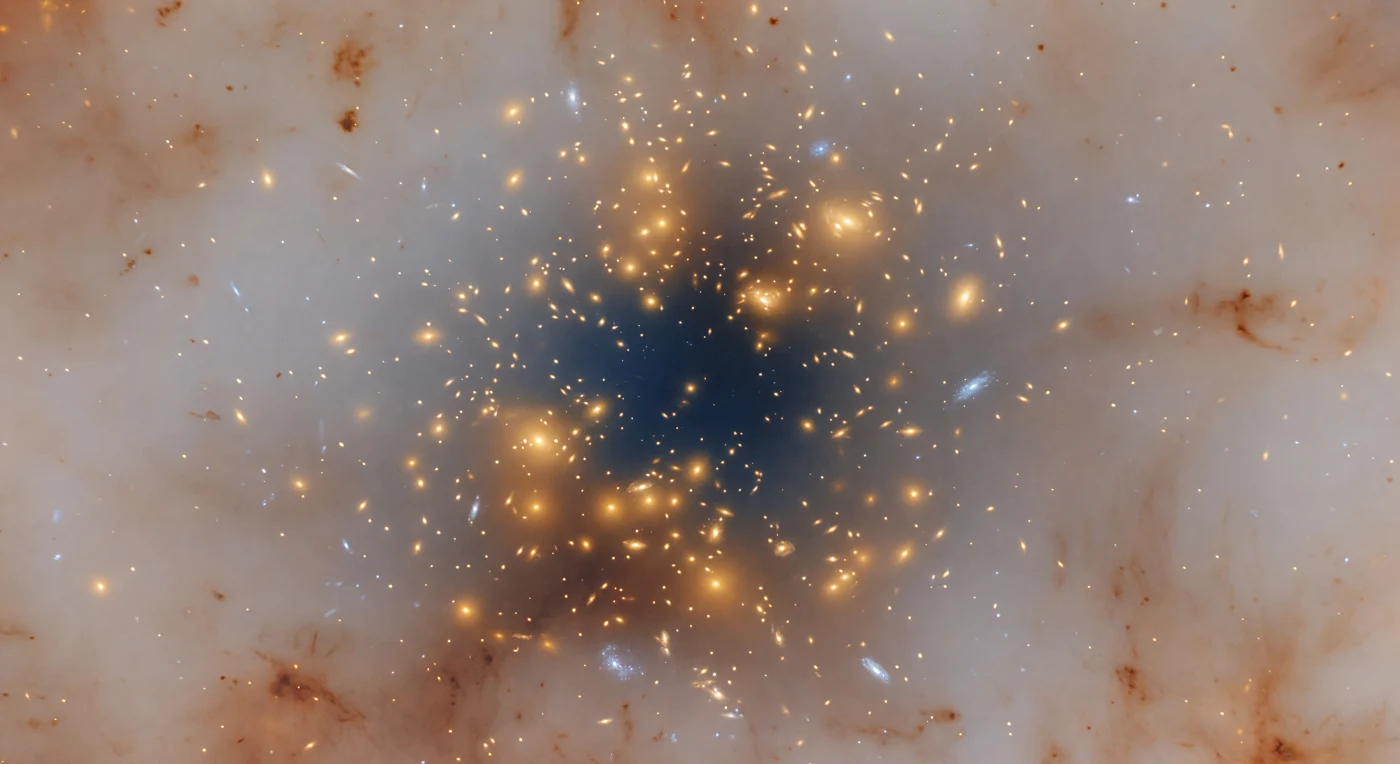
The eye is drawn first to the cluster's warmth — hundreds of elliptical galaxies drifting in amber and honeyed gold, their halos bleeding together into a diffuse intracluster glow, while lensed arcs of blue background objects trace the invisible architecture of dark matter curving space at the periphery. Yet this visible splendor is secondary to what it erases: directly behind the cluster, pressed into the ancient cream-and-russet tapestry of the cosmic microwave background, a circular void of deep blue-black silence marks where the cluster's intracluster medium — a fully ionized plasma reaching one hundred million degrees — has intercepted CMB photons traveling since the universe was a mere 380,000 years old and boosted them to higher frequencies through inverse-Compton scattering, draining microwave energy from that precise footprint in a process known as the thermal Sunyaev-Zel'dovich effect. The shadow grades smoothly from near-absolute midnight at the cluster's core, where plasma density peaks, outward through slates and indigos before the primordial glow reasserts its russet warmth just beyond the cluster's gravitational reach. What makes the perception vertiginous is the simultaneous coexistence of two realities sharing the same line of sight without acknowledgment: golden optical warmth in the foreground, cold spectral absence in the microwave background behind it — the universe annotating its own deepest layer with an imprint of invisible heat, a negative silhouette of billion-degree gas pressed permanently into the oldest light that exists.