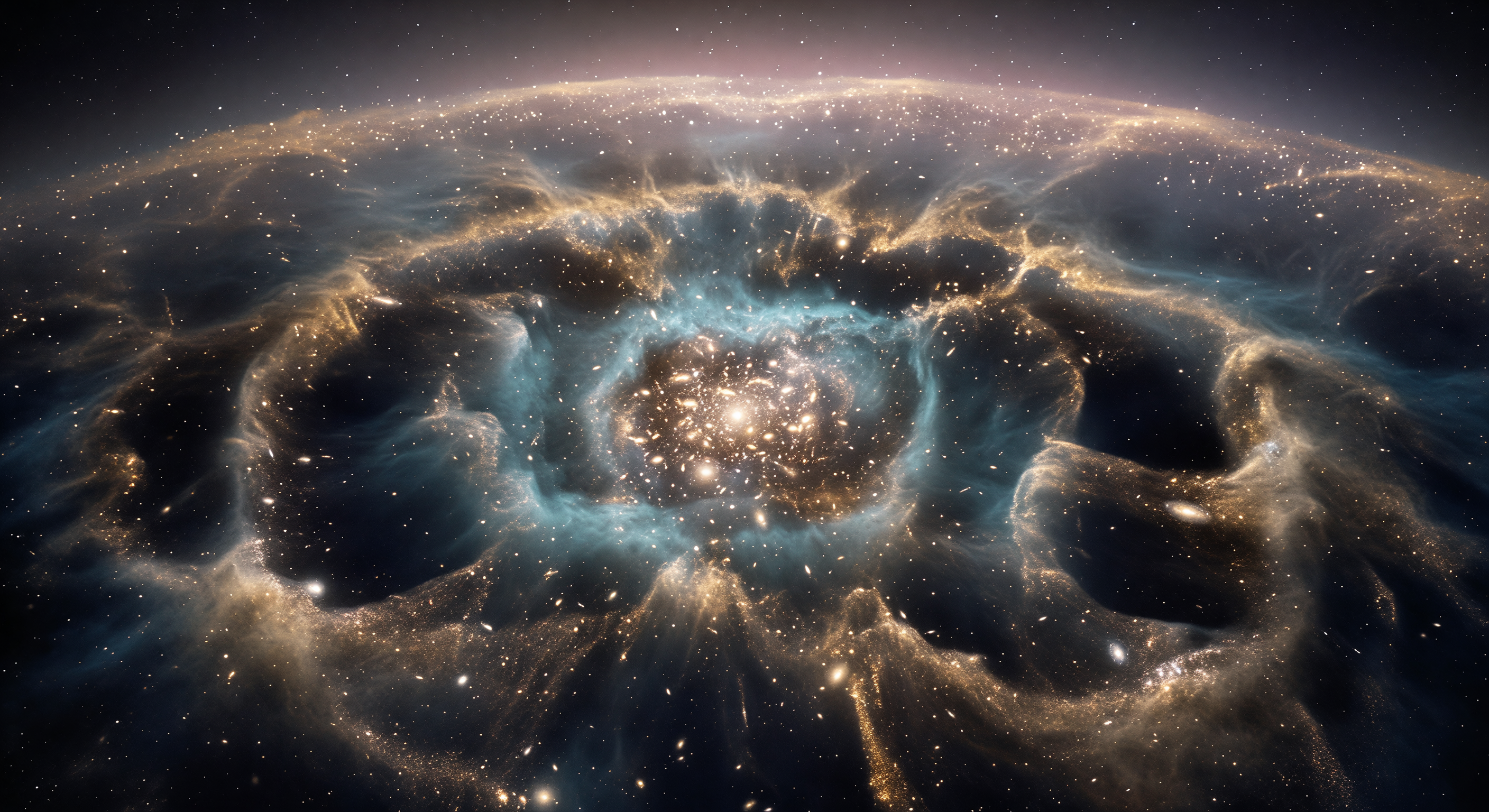
You are suspended at the gravitational heart of the Great Attractor convergence zone, where filaments of warm amber and antique gold — each a river of massed elliptical galaxies several million light-years thick — arc inward from every direction like the spokes of an inconceivably vast wheel, their edges dissolving into hazes of ionized intergalactic gas while the intervening voids drop to a deep, saturated indigo-black of nearly absolute emptiness. At the center of this convergence, the Norma Cluster blazes as a densely packed knot of hundreds of galaxies whose combined starlight fades from ivory at the core outward through pale champagne and gold, enveloped in a mottled cyan-teal fog of intracluster plasma heated to tens of millions of degrees — the X-ray-emitting ICM that betrays, through its turbulence and brightness gradients, the shock-heating signature of matter that has been falling inward for billions of years. Blue velocity-flow streamlines curve inward from all directions, tracing the invisible gravitational funnel generated by a mass concentration so dominant it deflects the Hubble flow across hundreds of millions of light-years, pulling the Milky Way and its neighbors toward this region at roughly 600 kilometers per second. In the far background, the Shapley Supercluster glows as a diffuse horizon of pale gold and rose light — too distant to resolve into individual galaxies, it becomes a luminous coastline, a deeper reservoir of mass behind the attractor itself, its gravity layered onto the convergence like a second, slower tide. The full panorama is a nested succession of cosmic architecture in which every scale of structure — cluster, filament, supercluster wall, void — is simultaneously visible, each layer more ancient in its light than the last, the silence of the dark gulfs between the glowing spokes making the scene feel at once intimate and vertiginously immense.
Other languages
- Français: Flux du Grand Attracteur
- Español: Flujo del Gran Atractor
- Português: Fluxo do Grande Atrator
- Deutsch: Großer Attraktor Konvergenz
- العربية: تدفق الجاذب العظيم
- हिन्दी: महा आकर्षक अभिसरण प्रवाह
- 日本語: 大引力源への収束流
- 한국어: 거대 인력체 수렴 흐름
- Italiano: Flusso del Grande Attrattore
- Nederlands: Grote Aantrekker Stroom