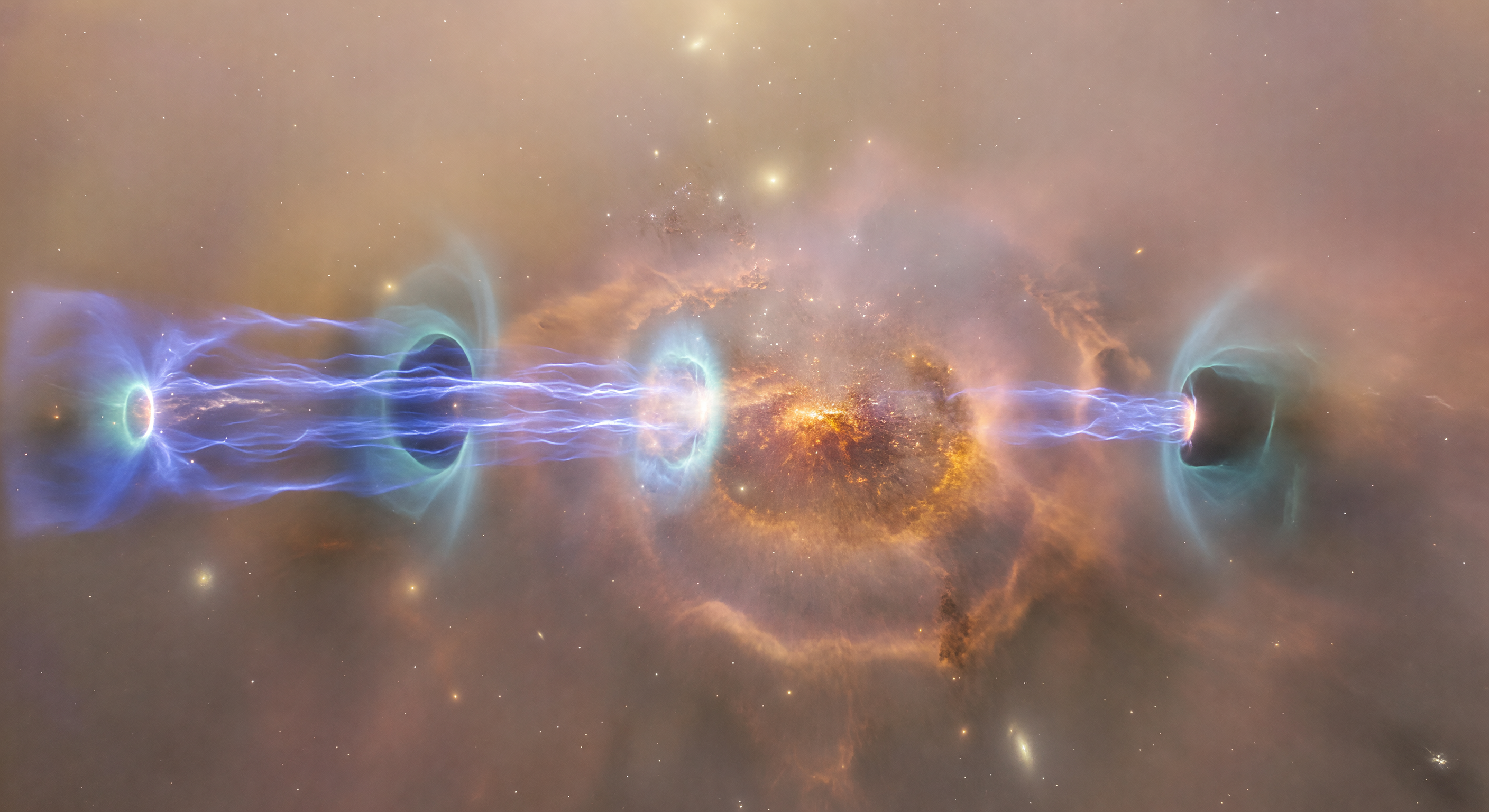
Suspended half a megaparsec off the equatorial plane of a colossal elliptical galaxy, the viewer takes in a structure of almost incomprehensible bilateral symmetry: two electric-blue jets lance outward from a smoldering amber nucleus, each traveling roughly a megaparsec before slamming into the surrounding intracluster medium in brilliant hotspot shocks—compact, near-white knots of frozen violence where the jet's kinetic energy converts instantaneously into broadened plasma flares. These are Fanaroff-Riley Class II radio jets, among the most energetic sustained phenomena in the known universe, born from the accretion disk of a supermassive black hole and confined by magnetic fields into columns so tightly wound they appear almost solid at their base before fraying at the edges into vast lobes of faded burnt orange and dusty mauve—magnetized relativistic plasma spread across volumes larger than the host galaxy cluster itself. Flanking the jets, dark ellipsoidal X-ray cavities mark where that plasma has physically evacuated the hot intracluster medium, their charcoal interiors rimmed in cold cyan where compressed gas glows at tens of millions of Kelvin—direct evidence that a single active nucleus is reshaping the thermal structure of an entire cluster. The intracluster medium itself hangs as a faintly luminous gold-rose haze filling all available volume, its glow the product of thermal bremsstrahlung from diffuse ionized plasma, turning what might otherwise be featureless intergalactic void into something unmistakably inhabited and alive.
Other languages
- Français: Survol des Lobes de Radiogalaxie
- Español: Sobrevuelo del Lóbulo Radiogaláctico
- Português: Sobrevoo dos Lobos de Radiogaláxia
- Deutsch: Radiogalaxie-Lappen Vorbeiflug
- العربية: تحليق عند فصوص المجرة الراديوية
- हिन्दी: रेडियो गैलेक्सी लोब उड़ान
- 日本語: 電波銀河ローブ接近飛行
- 한국어: 전파은하 로브 근접 비행
- Italiano: Sorvolo dei Lobi di Radiogalassia
- Nederlands: Radiosterrenstelsel Lob Doorvlucht