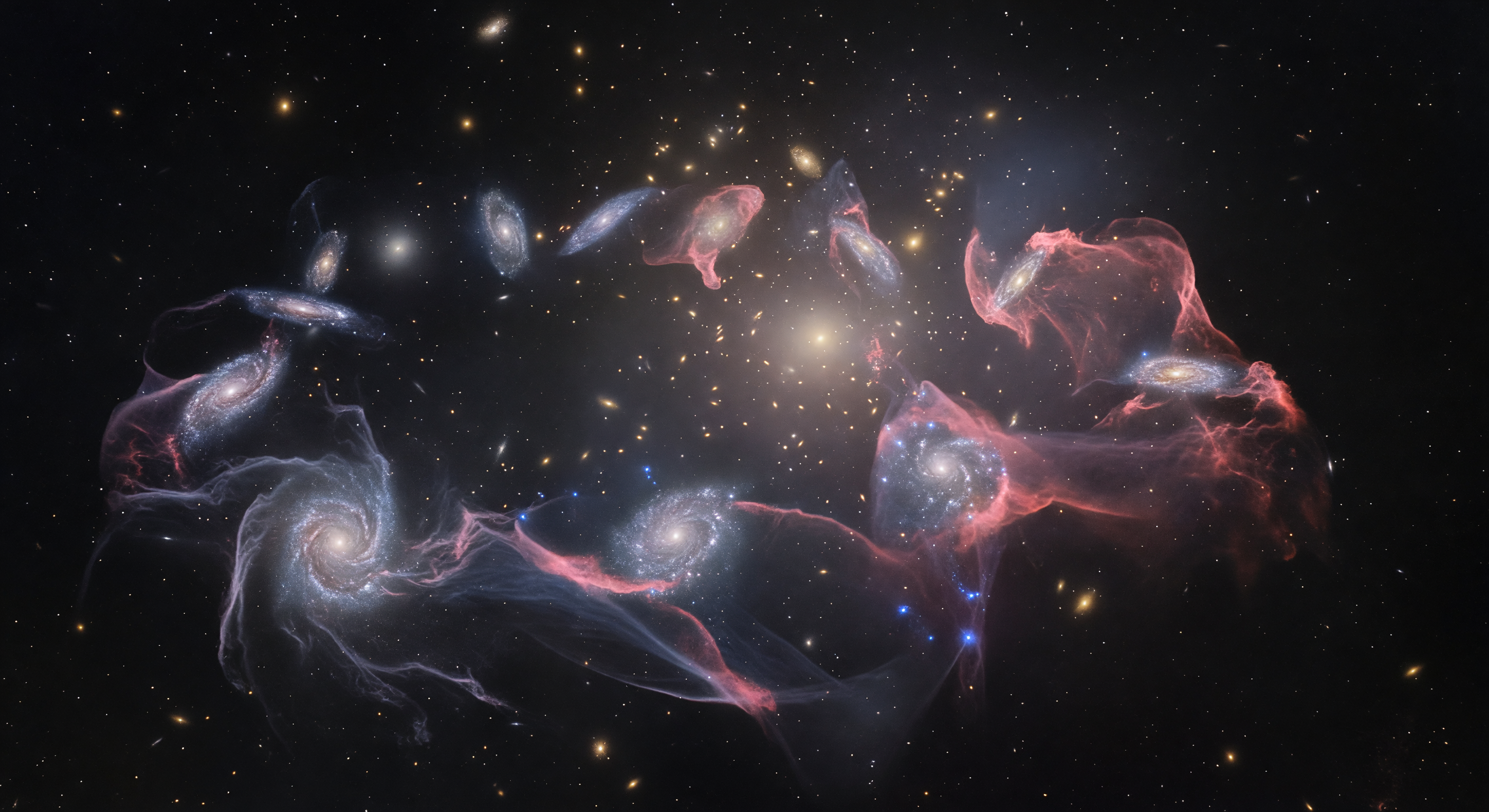
You are suspended in the rarefied outskirts of a massive galaxy cluster, drifting through intergalactic medium so tenuous it is felt only as an asymmetric thermal pressure — the invisible ram-pressure wind radiating outward from the cluster's vast hot corona of X-ray-emitting plasma at tens of millions of degrees. Ahead of you, a loose procession of spiral galaxies descends along the gravitational gradient toward a diffuse golden furnace glow deep in the background — the merged light of thousands of elliptical and lenticular galaxies crowded into the cluster core, their combined luminosity bleeding into a warm amber haze shot through with brighter nuclei. The nearest spirals in the chain trail long, diaphanous tidal streamers of pale blue-white stars and gas, arms unwound into gossamer threads by differential gravity, while the galaxies closest to the core have been transformed into something more violent and more beautiful: their windward faces still show tight blue spiral arms spangled with active star-forming knots, but from their leeward flanks, curtains of ionized hydrogen billow outward in vivid coral-pink and crimson jellyfish tails — Hα-bright filaments hundreds of thousands of light-years long, filigreed at their tips with compact cobalt clumps where ram-pressure compression has triggered new bursts of star formation. This is the observable signature of the intracluster medium stripping disk gas from infalling galaxies, a slow asymmetric violence that redistributes baryons across intergalactic space and quenches star formation on timescales of billions of years, inscribed here in the luminous contrast between hard stellar blue and soft biologic pink dissolving into the ambient dark.
Other languages
- Français: Galaxies en chute, gaz arraché
- Español: Espirales en caída, gas despojado
- Português: Galáxias em queda, gás removido
- Deutsch: Galaxienfall, Staudruck entkleidet
- العربية: مجرات ساقطة تجرد من غازها
- हिन्दी: आकाशगंगा पतन, गैस विरत
- 日本語: 落下銀河群、剥ぎ取られた星雲
- 한국어: 은하군 낙하, 박리된 가스
- Italiano: Galassie in caduta, gas strappato
- Nederlands: Vallende sterrenstelsels, gas weggerukt