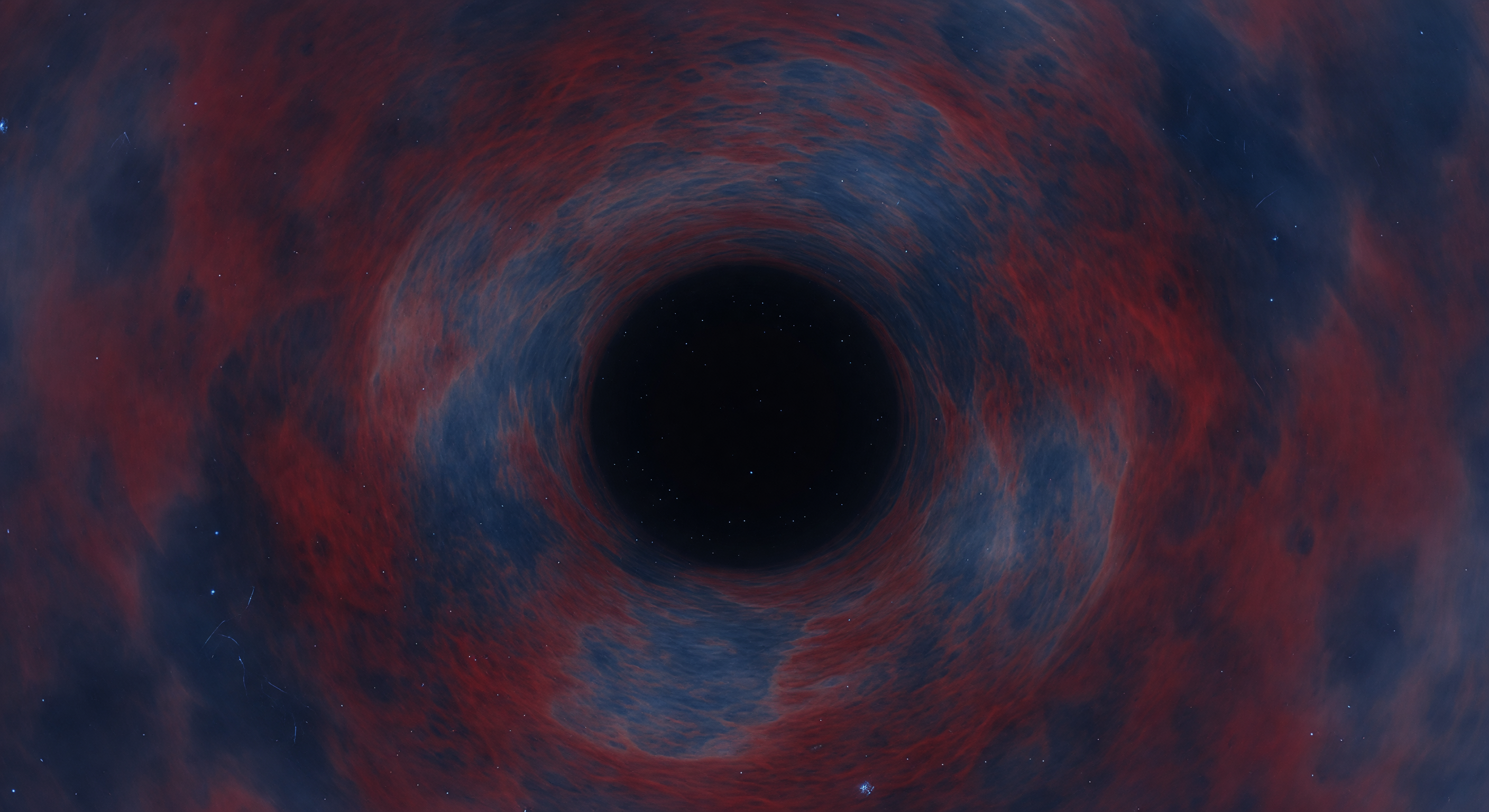
The view from this vantage point reveals the interior of the largest structure a human mind can meaningfully hold: the last-scattering surface, a continuous spherical shell enclosing the observer in every direction, its skin painted in the desaturated ochre-rust of warm plasma patches and the bruised indigo of cooler regions—temperature fluctuations of no more than one part in one hundred thousand, frozen into a softly luminous fresco at the moment recombination released the universe's first free photons, approximately 380,000 years after the Big Bang. These mottled undulations—broad continental warmths bleeding into cold polar bays, with finer textures nested within—record the primordial acoustic oscillations of a baryon-photon plasma, the seeds from which all subsequent gravitational structure would eventually grow. Between the observer and that receding shell, scattered across an intervening darkness of billions of light-years, faint electric-blue pinpoints betray the earliest protogalactic concentrations at redshifts around ten, their light compressed and dimmed almost to invisibility, clustering in thin filamentary wisps that hint at the first stirrings of the cosmic web. No matter where one looks, the dome maintains exactly the same apparent distance—neither floor nor ceiling nor wall but all of them simultaneously—because this horizon is defined not by a surface one could approach but by the finite speed of light itself meeting the age of the cosmos. The isotropic warmth pressing inward from every direction casts no shadow and acknowledges no preferred axis, filling the enclosed space with the quiet, all-surrounding glow of fossilized light from the universe's earliest legible moment.
Other languages
- Français: Intérieur du Dôme CMB
- Español: Interior de la Cúpula CMB
- Português: Interior da Cúpula CMB
- Deutsch: CMB-Kugelinneres Letztstreuung
- العربية: قبة آخر تشتت CMB
- हिन्दी: CMB अंतिम-प्रकीर्णन गुंबद
- 日本語: CMB最終散乱面ドーム内部
- 한국어: CMB 마지막 산란 돔 내부
- Italiano: Interno della Cupola CMB
- Nederlands: CMB Laatste Verstrooiing Koepel