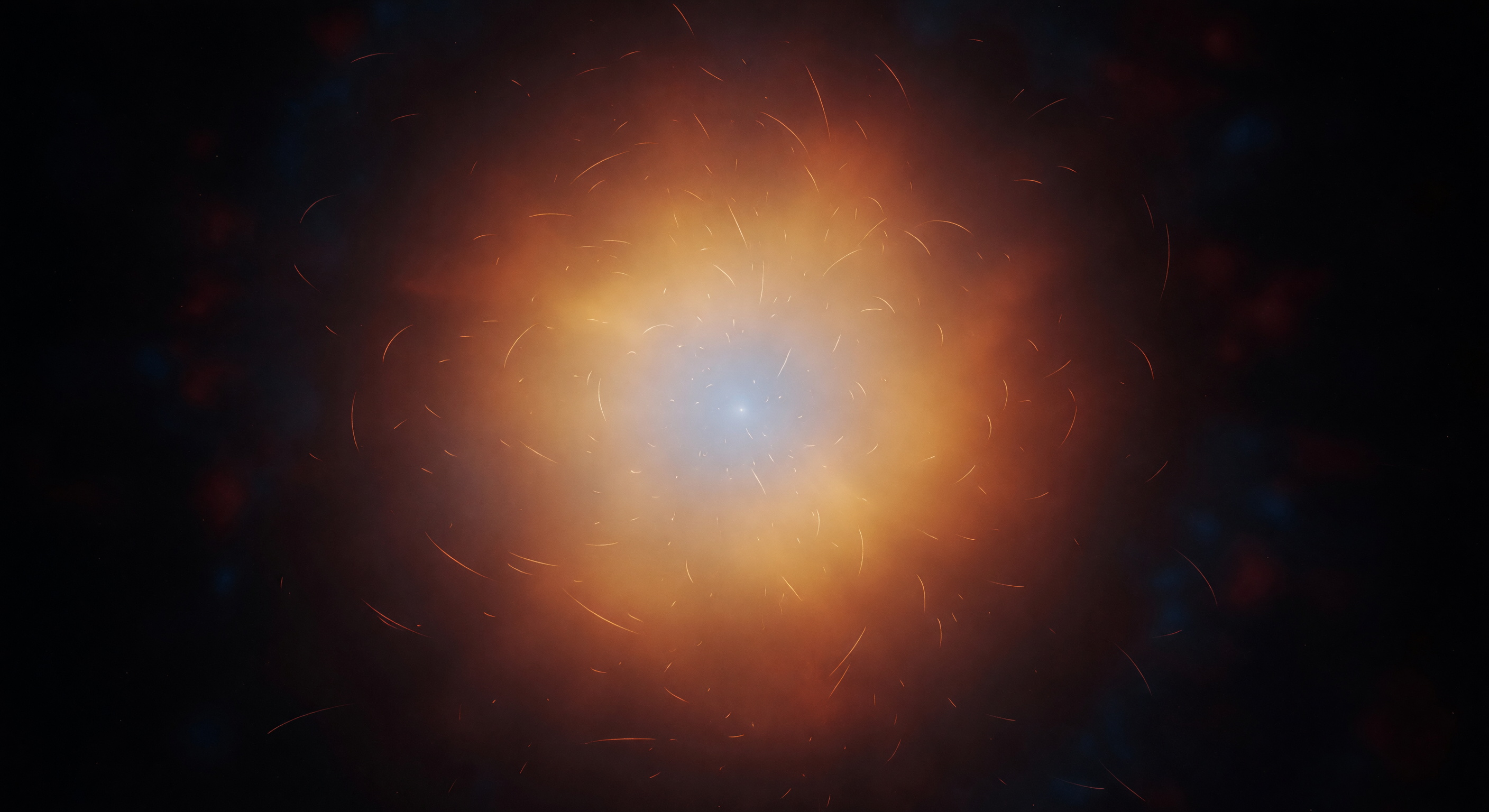
Standing at the conceptual center of all observation, you face a spherical enclosure that closes around you in every direction simultaneously — not a surface you can approach, but a geometry that enfolds, the particle horizon pressing inward from all sides like the interior of a slowly brightening furnace. The darkness nearest to you is threaded with the faintest mottling of the cosmic microwave background, those burgundy and cobalt temperature fluctuations representing photons released at redshift z ≈ 1089, some 380,000 years after the Big Bang, their wavelengths stretched by cosmic expansion until they carry the thermal energy of liquid helium, the oldest light that can exist. Beyond this veil, the vacuum itself thickens — not metaphorically but structurally — as you approach the last-scattering surface where photon mean free path collapsed to zero and the early universe became a plasma so dense that light could not travel freely, its opacity a physical condition rather than an obstruction, the boundary between a transparent cosmos and a radiating fireball of ionized hydrogen and helium at temperatures exceeding 3,000 Kelvin. The blue-white core of that enclosure does not flicker or pulse; it is a frozen record of causal finality, every direction yielding the same blazing closure, the point where information ends not because something blocks the view but because the universe had not yet become the kind of place where vision was possible.
Other languages
- Français: Gradient de Feu à l'Horizon
- Español: Gradiente de Fuego en el Horizonte
- Português: Gradiente da Bola de Fogo Cósmica
- Deutsch: Feuerball am Teilchenhorizont
- العربية: تدرج كرة النار الكونية
- हिन्दी: कण क्षितिज अग्निगोला ढाल
- 日本語: 粒子地平線の火球グラデーション
- 한국어: 입자 지평선 화염 그라디언트
- Italiano: Gradiente di Fuoco all'Orizzonte
- Nederlands: Vuurbal aan de Deeltjeshorizon