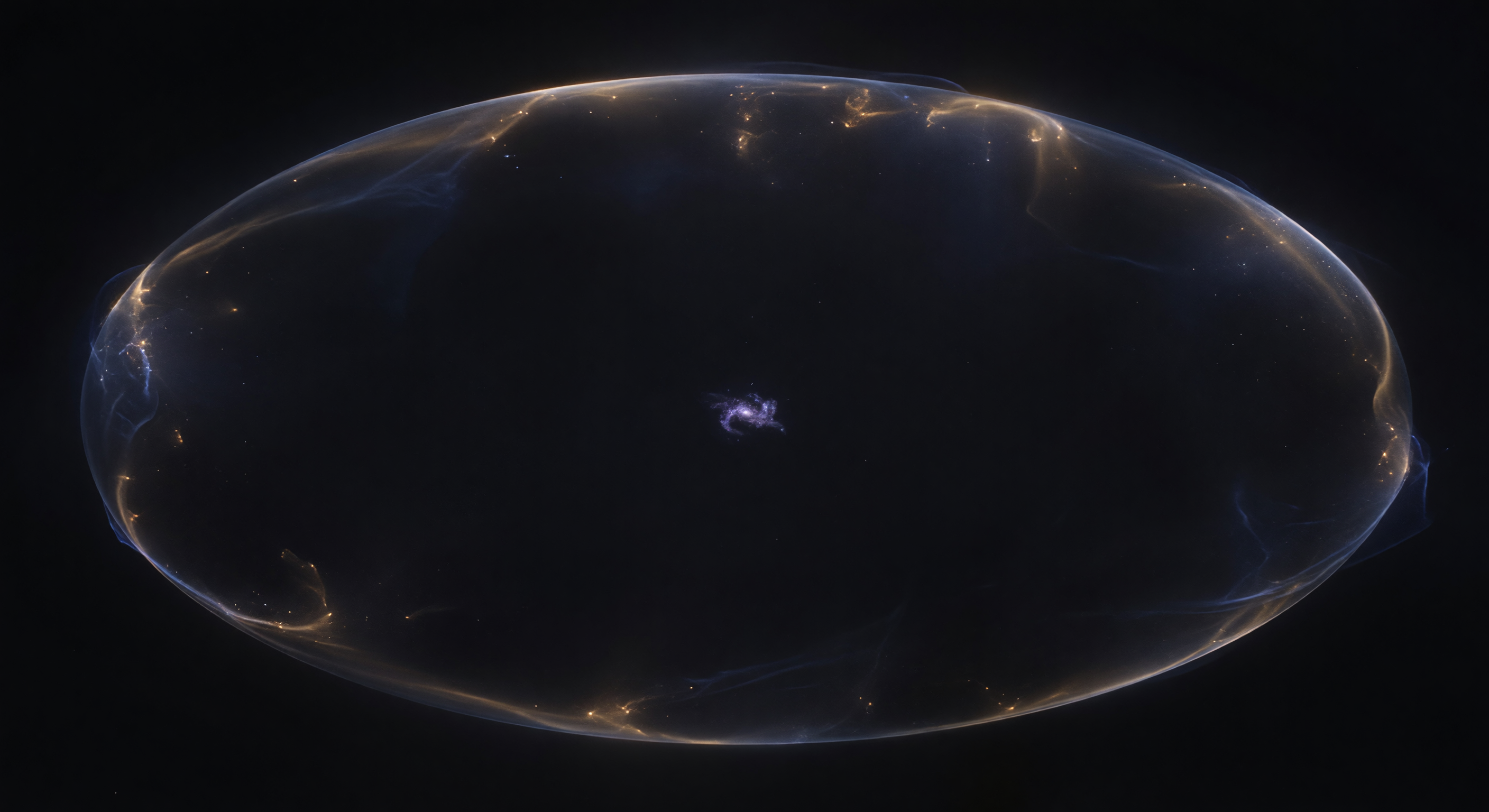
At the geometric heart of the Boötes Void, the overwhelming impression is not darkness as absence but darkness as substance — a three-dimensional blackness stretching 250 million light-years in every direction that presses against perception like a physical medium, unbroken by any star, dust lane, or gas cloud except for the most tenuous imaginable veil of ultra-diffuse intergalactic matter hovering at the threshold of visibility as a pewter whisper barely distinct from nothing. Far at the periphery, hundreds of millions of light-years away and compressed by perspective into a continuous curved membrane, the surrounding galaxy walls of the cosmic web resolve into a warm amber and copper-gold luminous skin — the iridescent inner surface of a supervoid boundary, tracing the spherical geometry of one of the largest known underdensities in the universe, where the large-scale structure of dark matter filaments and baryonic plasma has simply failed to collapse, leaving this vast evacuated basin in the cosmic foam. Improbably alone in the foreground, a single void dwarf galaxy burns electric blue-violet, its unobstructed star formation fed by pristine hydrogen untouched by galactic neighbors, its cold sharp light casting no glow on anything because there is nothing nearby to receive it. Coating the entire visual field with perfect isotropy, an almost imperceptible cool blue-gray luminous undercoat — the cosmic microwave background radiation at 2.7 Kelvin, a thermal relic of recombination some 380,000 years after the Big Bang — presses evenly against every direction at once, the oldest light in the universe reduced to a barely perceptible whisper of cold radiance lining the inside of the cosmos itself.
Observable universe