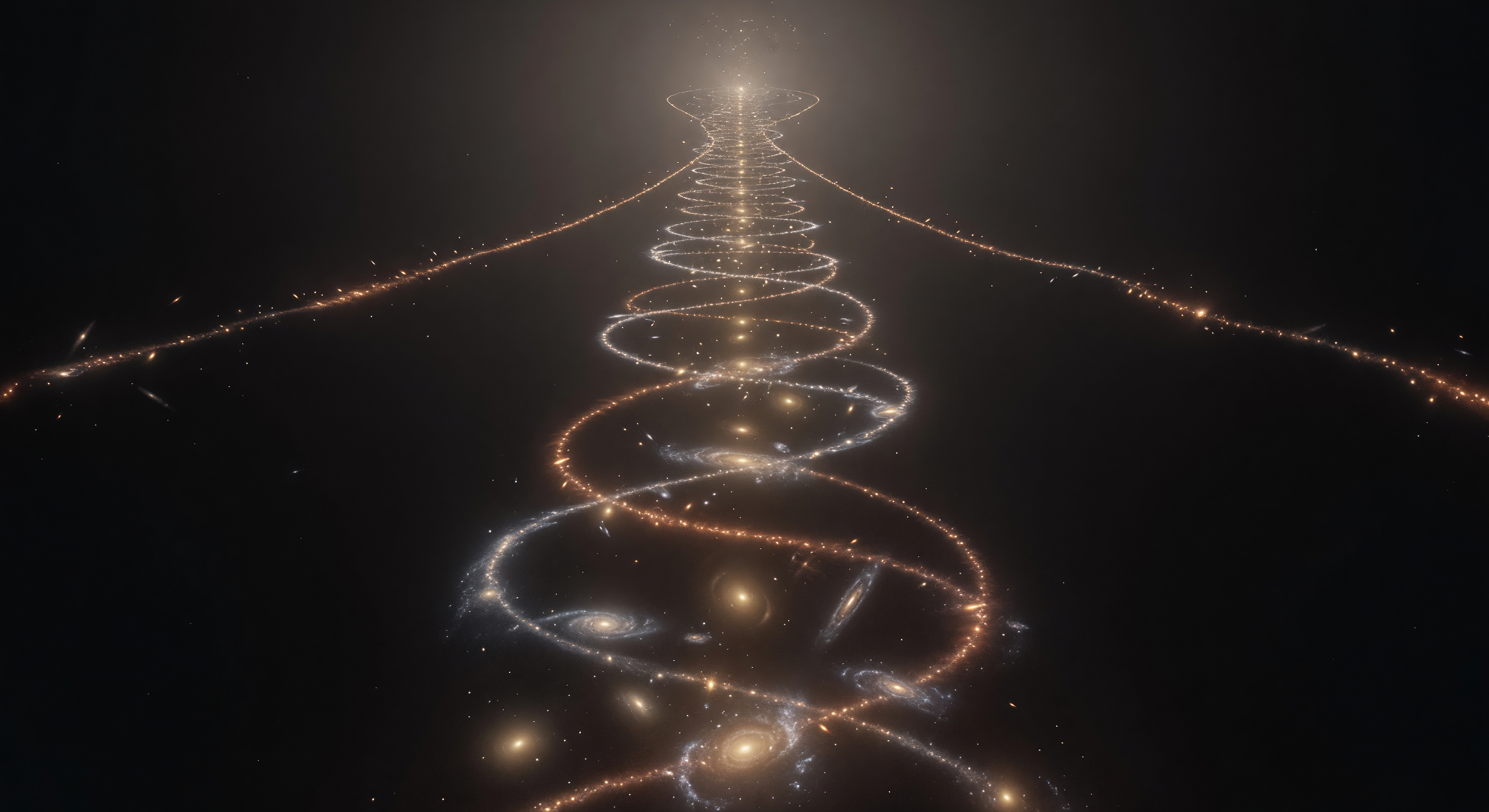
You are suspended within the luminous spine of a structure so vast that its full length would take light hundreds of millions of years to traverse — an intergalactic filament of the cosmic web, one of the universe's great load-bearing threads, woven from dark matter scaffolding and traced by warm plasma too tenuous to be called gas in any earthly sense, yet deep enough across its accumulated tens of millions of light-years to radiate a ghostly amber warmth. Looking along the filament's axis, galaxy chains resolve into sweeping arcs of honeyed ellipticals and cool blue spirals strung like luminous beads, their tidal bridges — pale gold shading to silver, spun across billions of years by gravitational patience — catching light with a translucence no solid material possesses, while the corridor narrows toward a distant supercluster nexus blazing gold-white at the vanishing point of this immense architectural tunnel. On both flanks, orthogonal filaments cross the background as rust-colored ropes dissolving into voids whose darkness is not merely the absence of light but the physical presence of a hundred-million-light-year emptiness, the large-scale structure's counterpoint to every node and thread. Pressing in from the outermost periphery of vision, a barely perceptible ash-white warmth traces the horizon of the knowable — the cosmic microwave background, light from 380,000 years after the Big Bang, redshifted to a temperature of 2.7 Kelvin, giving even absolute void a floor it cannot fall below.
Other languages
- Français: Couloir de Filament, Vue Axiale
- Español: Corredor de Filamento, Eje Cósmico
- Português: Corredor de Filamento, Ao Longo do Eixo
- Deutsch: Filamentkoridor, Blick Entlang der Achse
- العربية: ممر الخيط الكوني، نظرة محورية
- हिन्दी: तंतु गलियारा, अक्ष के साथ दृश्य
- 日本語: フィラメント回廊、軸沿いの眺め
- 한국어: 필라멘트 통로, 축을 따라 바라보다
- Italiano: Corridoio di Filamento, Vista Assiale
- Nederlands: Filamentcorridor, Blik Langs de As