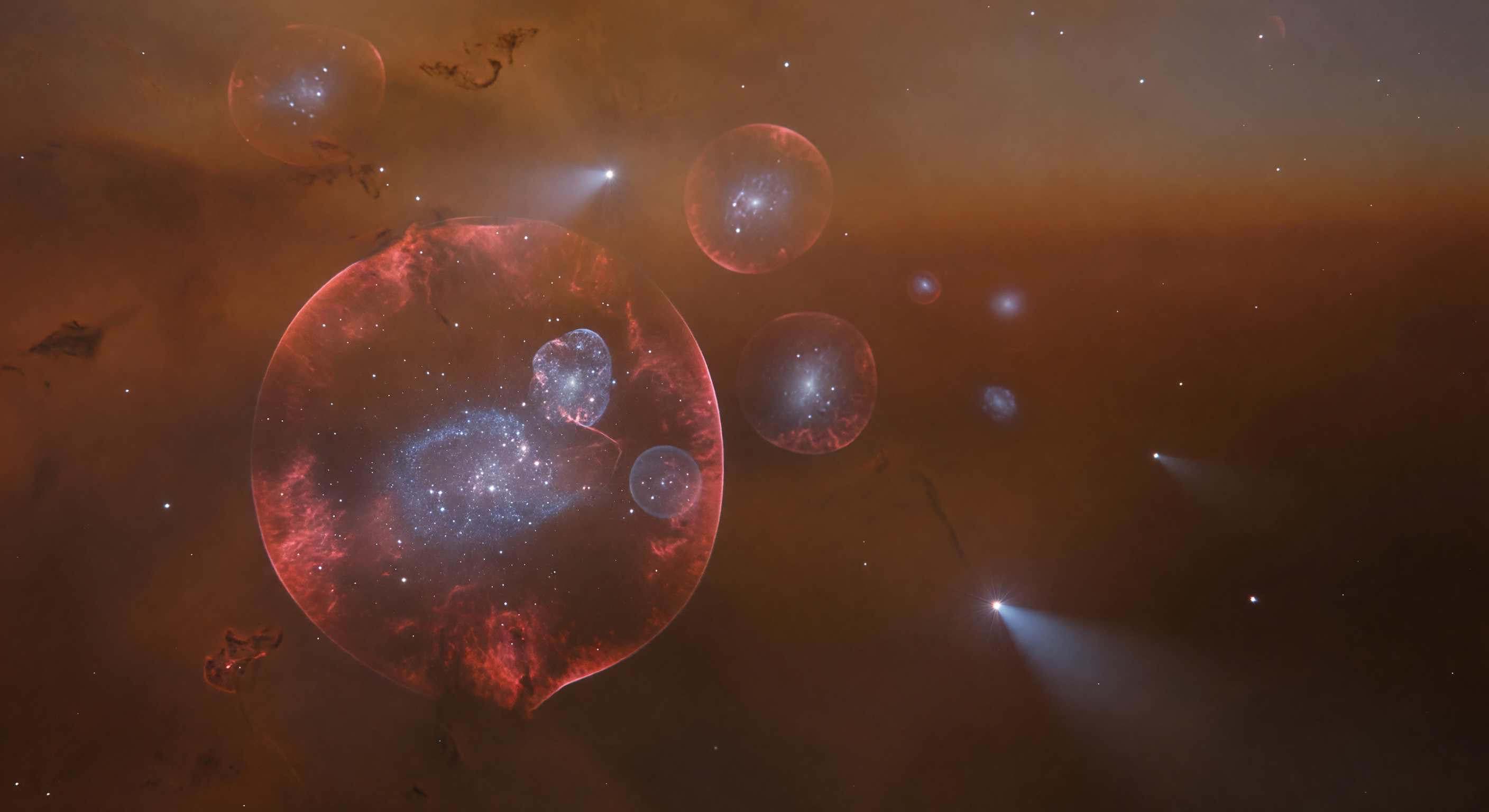
You are suspended inside the intergalactic medium at cosmic dawn, roughly one billion years after the Big Bang, enveloped in a rust-brown murk of neutral hydrogen that absorbs and reddens nearly all light attempting to cross it. The scene is dominated by the war between opacity and illumination: young proto-galaxies burn with savage ultraviolet intensity, each one a dense smear of Population II and III stars compressed into irregular knots, their radiation carving spherical pockets of ionized transparency — reionization bubbles — out of the surrounding fog, with the perimeter of each bubble glowing as a thin, crimson Lyman-alpha shell where outbound UV photons collide with intact neutral hydrogen at the ionization front and force it into re-emission. Quasar point sources drive this process further still, their luminosity so extreme it overwhelms the ambient medium in narrow cones, cutting electric-blue ionized corridors through the rust-colored gas like slow-motion searchlights, each cone edged with its own faint crimson fringe where the ionizing front meets unprocessed hydrogen. The universe here is not empty but choked and gravid, its gas still cooling from its primordial state, threaded with density knots and filamentary structure inherited from quantum fluctuations amplified over a billion years — a cosmos on the precise threshold between opacity and transparency, being burned open from the inside by its own first light.
Other languages
- Français: Frontière des Bulles de Réionisation
- Español: Frontera de Burbujas de Reionización
- Português: Fronteira das Bolhas de Reionização
- Deutsch: Reionisationsära Blasengrenze
- العربية: حدود فقاعات عصر إعادة التأين
- हिन्दी: पुनर्आयनीकरण युग बुलबुला सीमा
- 日本語: 再電離時代の泡の境界
- 한국어: 재이온화 시대 거품 경계
- Italiano: Frontiera delle Bolle di Reionizzazione
- Nederlands: Reïonisatietijdperk Bellengrens