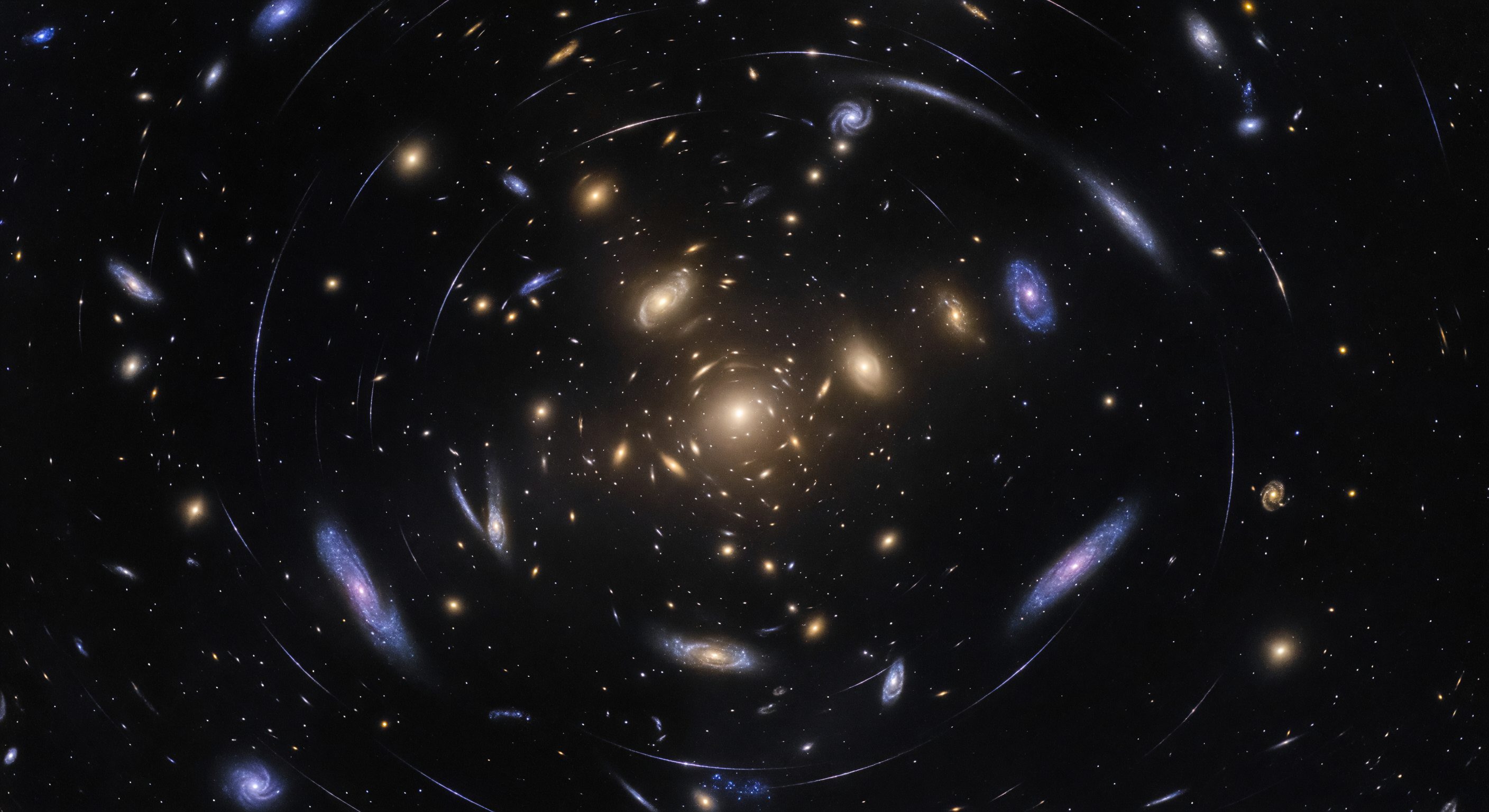
The observer hangs in the intergalactic void roughly one hundred million light-years from a massive galaxy cluster whose gravitational field has become the organizing principle of the entire visible sky. Directly ahead, hundreds of ancient elliptical galaxies merge perceptually into a single warm amber mass, their old stellar populations bleeding together through diffuse intracluster light — a fog of unbound stars stripped across billions of years of tidal interaction, pooling between galaxies like embers settling into ash. Around this golden core, the background universe has been geometrically dismantled: light from star-forming galaxies at redshifts near three, galaxies that existed when the universe was barely two billion years old, arrives at this position along multiple paths bent by the cluster's mass concentration, reconstructing itself as thin electric-blue arcs, closed Einstein rings, and repeated mirror images of the same spiral resolved clearly enough that individual star-forming knots can be matched across positions separated by vast angular distances — the same moment of cosmic time, the same patch of a young universe, delivered simultaneously by entirely different routes through curved spacetime. Pulling awareness outward to the wider field, a quieter signature of the same mass becomes legible: background disk galaxies at every intrinsic orientation have been statistically torqued, their apparent shapes curving tangentially around the cluster center in a faint coherent shear, too subtle to read in any single galaxy but unmistakable as a texture across the full field, the gravitational imprint of dark matter made visible only through the distorted testimony of billions of light-years of background structure.
Other languages
- Français: Panorama de Lentille Gravitationnelle
- Español: Panorama de Lente Gravitacional
- Português: Panorama de Lente Gravitacional
- Deutsch: Gravitationslinsen Panorama
- العربية: بانوراما العدسة الجاذبية
- हिन्दी: गुरुत्वाकर्षण लेंस पैनोरामा
- 日本語: 重力レンズ大パノラマ
- 한국어: 중력 렌즈 파노라마
- Italiano: Panorama Lente Gravitazionale
- Nederlands: Zwaartekrachtslens Panorama