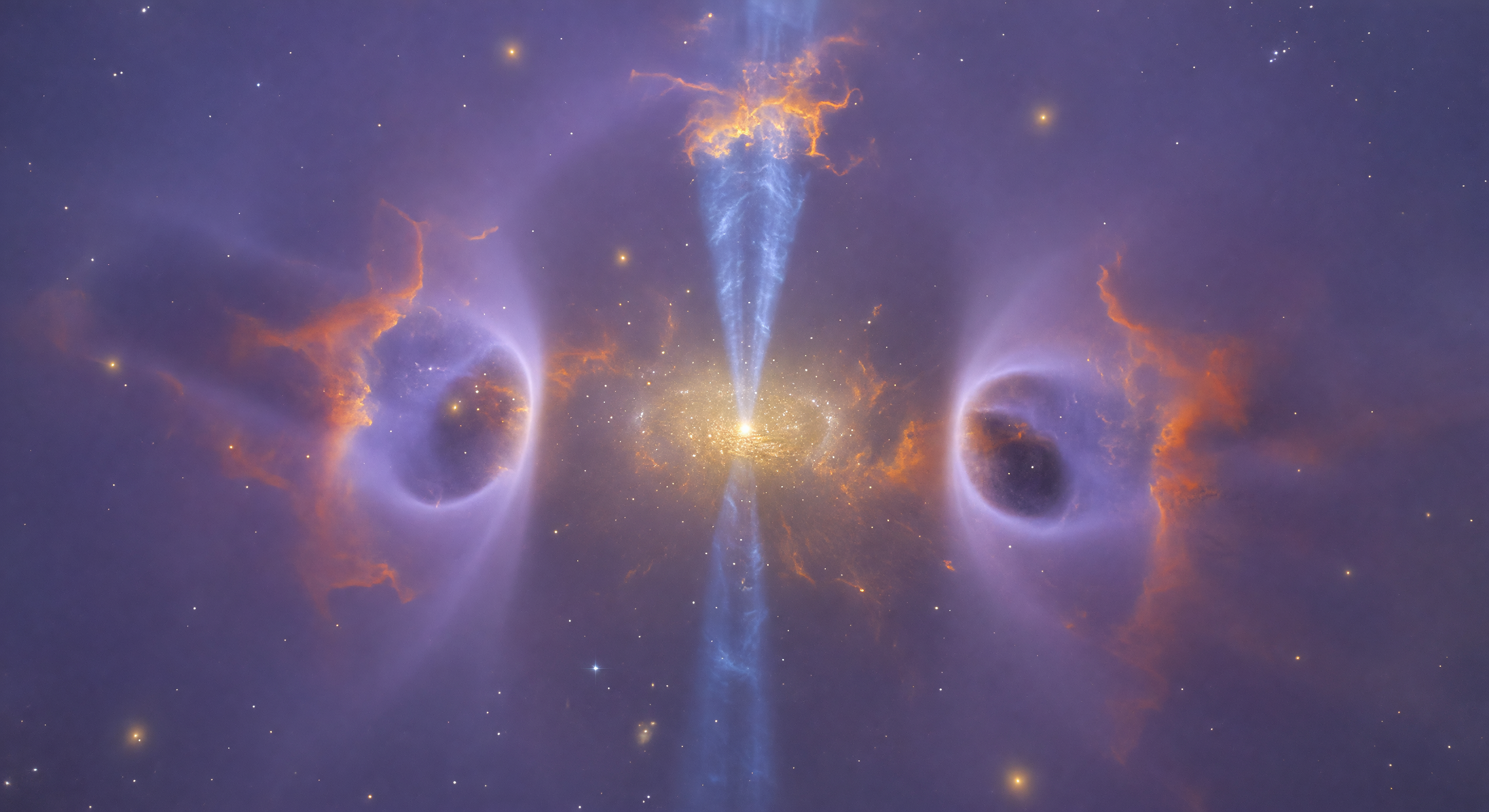
One megaparsec out from the nucleus, the scene is dominated by the galaxy's blazing golden core, its elliptical body dissolving at the edges into the faint violet-purple luminescence of the intracluster medium — a fully ionized plasma at tens of millions of degrees, so tenuous it would register as hard vacuum by any terrestrial measure, yet glowing continuously in X-ray frequencies across volumes larger than entire galaxy groups. From that warm nucleus, twin jets of relativistic plasma — electrons and magnetic fields wound together and accelerated by the supermassive black hole's accretion disk — knife outward in perfectly collimated blue-white columns, products of one of the most energetic continuous processes in the known universe, each carrying mechanical power equivalent to trillions of solar luminosities and suppressing star formation across the entire cluster by injecting energy into the surrounding ICM for hundreds of millions of years. Where the jets finally exhaust their collimation and thermalize against the resisting intracluster medium, they inflate into enormous orange-red radio lobes — structures spanning distances comparable to the separation between the Milky Way and the Andromeda Galaxy — their interiors filled with aging relativistic electrons radiating away their energy through synchrotron emission as the color shifts from electric orange at the shock front to deep rust further inward. Flanking the nucleus, the dark X-ray cavities — physical excavations carved by repeated jet outbursts over cosmic time — press ghostly ovoid shadows into the surrounding ICM glow, their soft pressure boundaries and concentric ghost rings of compressed, brightened plasma recording a history of episodic mechanical feedback written in the medium itself.
Other languages
- Français: Jet AGN Chalumeau Cosmique
- Español: Soplete Cósmico Jet AGN
- Português: Maçarico Cósmico Jato AGN
- Deutsch: AGN Jet Kosmischer Brenner
- العربية: مشعل كوني نفاث AGN
- हिन्दी: AGN जेट ब्रह्मांडीय ब्लोटॉर्च
- 日本語: AGNジェット宇宙の炎
- 한국어: AGN 제트 우주 화염
- Italiano: Getto AGN Fiamma Cosmica
- Nederlands: AGN Straal Kosmische Fakkel