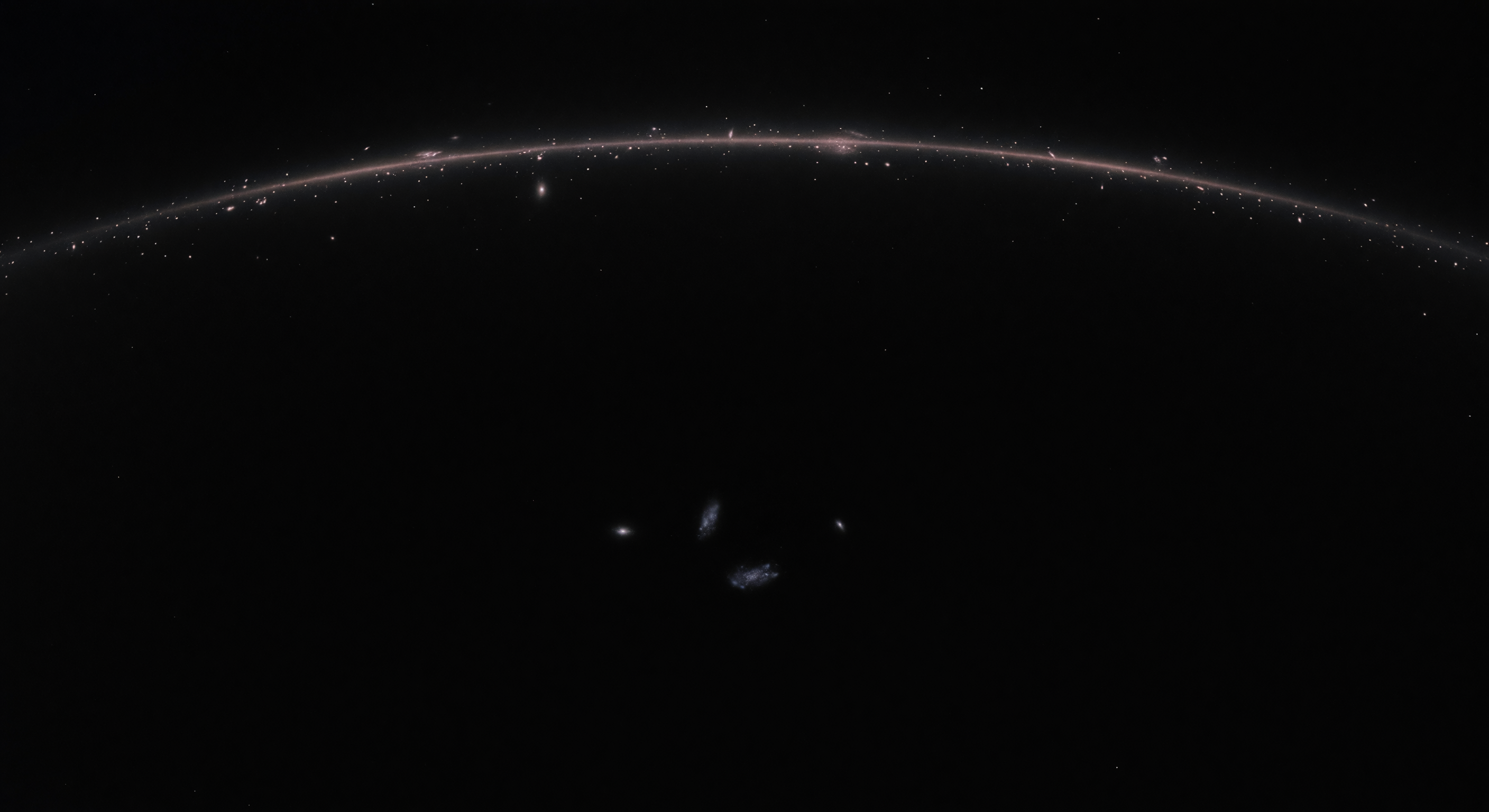
You are suspended at the geometric center of the Boötes Void, one of the largest known supervoids in the observable universe, a spherical absence roughly 330 megaparsecs across whose interior holds so few galaxies that cosmologists still debate whether its emptiness is statistically explicable. In every direction, the darkness is not the ordinary black of interstellar space but something denser and more total — the cosmic microwave background permeates the sphere as a faint, perfectly uniform thermal whisper, its infrared warmth so diffuse it reads less as light than as the residual heat signature of a universe that was once far hotter and far smaller, while three dwarf irregular galaxies drift in the foreground like torn fragments of luminous tissue, their blue-violet star-forming knots the only specific texture in hundreds of millions of light-years of near-absolute vacuum. The intergalactic medium here is so rarefied that a cubic meter of this space contains fewer atoms than the finest laboratory vacuum achievable on Earth, a density so low that matter has effectively ceased to be a meaningful category, and the dominant constituent of the volume is dark energy, the same accelerating pressure that is actively preventing this void from ever being reclaimed by the large-scale structure surrounding it. At the very limit of perception, curving continuously around the entire horizon in every direction, the bounding filament walls of the void announce themselves as an extraordinarily faint warm arc — amber bleeding into dusty rose, the smeared collective glow of tens of thousands of galaxies compressed by hundreds of millions of light-years of distance into a thin, unbroken rim, less an edge than the memory of a structure so vast that the mind can hold its geometry only in the abstract.
Superclusters