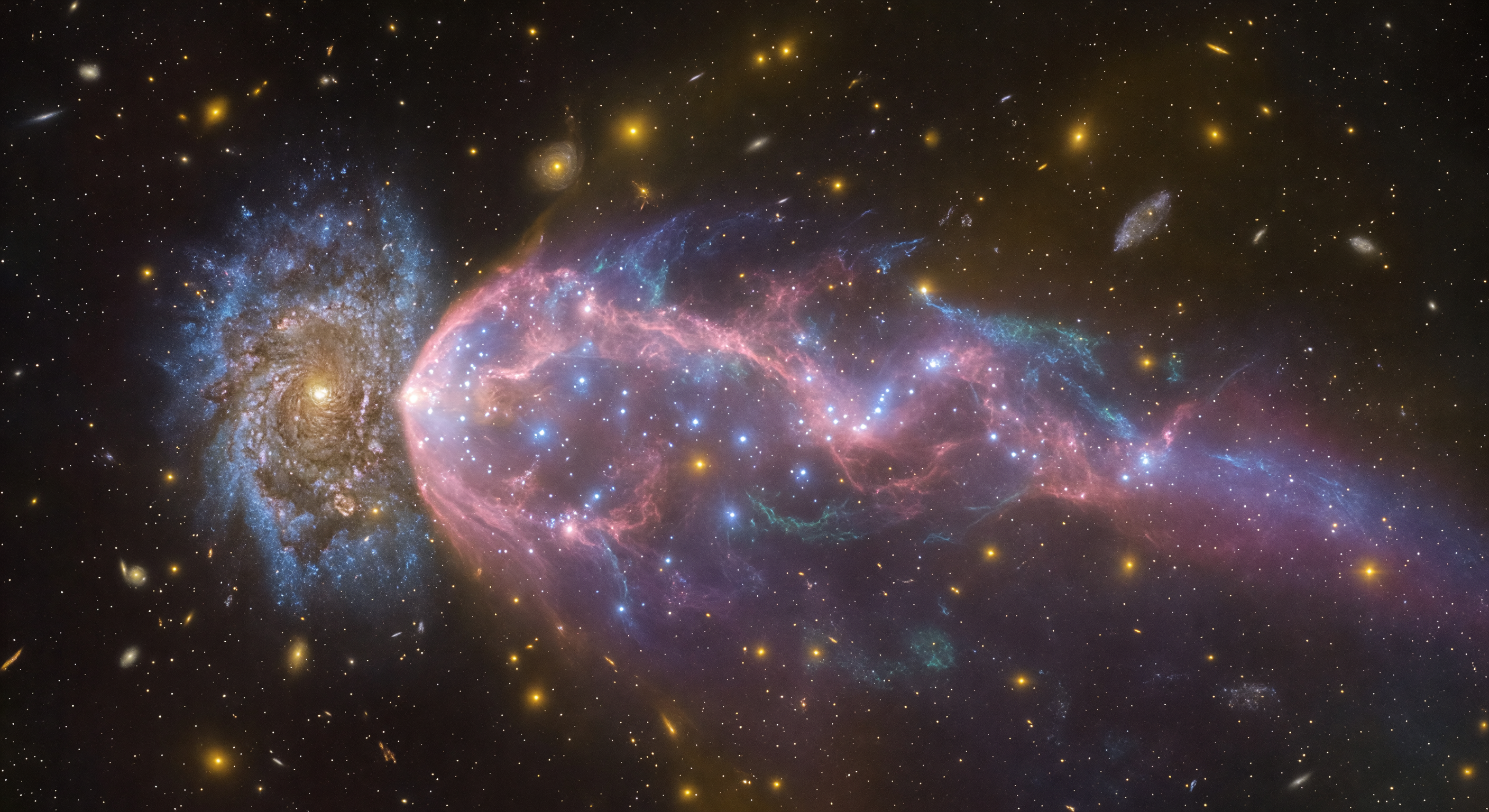
Ahead of you, a spiral galaxy in full face-on glory occupies the left expanse of the visual field, its golden core smoldering with the accumulated light of billions of aged stars while cobalt and teal arms still ignite with furious star formation — dust lanes pressed in dark ribbons between luminous arcs, H II regions scattered like embers, every structural detail resolved with brutal clarity. But this galaxy is not at rest: plunging into the cluster at over a thousand kilometers per second, it meets the intracluster medium — a fully ionized plasma heated to tens of millions of degrees — which tears at its interstellar gas and sculpts it into a comet tail half a megaparsec long, a cascading streamer of electric pink hydrogen-alpha emission threaded with blue-green doubly ionized oxygen filaments, narrowing from a blunt shock front at the galaxy's disk edge into a tapering luminous plume that dissolves into deep violet as stripped plasma cools and disperses. Within that tail, ram pressure itself becomes a creative force: dozens of blue-white stellar knots, compact star-forming clumps compressed into existence by the shock, burn like bonfires strung along a river of glowing fog, each one haloed in pale sapphire where its ultraviolet radiation reionizes the surrounding stripped gas. The background offers no relief — hundreds of amber and old-ivory elliptical galaxies crowd every direction, their warm thermal glow diffusing through the intracluster plasma like light through an impossibly vast amber glass, the contrast between their ancient quiescence and the spiral's violent blue youth written across the sky in half a million light-years of irreconcilable collision.
Other languages
- Français: Traînée Cométaire Par Pression
- Español: Estela Cometaria Por Presión
- Português: Rastro Cometário Por Pressão
- Deutsch: Staudruck Kometenschweif
- العربية: ذيل مذنب بضغط الاصطدام
- हिन्दी: दाब विखंडन धूमकेतु पूंछ
- 日本語: 衝突圧剥離彗星尾
- 한국어: 충돌압 혜성 꼬리
- Italiano: Scia Cometaria Per Pressione
- Nederlands: Stuwdruk Komeetstaart