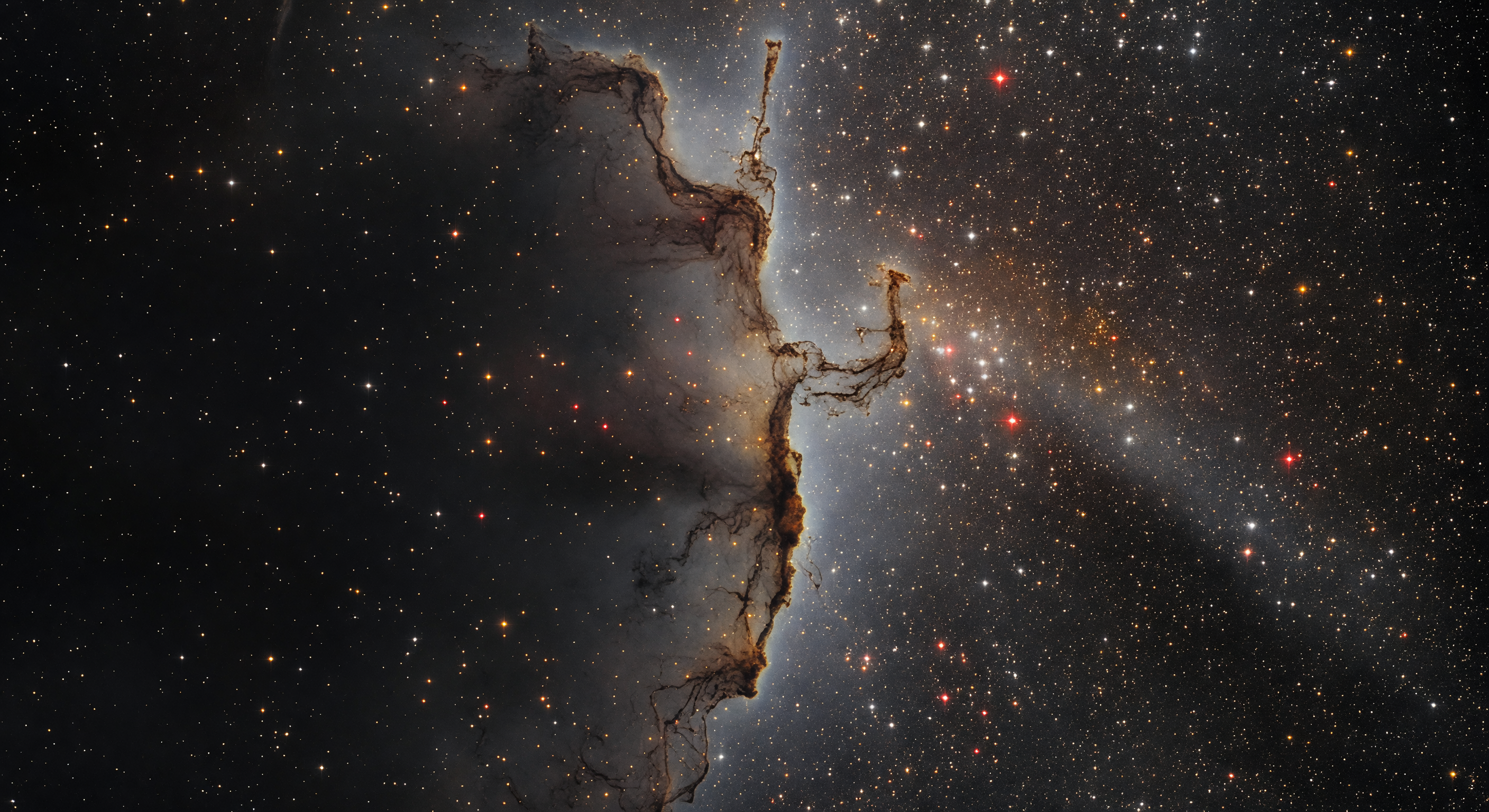
At the razor-edge of Barnard 68, you stand at one of the most absolute boundaries in the local galaxy — a wall not of stone or vacuum but of accumulated molecular dust so dense that thirty magnitudes of extinction swallow starlight whole, erasing photons that have traveled thousands of light-years only to vanish in the final fraction of a light-year. The surrounding galactic star field performs its slow chromatic surrender across the globule's margin: ivory stars shifting to amber, then burnt orange, then blood-crimson, then nothing, each color step a legible record of increasing dust column density as polycyclic aromatic hydrocarbons fluoresce faintly along the outermost tendrils under the attenuated ultraviolet of the interstellar radiation field. The boundary itself is not a smooth surface but a torn and three-dimensional terrain — fine dark filaments curling outward from the main mass like ink threads suspended in still water, their thinnest reaches still permitting the ghost of a deep-red star to bleed through at column densities just short of total opacity. Inside, sealed from starlight and chemistry-altering radiation, cold molecular gas at roughly ten Kelvin collapses in silence across timescales measured in millions of years, building toward the density thresholds where gravity will eventually overwhelm turbulent pressure and ignite a new star — making this dark edge not an ending but the most patient kind of beginning.
Other languages
- Français: Bord Sombre Globule Barnard 68
- Español: Borde Oscuro Glóbulo Barnard 68
- Português: Borda Escura Glóbulo Barnard 68
- Deutsch: Barnard 68 Dunkler Globulusrand
- العربية: حافة كتلة بارنارد 68 المظلمة
- हिन्दी: बार्नार्ड 68 गोलिका अंधेरा किनारा
- 日本語: バーナード68暗黒星雲の縁
- 한국어: 바너드 68 암흑 구상체 경계
- Italiano: Margine Oscuro Globulo Barnard 68
- Nederlands: Barnard 68 Donkere Globulerand