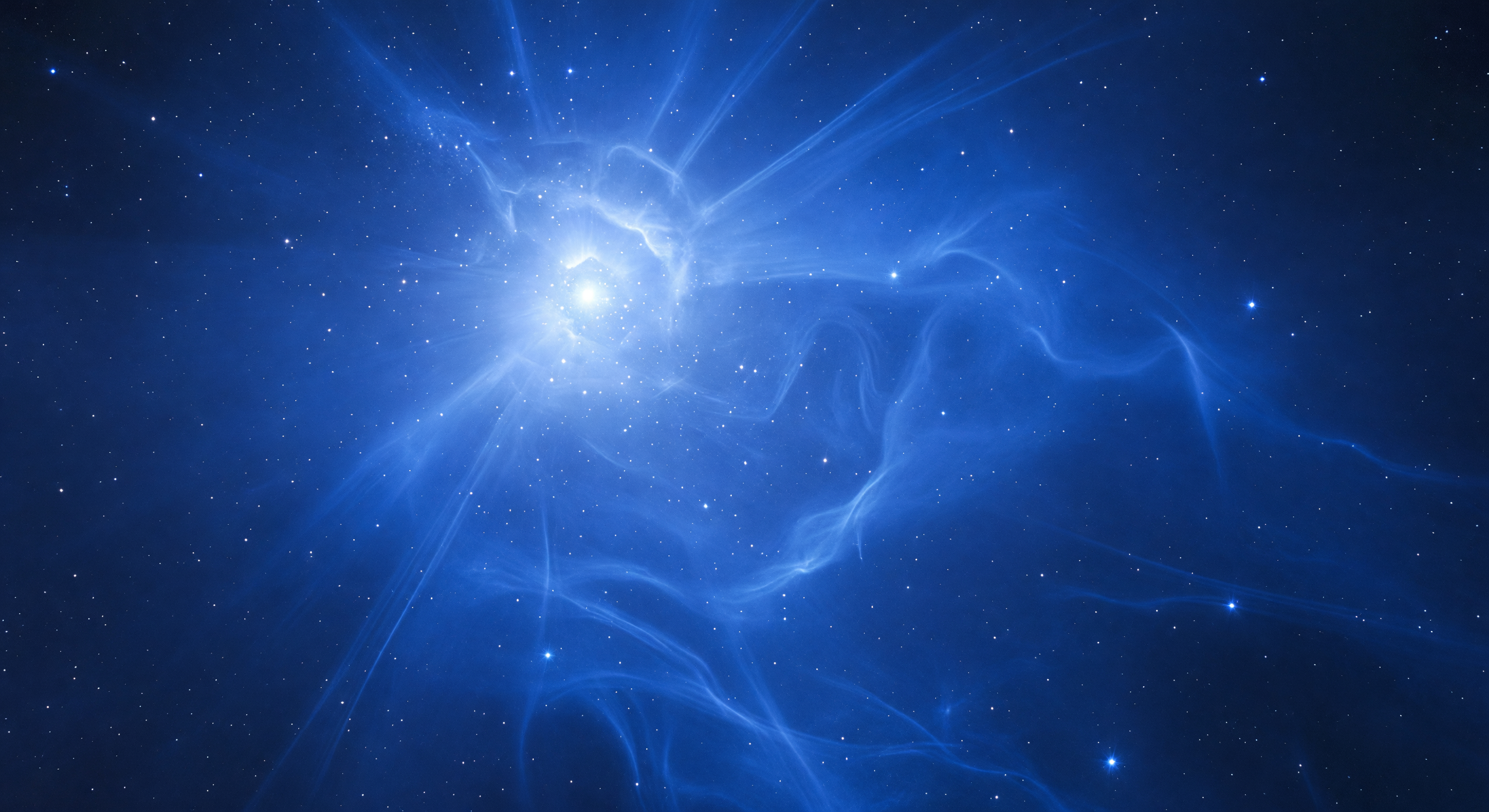
You are suspended inside the three-dimensional interior of a reflection nebula, adrift in an electric-azure radiance that fills every direction with no horizon, no floor, no ceiling — only a volumetric luminous fog of sub-micron silicate and carbonaceous dust grains scattering the short-wavelength photons of a blazing B2 star in every direction simultaneously, so that the light seems to emanate from the space itself. The dominant source burns at the upper left of the visual field with a searingly cold blue-white brilliance, its near-white corona bleeding outward through saturated cobalt and into deep indigo at the scene's farthest margins, where scattered light finally loses its hold and the void reasserts itself. Subtle density filaments coil radially outward from the stellar core, their edges softly defined and their interiors fractionally brighter than the surrounding haze, creating a layered sense of depth that recedes across distances measurable in light-years — structures born from the irregular compression history of a molecular cloud that was drifting and collapsing long before the star at its heart ignited. Background stars pierce the veil as sapphire points, their light shifted perceptibly bluer by the same Rayleigh-analog scattering that colors this entire luminous interior, each one a reminder that the fog you inhabit is not a wall but a window of immense, almost incomprehensible thickness.
Other languages
- Français: Brume Bleue des Pléiades
- Español: Neblina Azul de las Pléyades
- Português: Névoa Azul das Plêiades
- Deutsch: Plejaden Blauer Reflexionsnebel
- العربية: ضباب الثريا الأزرق
- हिन्दी: कृत्तिका नीली परावर्तन धुंध
- 日本語: プレアデス青き反射星雲
- 한국어: 플레이아데스 푸른 반사 성운
- Italiano: Nebbia Blu delle Pleiadi
- Nederlands: Plejaden Blauwe Reflectienevel