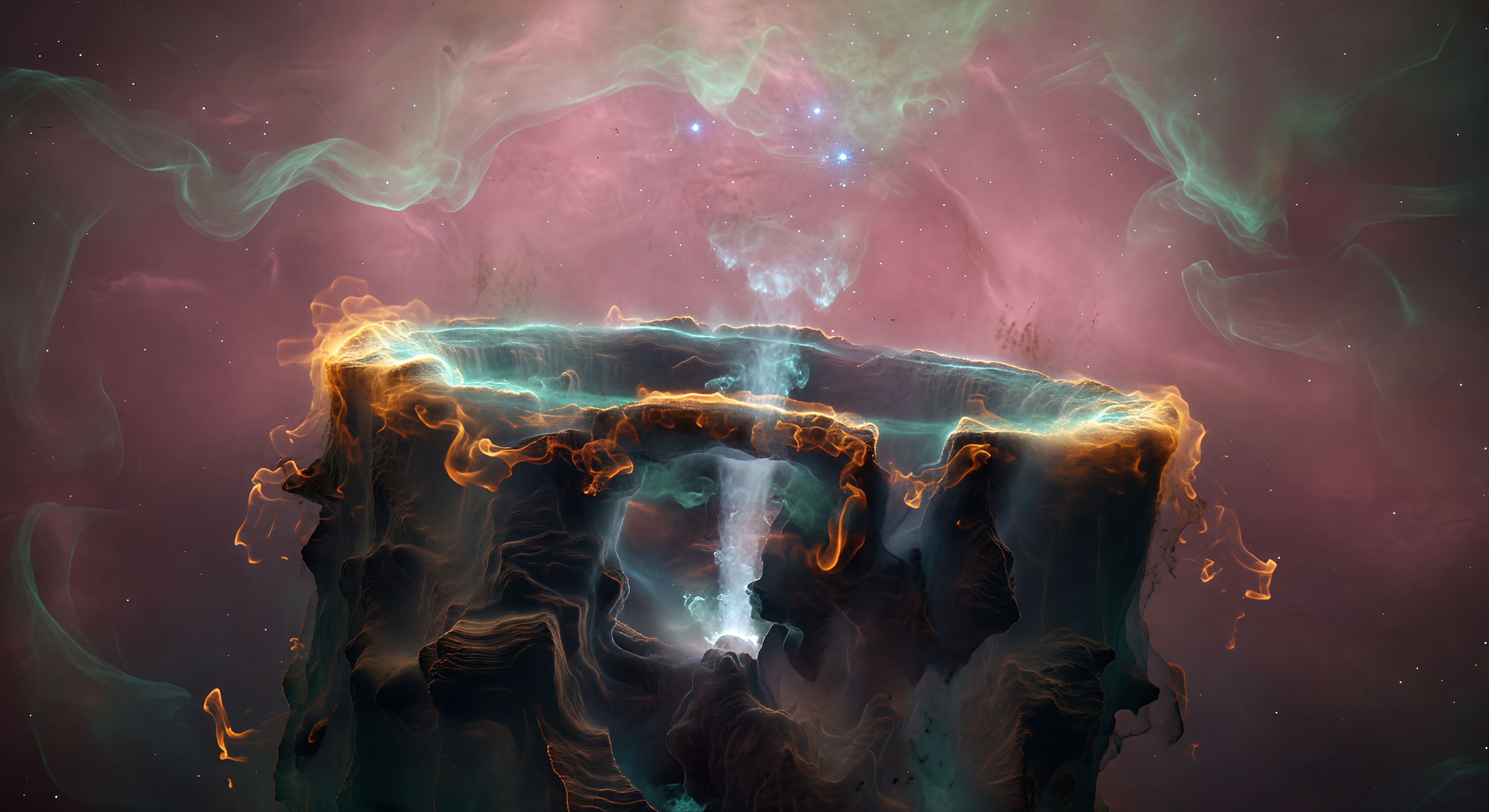
You are suspended at the apex of a molecular pillar whose sculpted crest rears beneath you like the crown of a petrified storm, its surface a dark compression of gas and interstellar dust — charcoal and basalt-brown — that has been accumulating and consolidating for millions of years inside a giant molecular cloud. Directly ahead, photoionization driven by a cluster of OB stars has eaten into the pillar's leading edge with geological patience, carving a fractalized ionization front where molecular hydrogen transitions, in a band barely wider than a cliff's edge, from cold near-black interior through amber and tangerine recombination glow into the surrounding H II plasma; the physics of this boundary — a photodissociation region only light-weeks thick — encodes in color a ten-thousand-year radiative history. From a cleft just below your position, a pale blue-white jet traces the exhalation of an embedded protostar still assembling itself in the pillar's protected dark interior, its outflow punching through the column's crust and fraying into teal wisps that dissolve within a few pillar-widths as the jet's momentum is thermalized by the ambient ionized medium. Above and in every direction beyond the pillar's rim, the H II cavity opens in volumetric magenta-rose — the integrated Hα emission of recombining hydrogen suffusing billions of cubic light-years into sourceless warm light — layered with translucent curtains of turquoise forbidden-line oxygen emission that billow with no wind across a space so vast that the pinpoint blue-white stars responsible for all of this erosion, all of this light, hang in the upper cavity like distant lamps casting hard shadows backward along the pillar's face.
Other languages
- Français: Sommet du Pilier Photoévaporé
- Español: Cima del Pilar Fotoevaporado
- Português: Ápice do Pilar Fotoevaporado
- Deutsch: Säulenspitze Photoverdampfung
- العربية: قمة العمود المتبخر ضوئياً
- हिन्दी: स्तंभ शिखर प्रकाश-वाष्पीकरण दृश्य
- 日本語: 柱の頂点光蒸発の眺め
- 한국어: 기둥 꼭대기 광증발 전망
- Italiano: Apice del Pilastro Fotoevaporato
- Nederlands: Zuiltop Fotoëvaporatie Uitzicht