Scientific confidence: Medium
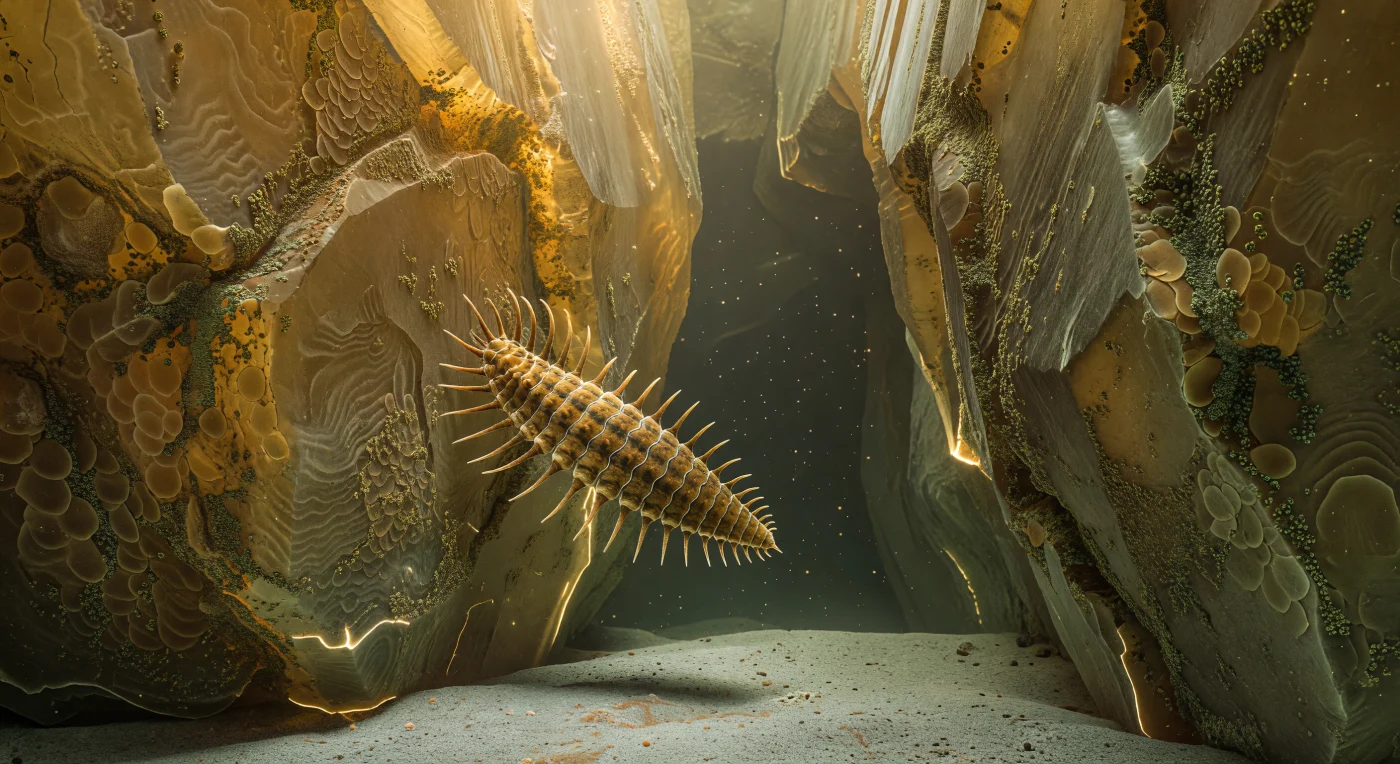
At the entrance to what might be a cathedral nave scaled down to the imperceptible, two massive quartz walls rise on either side — their faces geological in complexity, encrusted with flattened clay platelets like lichen on sandstone, glazed by a tawny-gold biofilm that catches diffuse amber light filtering through the translucent mineral itself. The passage ahead converges into a slot of near-blackness, olive-grey interstitial water filling the throat with faint turbidity, suspended detrital motes catching lateral light like dust frozen mid-fall in an airless room. Pressed against the left wall in the middle ground, a kinorhynch occupies this corridor as both traveler and structural element — its segmented amber-brown cuticle lacquered under rim illumination, each zonite bordered in a paler sclerite edge, while its fully extended introvert splays concentric rings of curved, chitin-tipped scalids directly into the biofilm surface, slightly deforming it, bracing the animal against a grain face the size of a building facade relative to its body. This is a world where gravity has surrendered authority to viscosity and surface tension, where chemical gradients invisible to any larger eye stratify the water column within fractions of a millimeter, and where the architecture of sediment — the pore throats, the biofilm veneers, the menisci seaming grain edges in bright curves — constitutes both landscape and ecological pressure in equal measure.
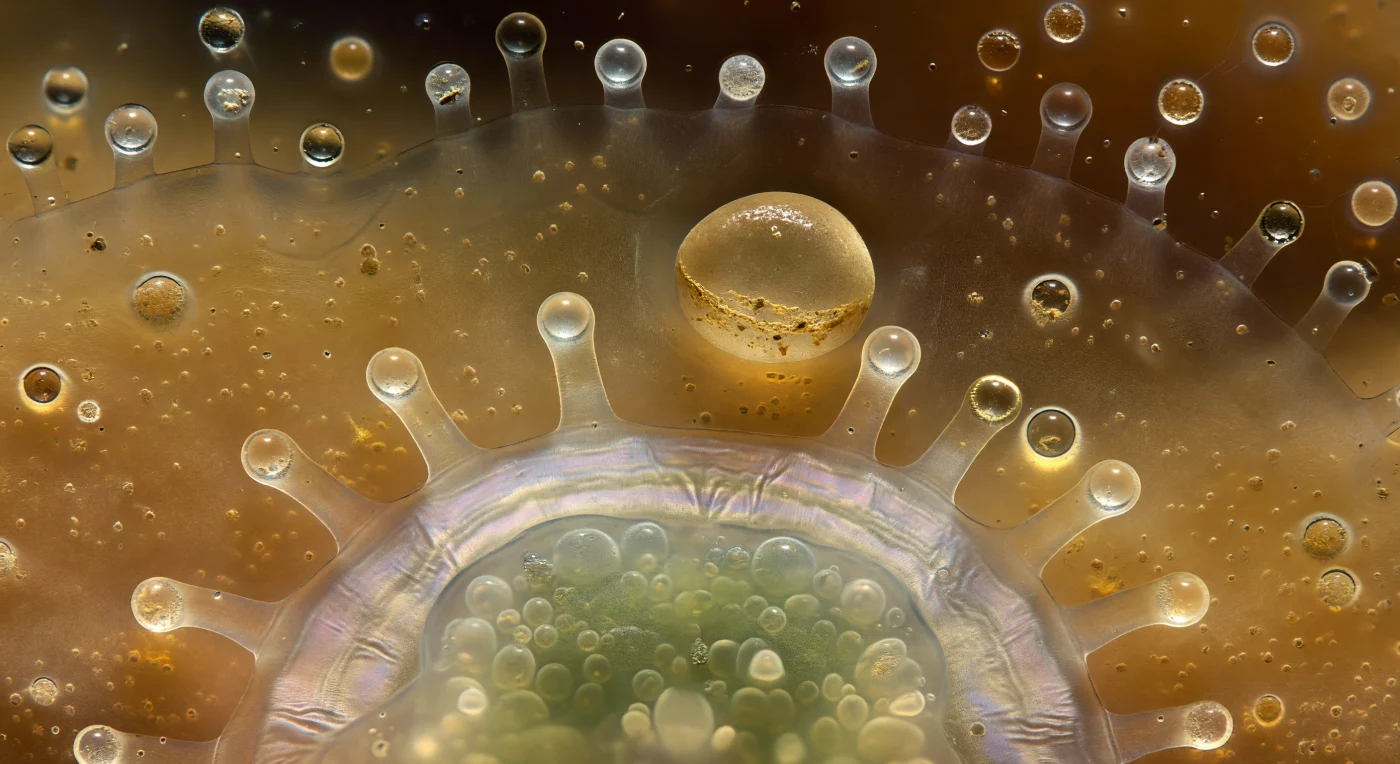
The posterior third of a *Macrodasys* gastrotrich fills the foreground under oblique DIC illumination, its nearly transparent cuticle shimmering with faint iridescent banding — lilac and pale gold — while greenish-gold gut contents glow through the body wall with the luminosity of sea glass held to light. Twelve paired adhesive tubes press fingertip-like against a tawny biofilm floor rich in ochre and burnished rust tones, each tube tip carrying a glistening bioadhesive droplet that functions as a miniature convex lens, warm amber at its base where it meets the extracellular polymer matrix and cold silver at its domed crown where it catches the oblique beam. Where each tube has pressed and released, the EPS is subtly disrupted into pale halos and faint radial creases — a footprint record of a slow, deliberate crossing of a single grain surface, the entire traverse perhaps a few body lengths. Eighty micrometers back in the depth of field, a second quartz grain hangs in soft amber focus, its own biofilm coat a thinner gold veneer interrupted by darker mineral inclusions, while the interstitial water filling the pore throat between the two surfaces announces itself only through a barely perceptible increase in luminous clarity and the perfect, uncollapsed dome geometry of each adhesive droplet — surface tension here a structural force as reliable as any wall.
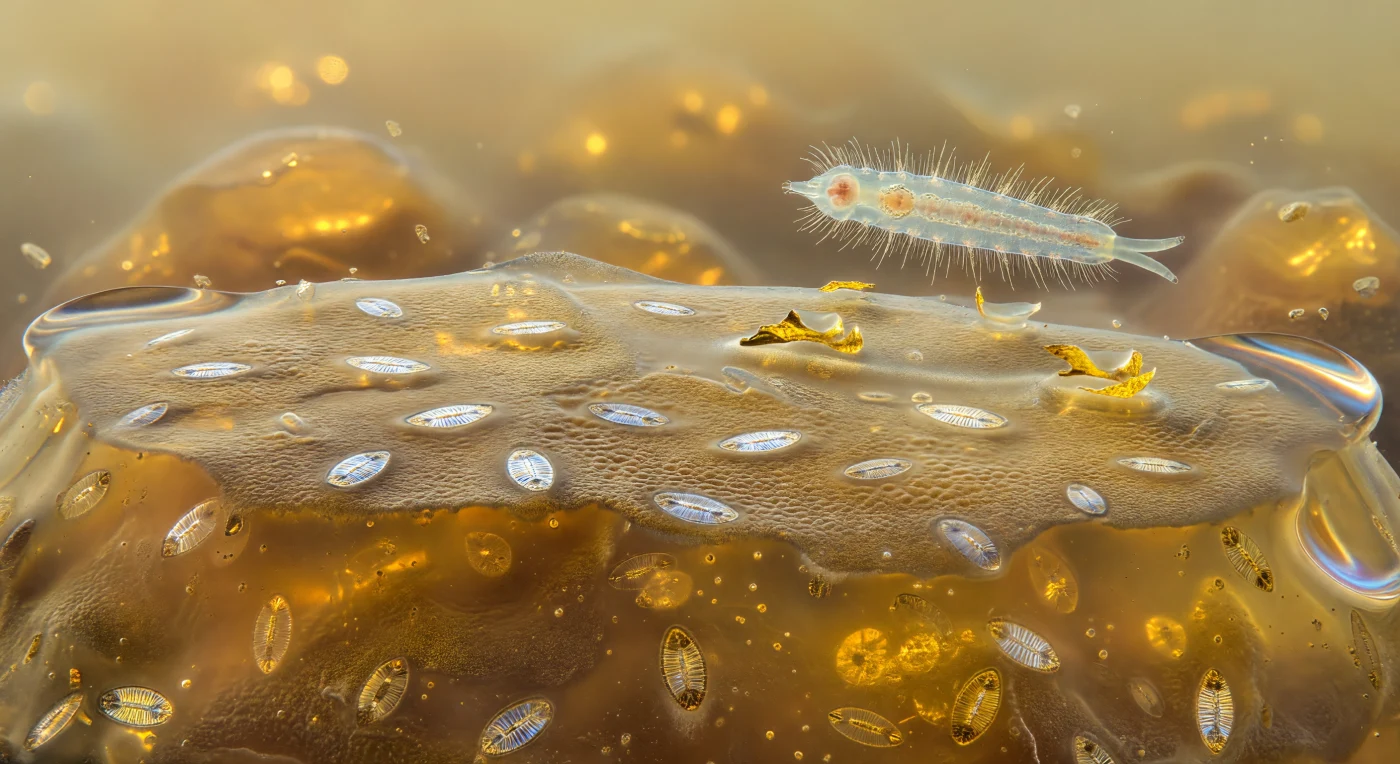
A single quartz grain dominates the view like a vast amber mesa, its translucent interior glowing with warm honeyed light refracted through layers of water and neighbouring grains dissolved into soft luminous boulders at the edges of perception. The grain's upper surface is not bare mineral but a living savanna of EPS biofilm — a gelatinous, gold-brown mat secreted by bacteria and half-buried diatoms, whose silica frustules flash cold geometric light like stained-glass fragments pressed into warm mucilage. Crossing this terrain from the upper right, a gastrotrich moves on two longitudinal bands of ventral cilia, each filament a silver hair caught mid-beat, the organism's transparent cuticle revealing the faint rose-amber shadows of a pulsing tri-radiate pharynx and granular gut within; behind it, two posterior adhesive tubes have just released the biofilm surface, leaving a pair of minute craters in the EPS where the glue-and-release mechanism operated, the mucilage still rebounding at the edges, catching amber backlight like crinkled foil. At this scale, surface tension and viscosity govern all motion — gravity is functionally irrelevant — and the thin concave menisci visible at the frame's periphery, where interstitial water clings to grain edges in faint blue-white curves, are forces powerful enough to trap or fling a body this size during tidal exposure. The entire scene breathes with the slow chemistry of a living sediment: oxygen diffusing downward through microns of overlying water, the biofilm mat metabolising, the gastrotrich grazing a landscape built equally of mineral and life.
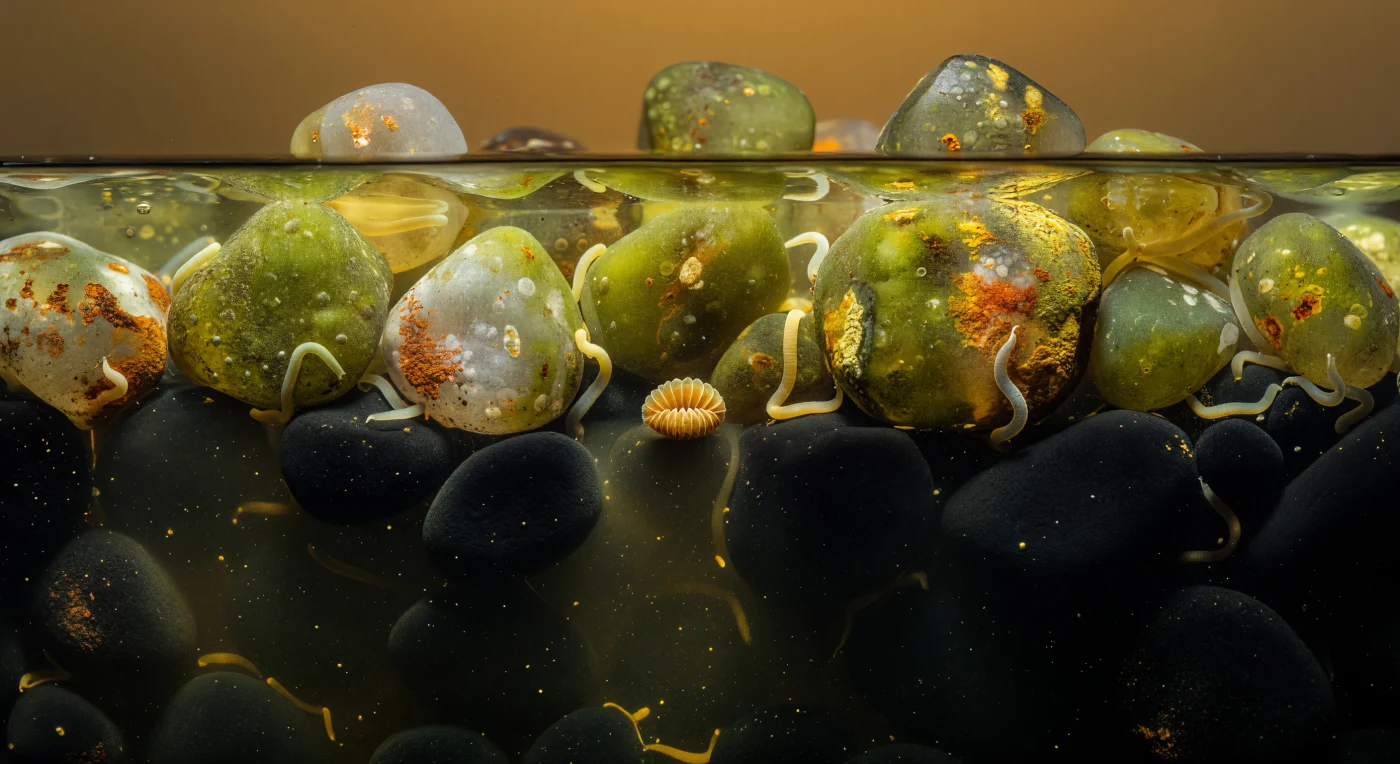
You hover at the edge of a chemical precipice, suspended in crystalline pore water between two irreconcilable worlds, looking down a cliff-face of sand grains that descends within a few hundred microns from teeming amber-lit life into jet-black mineral silence. Behind you, quartz grains the size of office towers carry their golden-green biofilm lacquer — living enamel built from diatoms, bacteria, and extracellular polymer — while nematodes the length of city blocks sinuate through water so oxygen-rich it almost glows; ahead and below, those same grains are coated entirely in iron monosulfide, FeS, a precipitate that absorbs all available light and renders every surface the color of wet coal, the product of sulfate-reducing bacteria exhaling hydrogen sulfide upward through the pore network in a continuous chemical scream. The transition zone between them — a mere two-millimeter band — represents one of the steepest redox gradients on Earth, a compressed geological drama where dissolved oxygen drops to zero, iron and manganese cycle through transitional valences, and biofilms bleach from living gold-green to ashen grey as anaerobic chemistry dismantles the architecture of the upper world. At the exact lip of the black layer, a single loricifera rests curled within its rigid cuticular lorica, overlapping plates sculpted like a miniature armored seed pod, its introvert retracted inward — a member of a phylum unknown to science until 1983, existing here at the boundary between oxygen and oblivion, the last macroscopic life visible before the sulfurous dark below swallows everything.
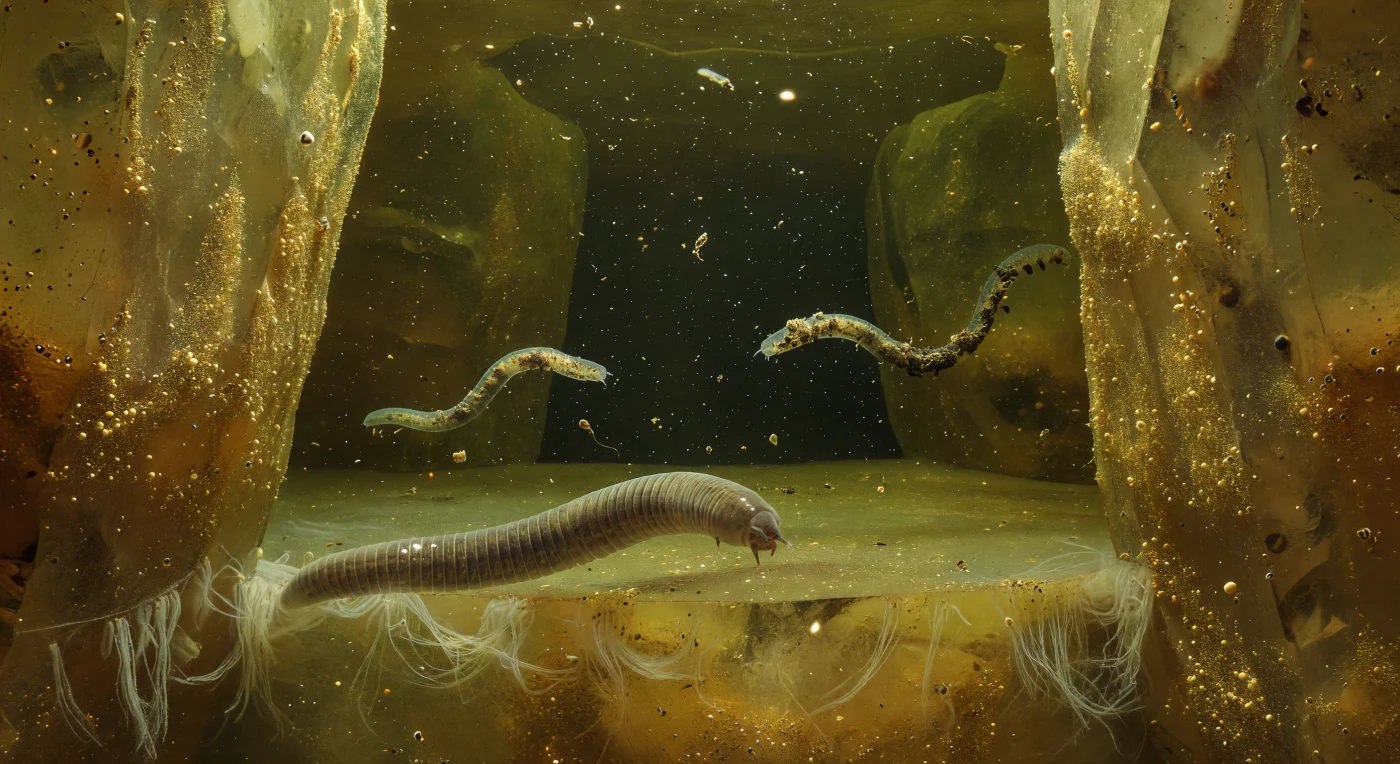
You are suspended inside the sediment itself, enclosed within a vaulted pore space no wider than the period at the end of this sentence — four mineral walls of translucent quartz and feldspar rising on every side, their surfaces crusted in living amber biofilm and draped in pale filamentous mats of sulfur-oxidizing bacteria that sway in the slow hydraulic pulse of tidal water pressing through the sediment column above. Dominating the foreground, a predatory Oncholaimus-type nematode curves through the turbid olive water with the unhurried authority of an apex predator in a closed system, its thick grey-beige cylinder of cuticle catching specular highlights along the dorsal ridge, the faint trilobed shadow of its buccal armature just legible at the blunt anterior tip — a jaw built to pierce and evacuate the body contents of other nematodes. Behind it, two deposit-feeding nematodes move in sinuous arcs, their nearly transparent body walls revealing dark ropes of ingested world: mineral grains, diatom fragments, and compacted bacterial biomass travelling the length of their guts as a slowly moving column of consumed sediment. Through all of this drifts a gentle downward snow of organic detritus — degraded plant matter, bacterial aggregates, and EPS mucus strands — each particle haloed in refracted amber light as it settles through pore water that is itself a living medium, dense with dissolved organics and suspended microbial cells, in a labyrinth that extends infinitely in every direction, one grain diameter at a time.
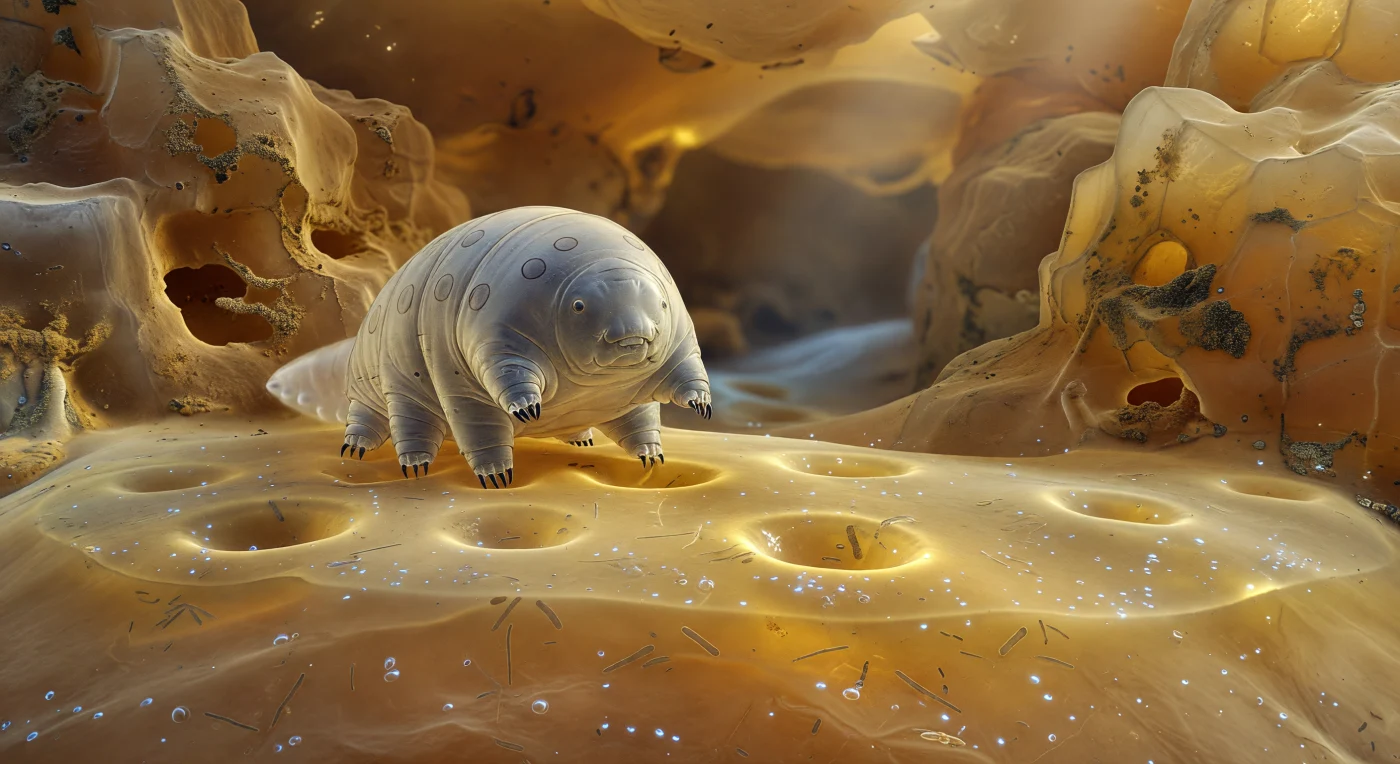
You are crouched at biofilm level, face-to-face with a creature whose barrel-shaped body fills your field of view like a pale luminous boulder — a Stygarctus tardigrade, roughly 400 micrometres long, moving with the unhurried deliberation of something that has never needed to rush. Its semi-transparent grey-blue cuticle reveals faint annular bands of circular musculature beneath, dark hoops visible through the pearl-like integument, while four grounded lobopods compress the amber extracellular polymeric substance layer into shallow craters, each cluster of curved claws sinking into the viscoelastic biofilm gel with the grip of grappling hooks — the claw tips vanishing below the golden meniscus as the EPS deforms and holds. The biofilm itself is the dominant material of this world: a continuous undulating sheet of amber-gold EPS secreted by the resident bacterial and diatom community, its matrix studded with silica diatom frustules that scatter the raking light into pale blue-white glints, while rod-shaped bacteria resolve as dark threads crossing the gel like veins in polished amber. Flanking the tardigrade, two quartz grains rise into the frame like sandstone mesa walls, their conchoidal fracture surfaces rough at this scale, their crests swept translucent caramel where the biofilm thins, while between them a pore-space corridor recedes into cool blue-grey shadow — interstitial water pooling in the throat beyond, a reminder that this gilded, cathedral-like surface opens immediately into a dark labyrinthine architecture of grain and void.
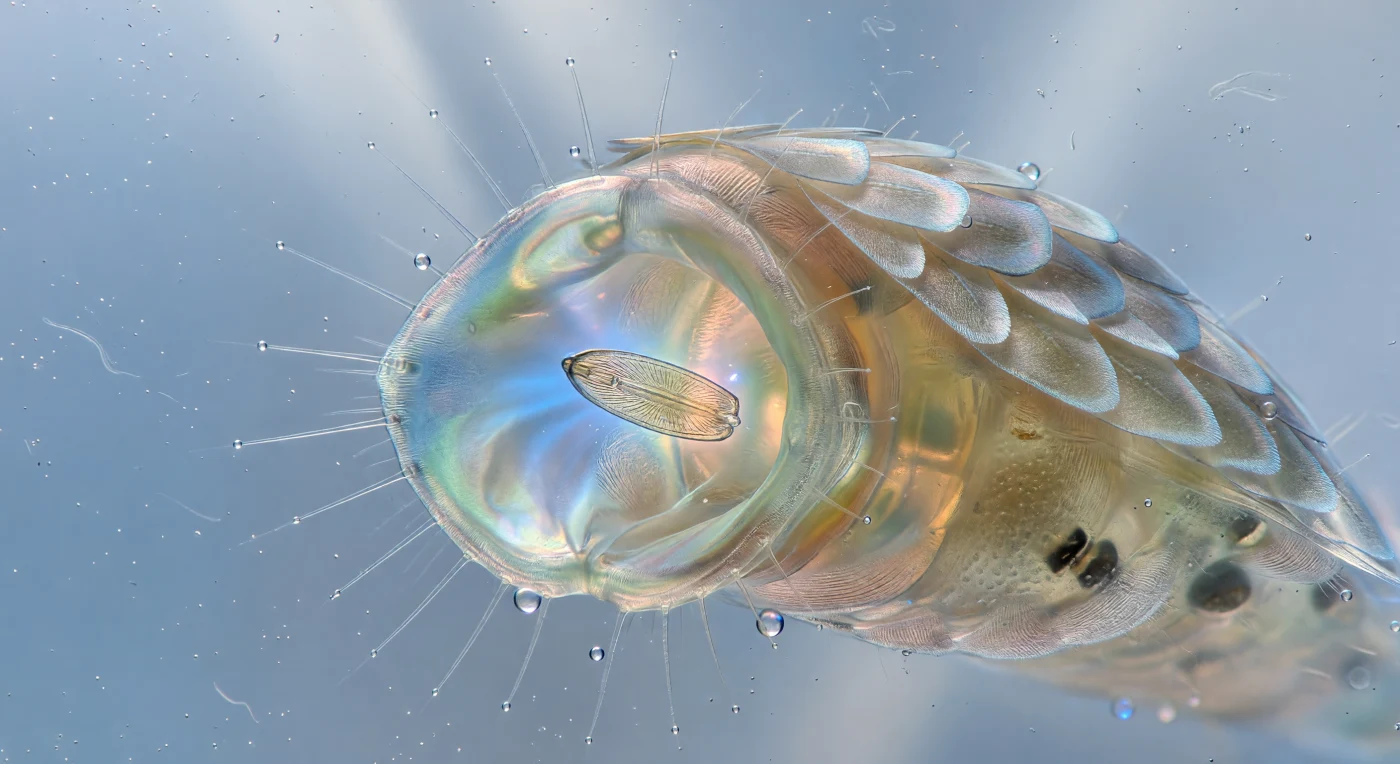
You are hovering microns from the face of an animal that has no right to look this monumental — a Chaetonotus gastrotrich in the act of feeding, its triradiate pharynx wrenched to maximum dilation, three muscular sectors splayed open like the petals of a carnivorous flower to form a triangular aperture barely fifteen microns across, yet framed so closely by transmitted blue-white light that it fills your entire visual field the way a cathedral rose window fills a nave. At the centre of that gape, a Navicula diatom frustule is already half-consumed, its silica hull glowing gold-tan and warm honey, its fine raphe striae still legible along the boat-shaped valve even as one blunt pole vanishes into pharyngeal darkness — a feeding strike unfolding in tens of milliseconds, driven by striated musculature whose tightly packed fibers read as rose-and-silver wood-grain under this collimated illumination, the whole system a pressurized hydrostatic pump refined across five hundred million years of meiofaunal evolution. Encircling the mouth, twenty buccal cilia project outward in a frozen metachronal halo, each hyaline rod tipped with an interstitial water meniscus that refracts the transmitted light into pinprick flares of violet and ice-blue, while behind them the dorsal cuticle recedes in overlapping rhomboid scales whose razor-thin keels produce thin-film interference in cold silver and dilute cobalt — structural iridescence compressed into geometry measured in single microns. The surrounding water is not empty but atmospheric, threaded with bacterial fragments, colloidal EPS strands, and mineral dust drifting like smoke frozen in glass, giving the open space between you and that dilated pharynx a depth and consequence entirely disproportionate to its physical size.
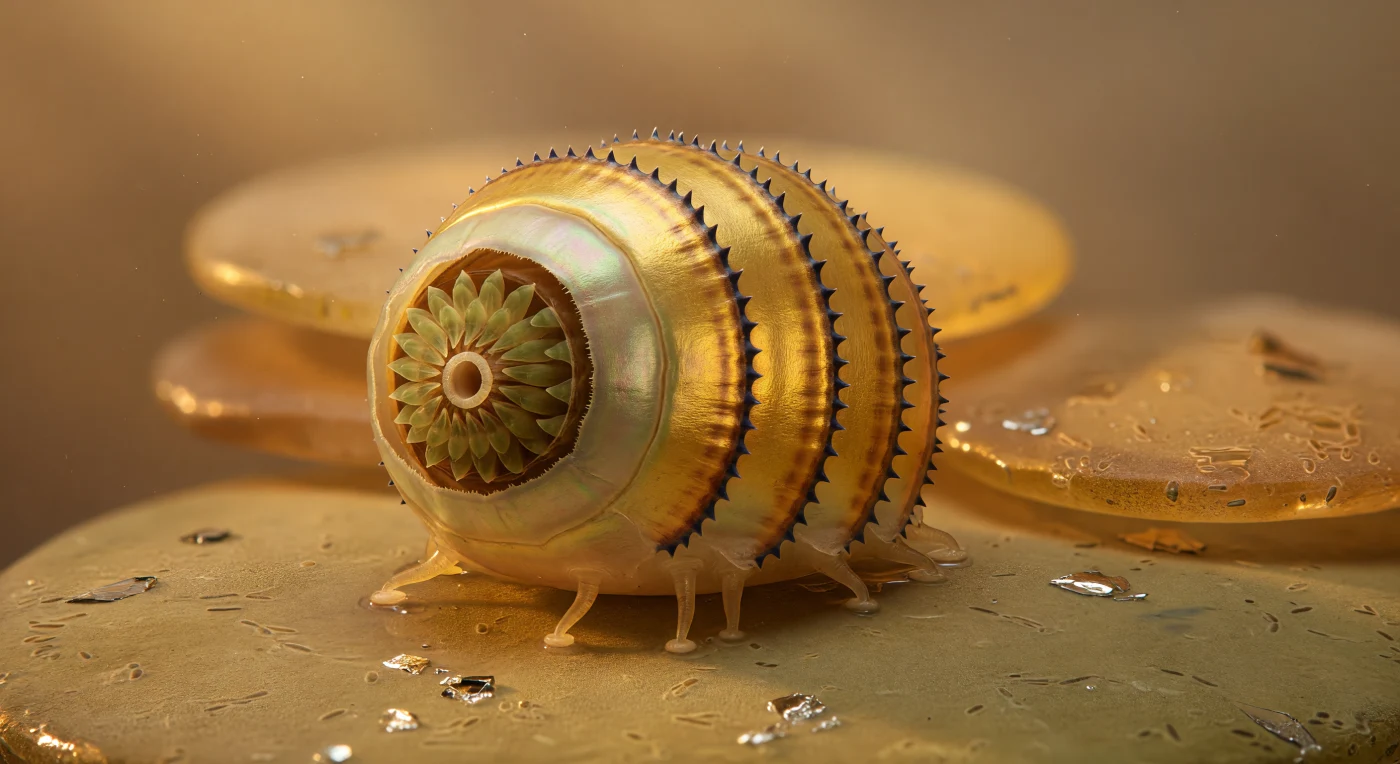
You are suspended at the equator of a single sand grain, face to face with a loriciferan — a creature whose phylum wasn't known to science until 1983, yet whose body plan has been refined across half a billion years of interstitial life. The animal fills your field of view like a barrel-vaulted fortress: six longitudinal lorica plates in deep honey-amber catch the raking oblique light as blazing brass ridges, while the channels between them plunge into mahogany shadow, the serrated overlapping margins casting micro-battlements of ink-blue notches each no wider than a single bacterium. At the anterior pole, the partially withdrawn introvert has bunched its concentric scalid rings into a folded rosette of translucent, chitinous-green spines — sensory and locomotory appendages that, when fully extended, anchor and pull the animal through pore throats barely wider than its own body — while at the base, two pairs of adhesive toes press slender discs flat against the biofilm-coated grain, each toe held in place by the same viscous meniscus forces that, at this scale, rival gravity entirely. The grain surface behind the animal dissolves into caramel bokeh threaded with micro-turbidity, the water column thick enough with dissolved organics and fine particles to read like fog at dusk, and the whole amber cavern carries the weight and silence of a place where surface tension, chemical gradients, and cuticular engineering are the only physics that matter.
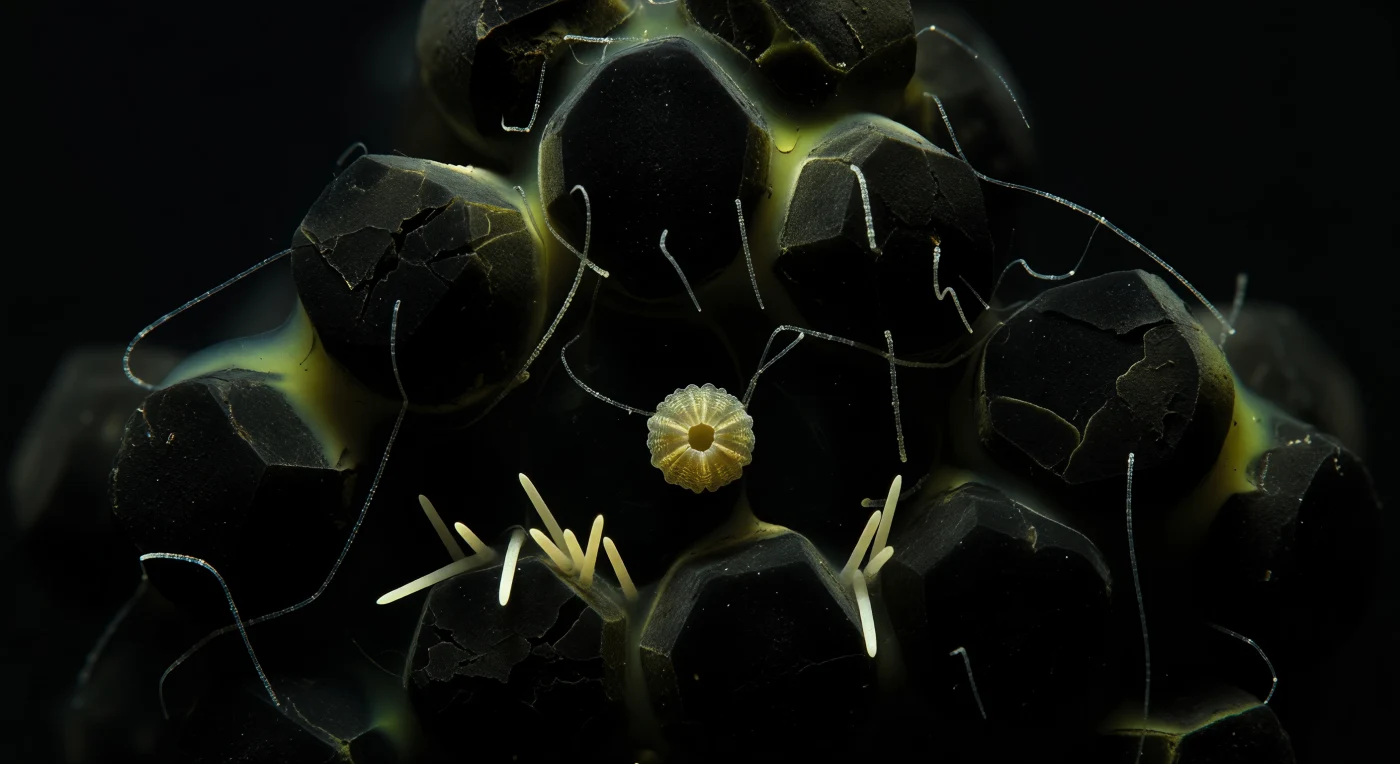
The frame offers almost nothing — a near-total darkness relieved only by the sickly green-yellow seep of polysulfide-saturated pore water pooling in a capillary throat, its color less light than dissolved chemistry made faintly perceptible, and by the white drape of chemosynthetic bacterial filaments — Beggiatoa-like threads a few micrometers wide, their internal sulfur granules lending them a faint, pearl-string opalescence as they hang between FeS-blackened grain surfaces that rise like obsidian monoliths, catching the sulfide tinge only at their sharpest fractured edges before surrendering to void. At absolute scene center, a single loricifera — roughly 200 micrometers from lorica rim to sealed posterior — sits motionless against one such grain, its introvert fully retracted and locked within overlapping cuticular plates whose ridged surfaces catch a diffuse amber halo that represents electrochemical gradient energy rather than any photon, because no photon from any sun has ever reached this anoxic basin floor. Loricifera, one of Earth's most recently discovered animal phyla, are among the only metazoans known to complete their life cycles in permanently sulfidic, oxygen-free sediments, surviving through biochemical strategies — possibly hydrogenosome-like organelles — that render this metabolic impossibility routine. Gypsum needles jut at acute angles from a nearby grain face, their pale CaSO₄ crystalline geometry geologically indifferent to the animal pressed still a grain-length away, the only creature in a world whose entire resolving distance collapses into irretrievable blackness within a single grain-length, where viscosity and chemical gradient are the only forces that matter.
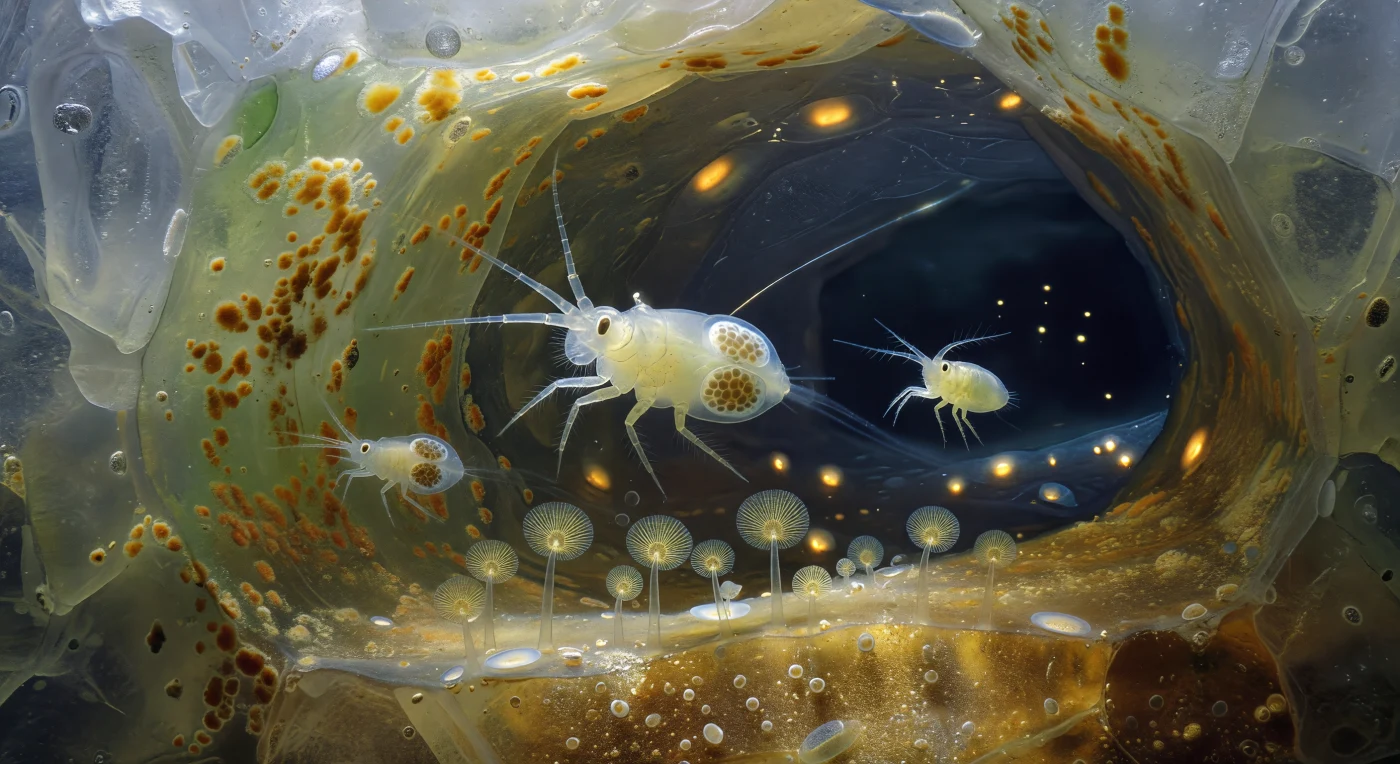
You are suspended inside a pore space barely wider than three copepod bodies — a mineral cathedral whose quartz walls loom like glacial cliffs, their interiors faintly golden-green where refracted light bends through crystalline lattice, their surfaces encrusted with ochre biofilm colonies as intricate as lichen on ancient stone. At the heart of this confined world, a female Tisbe copepod describes looping, unpredictable arcs through the still water, her cream-white body dragging two egg sacs swollen with amber embryos, while behind her a barely-perceptible iridescent shimmer — a molecular thread of sex pheromone lensing the diffuse blue-grey light — betrays the invisible chemistry guiding the smaller, angular male who follows with geniculate antennules locked forward, aesthetasc hairs splayed and trembling as he reads a signal dissolved into water so viscous and still that diffusion, not current, governs every encounter. At this scale, gravity is functionally irrelevant: what rules this world are chemical gradients, surface tension, and the geometry of pore throats that can pinch to near-nothing only a few body-lengths away, making each passage through the sediment matrix a negotiation with the architecture itself. Anchored to the rear grain wall, a grove of stalked Licmophora diatoms fans its pale-gold silica blades into the lateral light, casting Y-shaped shadows down across the glistening EPS biofilm below — a warm, varnished surface alive with bacterial microcolonies, the foundational productivity on which everything in this mineral labyrinth ultimately depends.
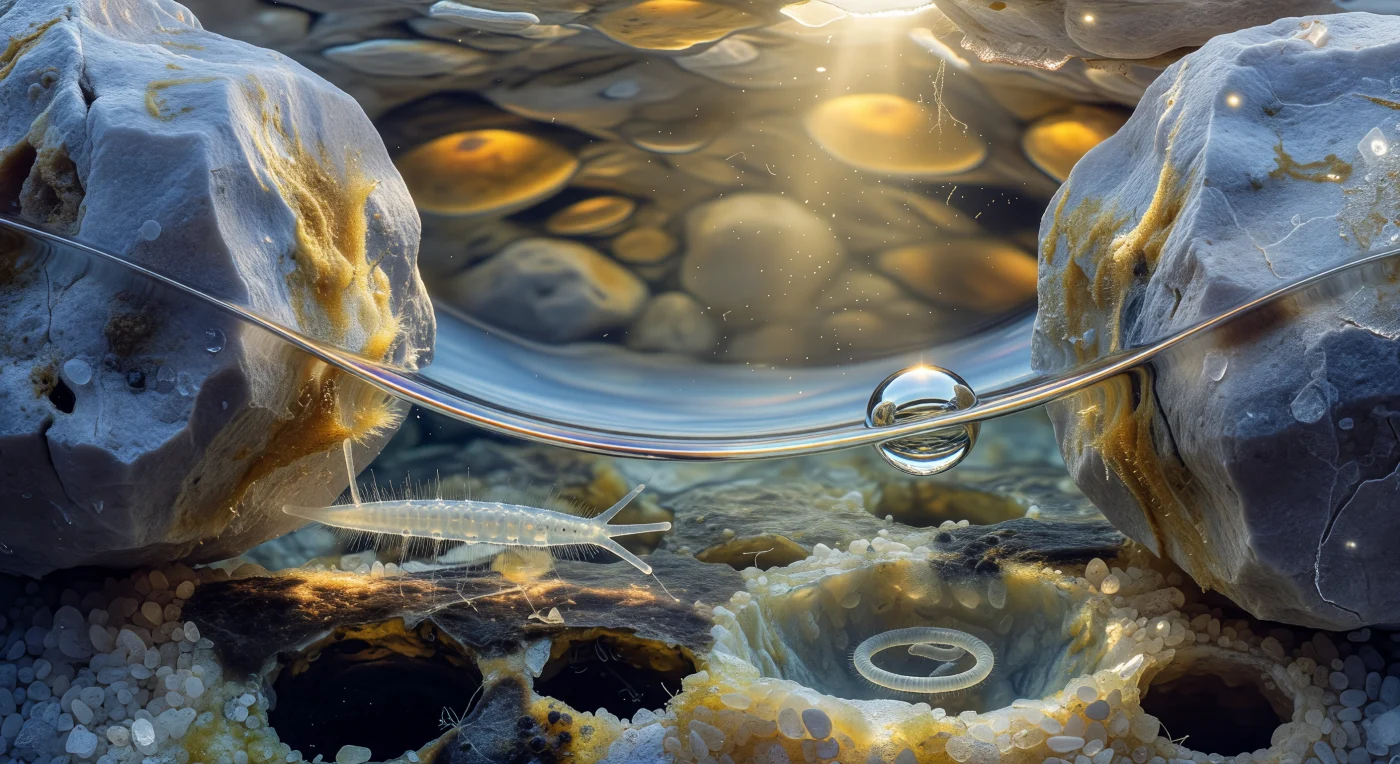
At the precise instant captured here, you are hovering at the eye level of a large gastrotrich inside a partially drained intertidal pore, the grain walls rising around you like bleached limestone cliffs whose surfaces carry amber-gold biofilm veneers and crystalline facets that catch a brutal column of sunlight pouring down through the pore opening above. That retreating meniscus — a concave silver-blue vault arching between two quartz boulders — is no mere water surface but a structural force of enormous consequence at this scale, its surface tension capable of dragging, crushing, or displacing any organism caught along its contact line, which glows now with prismatic violet and copper interference colors marking the exact frontier between the remaining aqueous world and the oxidised air beyond. A spherical fifty-micrometre bubble wedged in the pore throat to the right offers a perfect chrome reflection of the entire scene compressed into a polished sphere — meniscus, light column, grain walls all miniaturised — held in place by the same capillary physics that are forcing the gastrotrich pressed against the left grain to work its posterior adhesive tubes frantically against the biofilm surface, countering the retreating water mass pulling at its body. Meanwhile the nematode coiled in its shallow water-filled depression nearby requires no such effort, its smooth cylindrical body refracting the ambient blue-amber glow in calm contrast, illustrating the radically different survival strategies these two phyla deploy inside an architecture where gravity is irrelevant and surface tension governs everything.
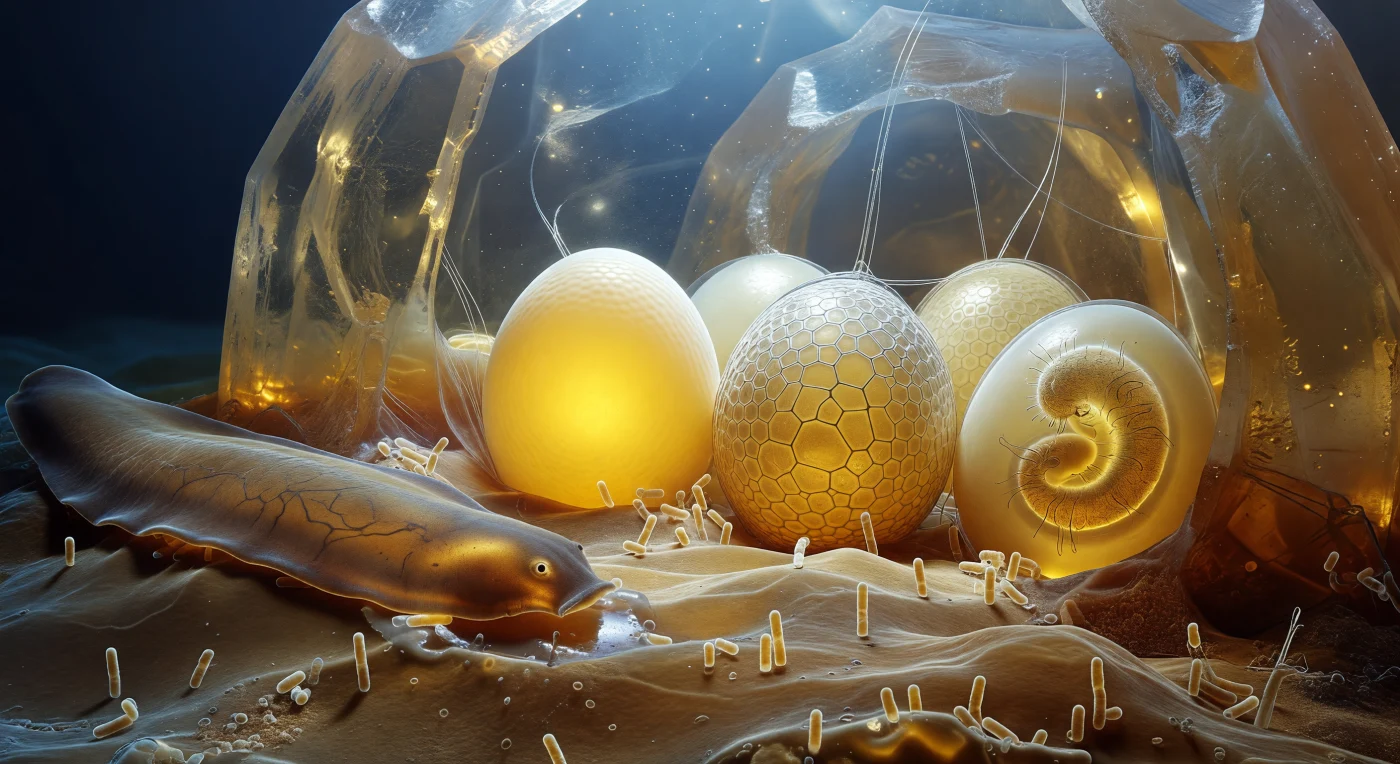
You are pressed against the amber-curved wall of a quartz grain, looking across a biofilm depression where four pale gold eggs rest in their adhesive cradles, each anchored by nearly invisible filaments stretched taut through a landscape of EPS dunes and upright rod bacteria — the eggs enormous at this scale, their hexagonal chorion reticulation catching cold blue-white light filtered up through the grain's translucent interior so that each glows from within like a lantern of honey, the undivided yolk a smooth aureate sphere, the morula beside it fractured into sixteen distinct blastomere compartments separated by dark membrane seams, and the third holding a curled embryo whose nascent pharynx is just legible as an amber thread inside its shell. This clutch represents the entire reproductive output of a hermaphroditic gastrotrich — a simultaneous hermaphrodite capable of self-fertilization, producing only a handful of eggs across a lifespan measured in days, each egg encased in a sculptured chorion that resists desiccation and physical abrasion in a sediment environment where capillary forces and grain collisions are lethal threats. From the left, a turbellarian flatworm advances as a slow brownish landslide, its blunt anterior margin trembling over the biofilm surface, flattening the bacterial nap beneath it, the warm umber opacity of its body a stark contrast to the luminous eggs ahead — between its leading edge and the nearest yolk, the gap is closing, and the slight inward bow of its chemosensory tissue reads as the creature parsing a lipid gradient it has been following through the sediment labyrinth. The pore throat behind the clutch opens into blue-black void, the next chamber of this mineral cathedral, every surface alive with electrochemical negotiation between organisms that have no nervous systems capable of fear but are nonetheless engaged, right now, in the oldest transaction in animal life.
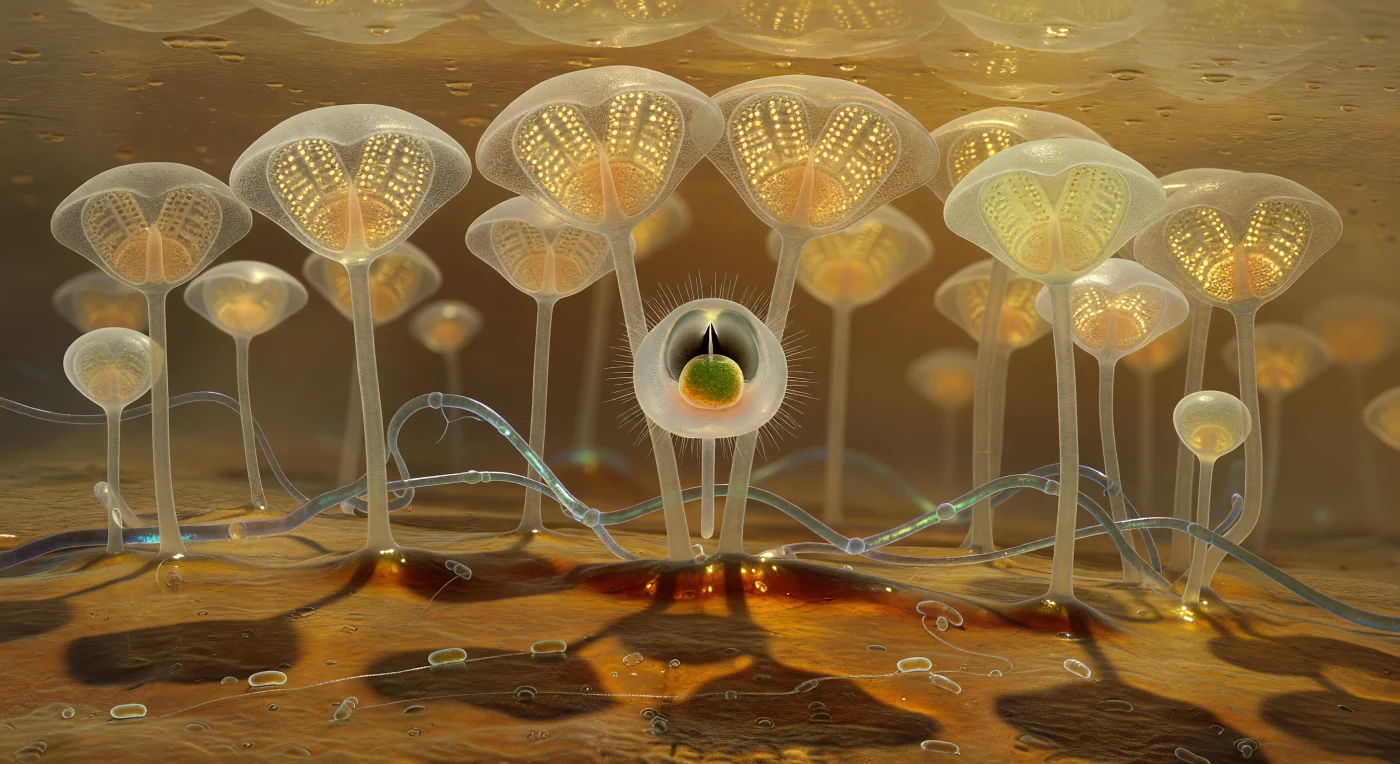
You are hovering at the base of a golden forest, eye-level with the anchoring points of translucent mucilage stalks that rise above you like the pillars of a flooded cathedral, each one crowned by a fan-shaped diatom valve whose silica frustule — etched with rows of submicron pores — blazes amber and frosted-cream where the oblique grain-filtered light catches it, while those facing away cast precise Y-shaped shadows across the lacquered extracellular polymeric substrate beneath your feet, a floor of compacted biological varnish that shifts from transparent amber in thin patches to deep burnt-ochre where the EPS matrix pools into glossy ridges. Pressed between two stalks at mid-canopy height, a Chaetonotus gastrotrich — a complete bilateral animal, organ systems visible through its milky cuticle as through frosted acetate — holds itself braced by posterior adhesive tubes against the torque of active feeding, its triradiate pharynx dilated to maximum aperture around a whole intact diatom cell whose silica valve is caught mid-compression at the buccal opening, the mechanics of ingesting a particle nearly as wide as the predator's own head playing out in a fraction of a second. Cyanobacterial filaments drape between stalk bases in blue-green loops, iridescent where a thin water film renders interference color, and comma-shaped bacteria inscribe glistening mucus trails across the varnish floor below — every surface here is simultaneously architecture, food source, and chemical signal, a world where viscosity and surface tension replace gravity as the governing forces, and where the entire known universe fits within the area of a fingertip pressed lightly into wet sand.
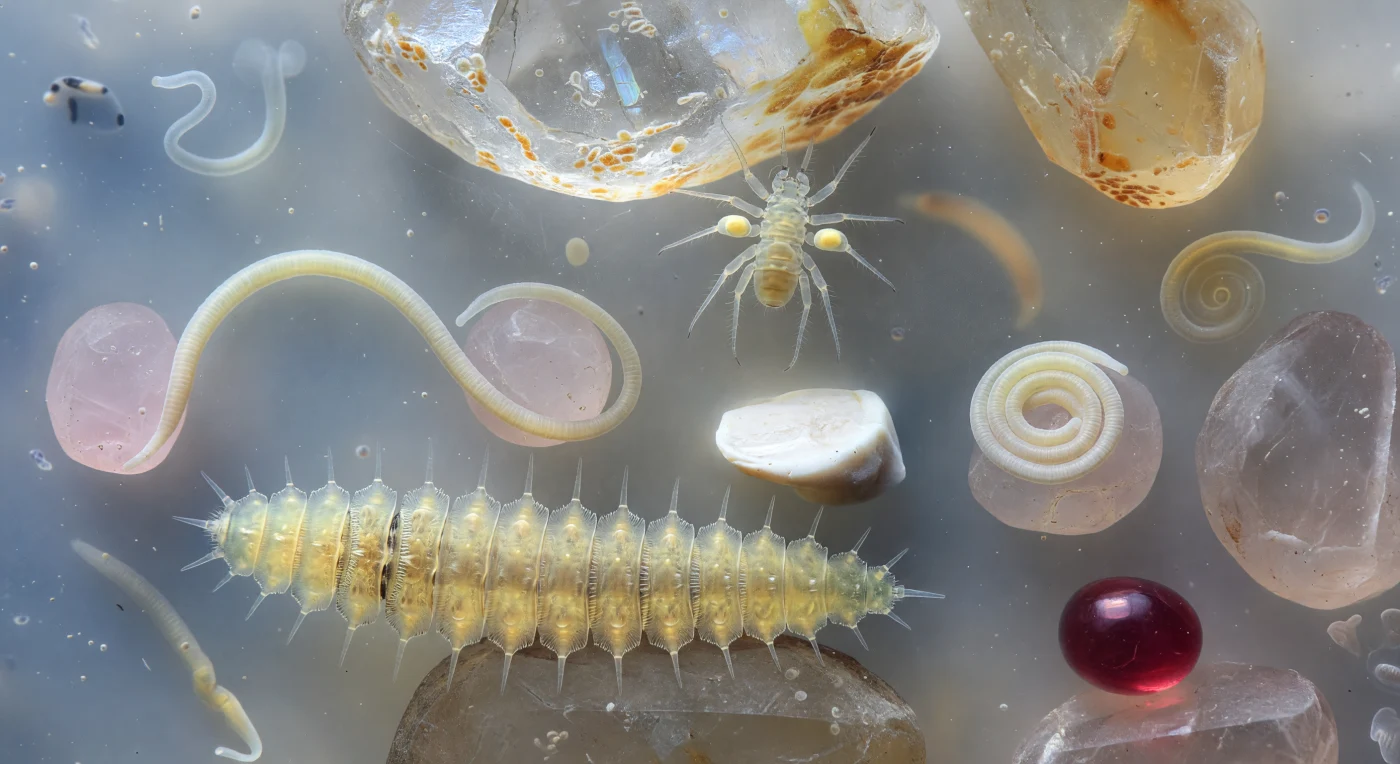
You are suspended inside a world that has no sky — only the curved flanks of mineral boulders receding into turbid blue-grey water, and the amber hull of a kinorhynch filling your entire field of view like an armored leviathan whose thirteen articulated zonites, each edged in paired lateral spines, constitute the dominant architecture of your horizon. This animal, measuring perhaps half a millimetre in reality, belongs to a phylum so ancient and architecturally intricate that its cuticular sclerites must be shed and rebuilt at every moult, each segment a precise interlocking plate of hardened cuticle — a biological engineering solution older than the first forests. Around it, nematodes that number in the millions per square metre of sediment below your feet pursue parallel existences in separate pore spaces: one pressed sinuously against a feldspar cleavage face in mid-undulation, another coiled in metabolic patience around a second grain, their unsegmented bodies exploiting a viscosity-dominated fluid regime where inertia is nearly meaningless and every movement is a negotiation with the water itself. A harpacticoid copepod hovers above them in a wider void, its biramous swimming legs extended in full fan, egg sacs swollen at its urosome, while behind all of them the pore water's colloidal haze dissolves further organisms into luminous suggestion — ghost ribbons and blurred curves hinting at the extraordinary density of metazoan life packed into what a human hand would register as a pinch of grey sand.