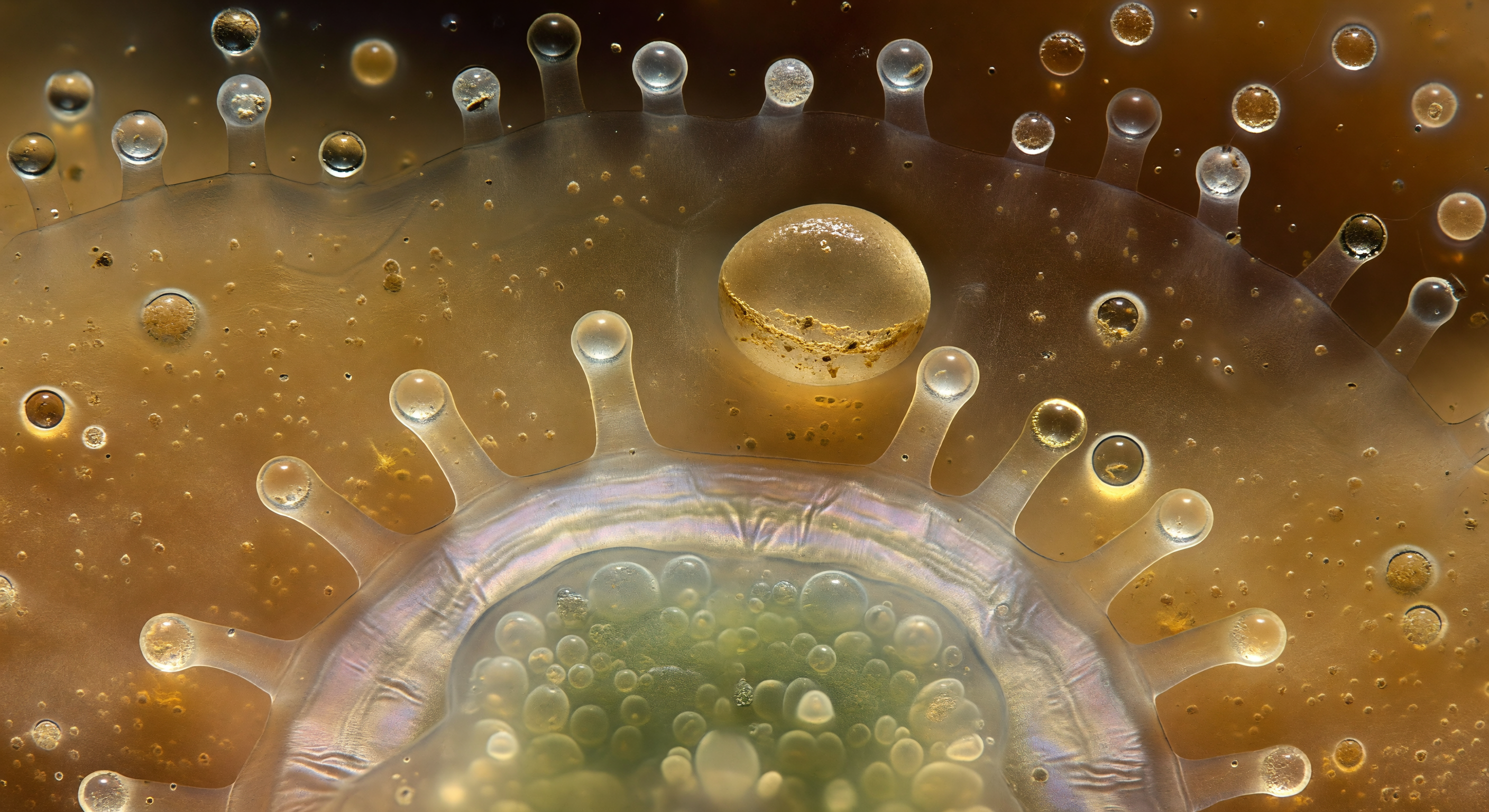
The posterior third of a *Macrodasys* gastrotrich fills the foreground under oblique DIC illumination, its nearly transparent cuticle shimmering with faint iridescent banding — lilac and pale gold — while greenish-gold gut contents glow through the body wall with the luminosity of sea glass held to light. Twelve paired adhesive tubes press fingertip-like against a tawny biofilm floor rich in ochre and burnished rust tones, each tube tip carrying a glistening bioadhesive droplet that functions as a miniature convex lens, warm amber at its base where it meets the extracellular polymer matrix and cold silver at its domed crown where it catches the oblique beam. Where each tube has pressed and released, the EPS is subtly disrupted into pale halos and faint radial creases — a footprint record of a slow, deliberate crossing of a single grain surface, the entire traverse perhaps a few body lengths. Eighty micrometers back in the depth of field, a second quartz grain hangs in soft amber focus, its own biofilm coat a thinner gold veneer interrupted by darker mineral inclusions, while the interstitial water filling the pore throat between the two surfaces announces itself only through a barely perceptible increase in luminous clarity and the perfect, uncollapsed dome geometry of each adhesive droplet — surface tension here a structural force as reliable as any wall.
Other languages
- Français: Tubes adhésifs en gros plan
- Español: Tubos adhesivos en primer plano
- Português: Tubos adesivos em close-up
- Deutsch: Haftröhren Nahaufnahme
- العربية: أنابيب لاصقة عن قرب
- हिन्दी: चिपकने वाली नली का क्लोज़-अप
- 日本語: 粘着管の接着クローズアップ
- 한국어: 점착관 고정 접사 촬영
- Italiano: Tubi adesivi in primo piano
- Nederlands: Hechtbuizen verankering close-up