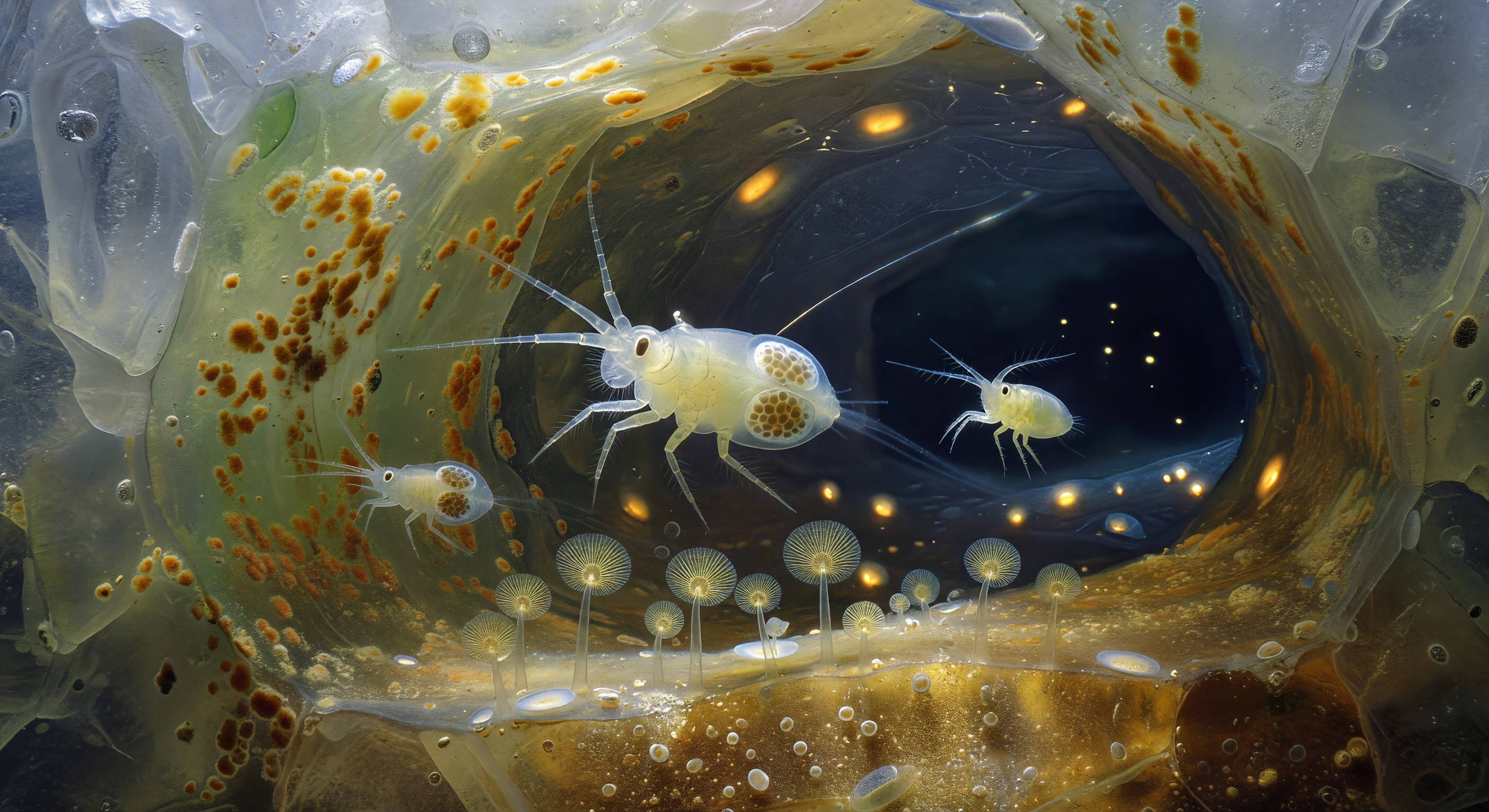
You are suspended inside a pore space barely wider than three copepod bodies — a mineral cathedral whose quartz walls loom like glacial cliffs, their interiors faintly golden-green where refracted light bends through crystalline lattice, their surfaces encrusted with ochre biofilm colonies as intricate as lichen on ancient stone. At the heart of this confined world, a female Tisbe copepod describes looping, unpredictable arcs through the still water, her cream-white body dragging two egg sacs swollen with amber embryos, while behind her a barely-perceptible iridescent shimmer — a molecular thread of sex pheromone lensing the diffuse blue-grey light — betrays the invisible chemistry guiding the smaller, angular male who follows with geniculate antennules locked forward, aesthetasc hairs splayed and trembling as he reads a signal dissolved into water so viscous and still that diffusion, not current, governs every encounter. At this scale, gravity is functionally irrelevant: what rules this world are chemical gradients, surface tension, and the geometry of pore throats that can pinch to near-nothing only a few body-lengths away, making each passage through the sediment matrix a negotiation with the architecture itself. Anchored to the rear grain wall, a grove of stalked Licmophora diatoms fans its pale-gold silica blades into the lateral light, casting Y-shaped shadows down across the glistening EPS biofilm below — a warm, varnished surface alive with bacterial microcolonies, the foundational productivity on which everything in this mineral labyrinth ultimately depends.
Other languages
- Français: Poursuite Phéromonale de Copépode
- Español: Persecución Feromonal de Copépodo
- Português: Perseguição Feromonal de Copépode
- Deutsch: Harpacticoide Kopepode Pheromonjagd
- العربية: مطاردة فيرومون القشريات الصغيرة
- हिन्दी: कोपेपॉड फेरोमोन पीछा
- 日本語: カイアシ類フェロモン追跡
- 한국어: 요각류 페로몬 추적
- Italiano: Inseguimento Ferormonale di Copepode
- Nederlands: Harpacticoide Copepode Feromoonachtervolging