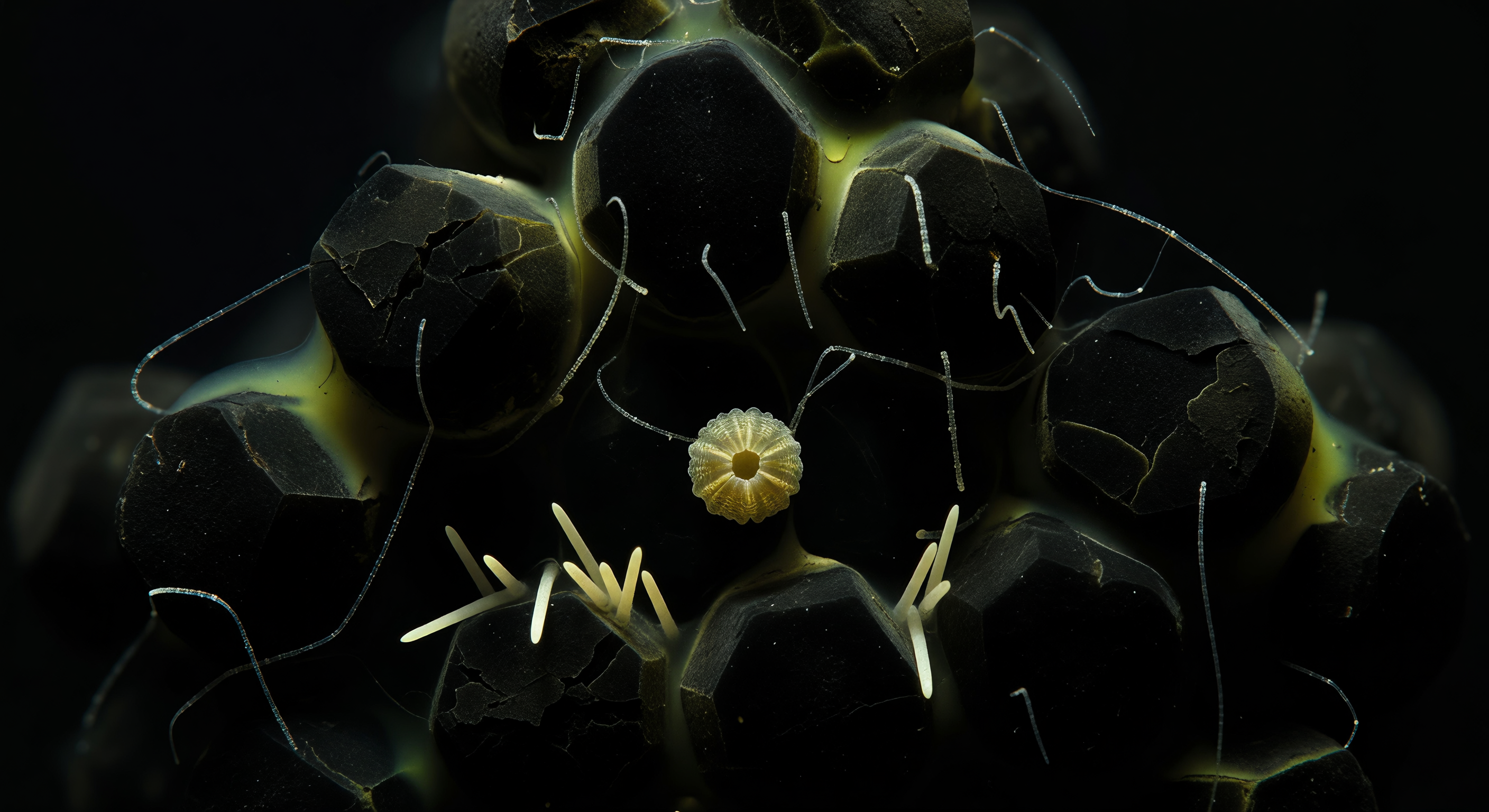
The frame offers almost nothing — a near-total darkness relieved only by the sickly green-yellow seep of polysulfide-saturated pore water pooling in a capillary throat, its color less light than dissolved chemistry made faintly perceptible, and by the white drape of chemosynthetic bacterial filaments — Beggiatoa-like threads a few micrometers wide, their internal sulfur granules lending them a faint, pearl-string opalescence as they hang between FeS-blackened grain surfaces that rise like obsidian monoliths, catching the sulfide tinge only at their sharpest fractured edges before surrendering to void. At absolute scene center, a single loricifera — roughly 200 micrometers from lorica rim to sealed posterior — sits motionless against one such grain, its introvert fully retracted and locked within overlapping cuticular plates whose ridged surfaces catch a diffuse amber halo that represents electrochemical gradient energy rather than any photon, because no photon from any sun has ever reached this anoxic basin floor. Loricifera, one of Earth's most recently discovered animal phyla, are among the only metazoans known to complete their life cycles in permanently sulfidic, oxygen-free sediments, surviving through biochemical strategies — possibly hydrogenosome-like organelles — that render this metabolic impossibility routine. Gypsum needles jut at acute angles from a nearby grain face, their pale CaSO₄ crystalline geometry geologically indifferent to the animal pressed still a grain-length away, the only creature in a world whose entire resolving distance collapses into irretrievable blackness within a single grain-length, where viscosity and chemical gradient are the only forces that matter.
Other languages
- Français: Loricifera dans l'abîsse anoxique
- Español: Loricifera en cuenca anóxica oscura
- Português: Loricifera na escuridão anóxica
- Deutsch: Loricifera im anoxischen Dunkel
- العربية: لوريسيفيرا في الظلام اللاهوائي
- हिन्दी: अनॉक्सिक गहराई में लोरिसिफेरा
- 日本語: 無酸素の闇のロリシフェラ
- 한국어: 무산소 심연의 로리시페라
- Italiano: Loricifera nel buio anossico
- Nederlands: Loricifera in anoxische duisternis