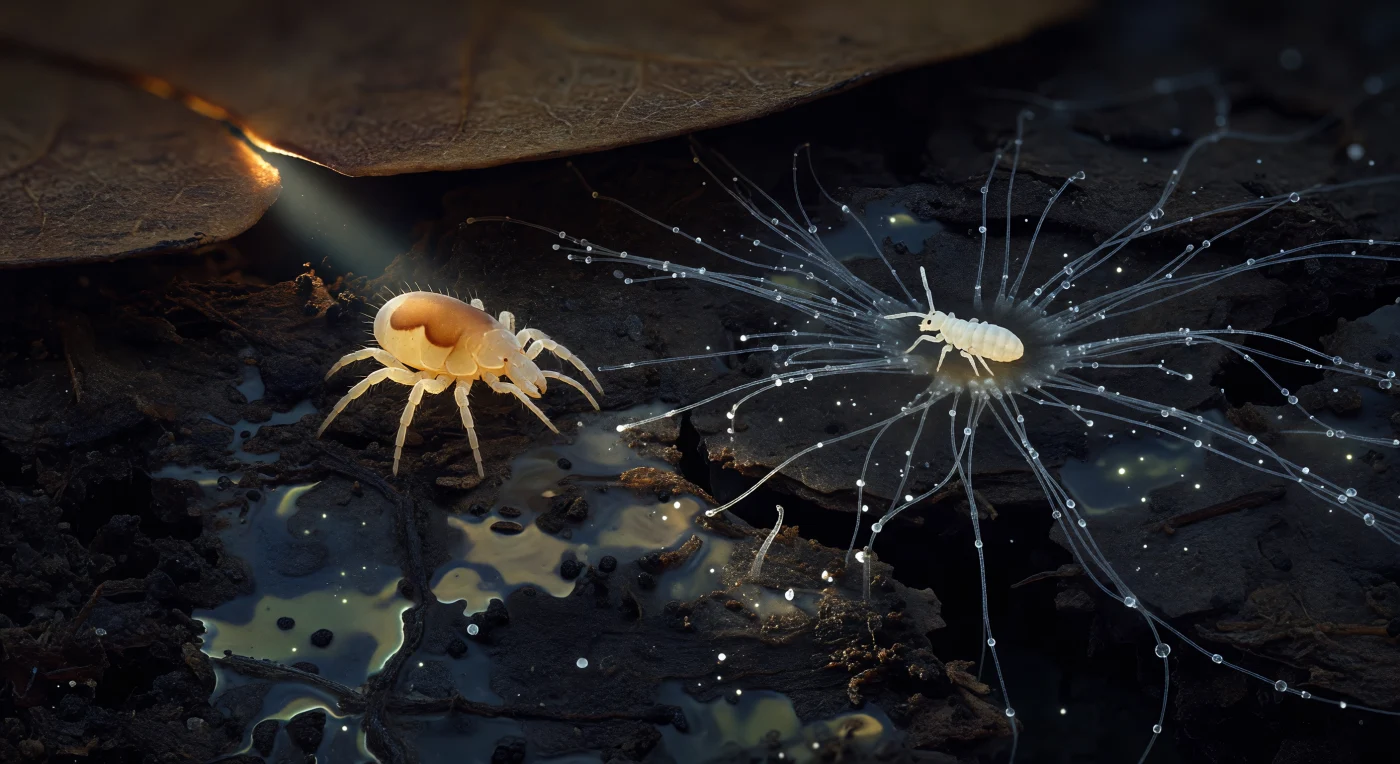
The viewer enters from low and behind, almost flush with the surface of the dark humus, peering along the advancing body of a pale amber predatory mite — a Hypoaspis — whose leathery dorsal shield catches a single lateral razor of light filtering through a crack in decomposing leaf litter above, glowing like polished butterscotch resin against the near-black substrate. Its elongated gnathosoma projects forward like an ivory probe, chemosensory setae lit as luminous filaments, while its eight clawed legs grip the granular terrain of compressed fungal melanin, leaf polymers, and mineral grains coated in a bacterial biofilm that refracts the sparse light into ghostly iridescent patches of blue-green and faint gold — oil on dark water, spread across what at this scale reads as an immense open plain governed entirely by surface tension and capillary force rather than gravity. Ten body-lengths ahead — a vast charged gulf of deep shadow — a cream-white Folsomia springtail grazes obliviously on a spreading colony of cotton-white fungal mycelium, its segmented body glowing softly like carved ivory, antennae probing the semi-translucent hyphal cables beaded with microscopic water droplets that scatter dim ambient light into cold white pinpoints, its furcula folded tight beneath its abdomen as a compressed arc of stored kinetic energy, one triggering instant away from a leap that would carry it one hundred body-lengths clear of this scene. The whole encounter is a frozen biological inevitability: predator closing, prey unaware, the gap between them a dark arena of chemical gradient, iridescent biofilm, and absolute silence.
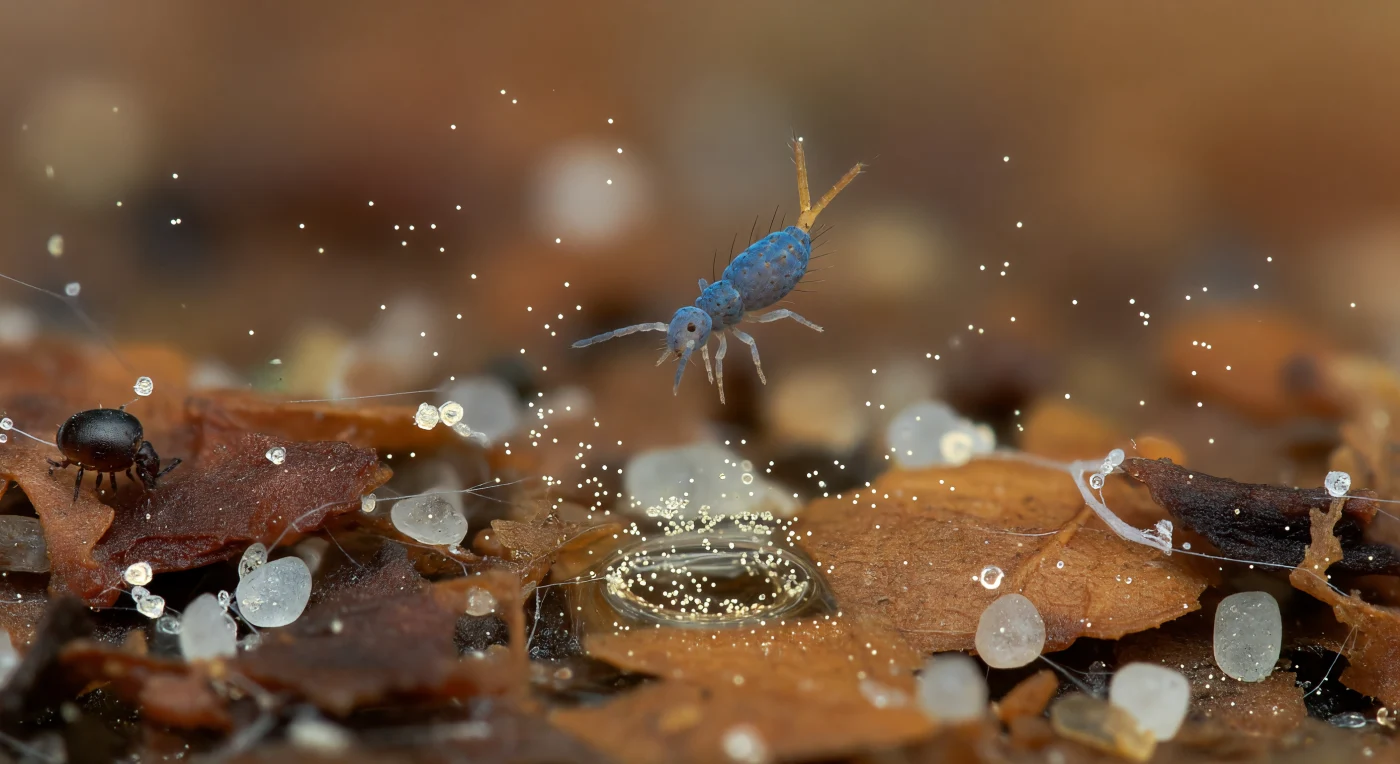
Suspended in the amber dark of the litter layer, an iridescent blue-gray springtail hangs at the precise millisecond of its escape — furcula still extended, body beginning its forward arc, six threadlike legs splayed outward as though startled by their own sudden freedom. The furcula itself, a translucent chitinous fork locked until this instant beneath a catch called the tenaculum, has just delivered its mechanical verdict: a release so fast — completed in under two milliseconds — that it ranks among the most violent accelerations in the biological world, launching a body of barely one milligram across a distance equivalent to a human clearing a twenty-story building. Below, the substrate dissolves into warm bokeh — compressed oak litter in burnt sienna and tobacco brown, pale quartz grains transmitting cool interior light, white mycelial cables strung taut between leaf fragments — and where the springtail's ventral collophore last pressed the surface, a halo of fungal spores drifts outward, each oblate sphere two to five micrometers across, catching the single cool shaft of cellulose-filtered daylight as pale gold motes. At the left edge of frame, barely resolved, a polished mahogany oribatid mite anchors the scene in ecology: these two animals share the same cathedral of decaying matter, one armored and deliberate, the other already gone.
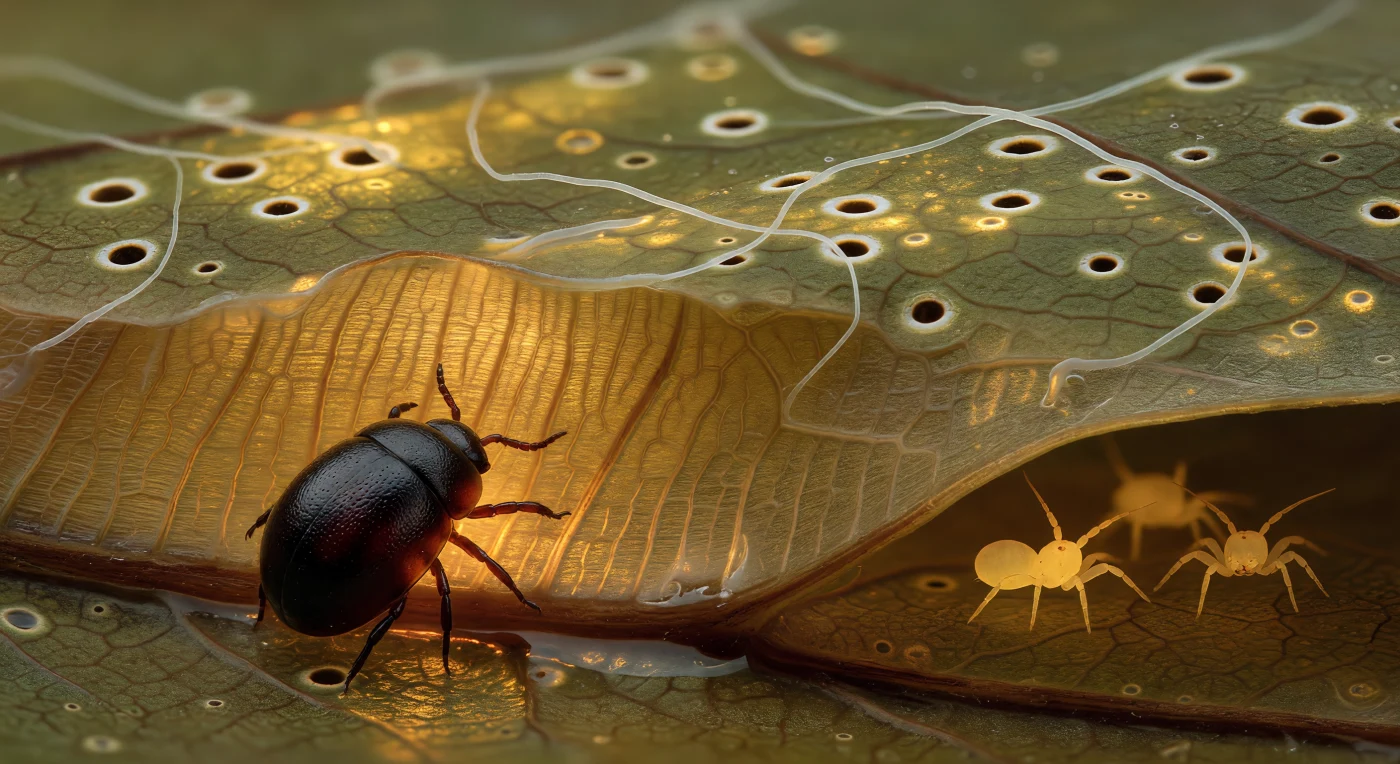
Behind the domed creature's lacquered mahogany-black notogaster — every microsculptured pit and polished facet rendered in crystalline precision — a towering ridge of compressed amber cellulose rises like a sheer geological escarpment, its parallel fiber striations glowing faintly ochre-gold where the tissue has thinned to near-transparency, backlit by daylight bleeding through the partially decomposed oak lamina below. The oribatid mite braces its four right-side legs against the vein's steep flank, hooked pretarsal claws locked into surface microstructure, each limb a dark amber thread no thicker than a silk strand — a creature whose heavily sclerotized exoskeleton evolved precisely for this kind of grinding, armored passage through leaf litter architecture, its notogaster a dome of chitin so hardened it resists compression, fungal enzymes, and the crushing weight of soil aggregates alike. Beyond the vein's crest, a vast translucent plateau opens into a landscape of stomatal pits gaping like open manholes, their guard-cell rims catching the backlight as pale ivory crescents, while fungal hyphae — five to ten micrometres across — stretch as slack pearl-white cables between surface irregularities, the dominant threads of a hidden decomposer network that these animals both navigate and consume. In the cool amber shadow beneath the vein's overhang, two pale prostigmata mites linger in soft focus, their creamy soft-shelled bodies and splayed legs barely resolved against the warm dark, dissolved into a world where surface tension and capillary adhesion govern every movement, every gleam of transmitted light, and every fragile contact between cuticle and the water film coating all things at this scale.
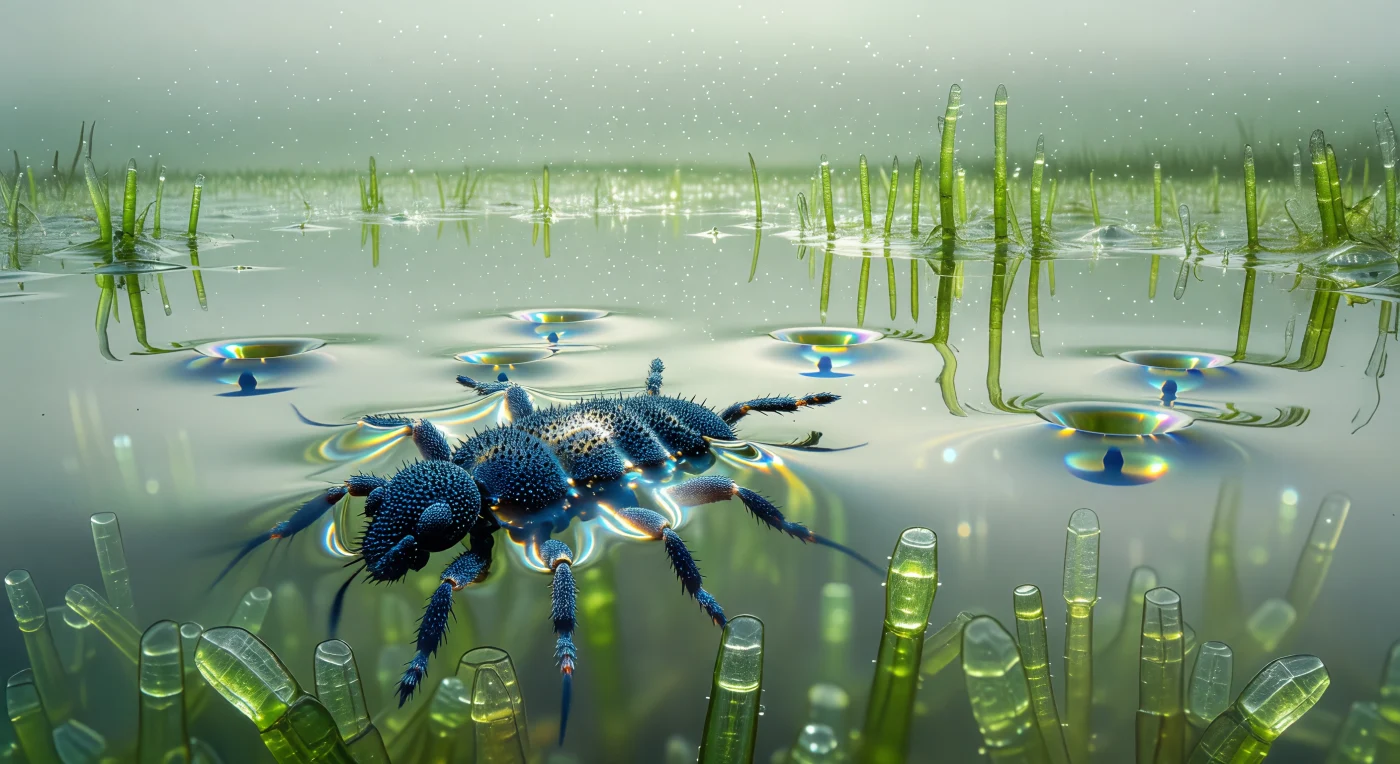
You are suspended at the level of the water's skin, eye-point a whisper above the mirror, looking across a flooded Sphagnum plain toward a creature that, from here, has the presence and mass of a dark boulder — *Podura aquatica*, a springtail barely a millimeter long, rendered enormous and geological by the intimacy of the vantage. Its cuticle resolves into a dense mosaic of granular micro-pillars, hammered obsidian catching diffuse green-white light, while around every contour of that body trembles the plastron: a continuous trapped-air film that reads as liquid silver and pale mercury, a physical consequence of the cuticle's hydrophobic nano-architecture preventing the water from collapsing inward and drowning the animal it sheathes. The water surface between you and the animal is not passive backdrop but a tensioned architectural membrane — an elastic film held taut by hydrogen-bond cohesion at roughly 72 millinewtons per meter — each of the six leg-contact points dimpling it into a smooth concave crater whose sloped walls refract diffuse daylight into faint prismatic rings, the shadow of each crater stretching long and blue across the silver-green mirror below like craters on a still lake seen from low orbit. Beneath that membrane, submerged Sphagnum hyaline cells — large, dead, water-storing chambers that give the moss its unmatched hydraulic capacity — glow jade and chartreuse like stained-glass lanterns set into a flooded cathedral floor, their reflection rising perfectly into the air above so that stem and mirror-image merge at the interface in seamless bilateral symmetry. Everything is frozen in the razor-still instant before the furcula fires, before the plastron shatters, before the mirror breaks.
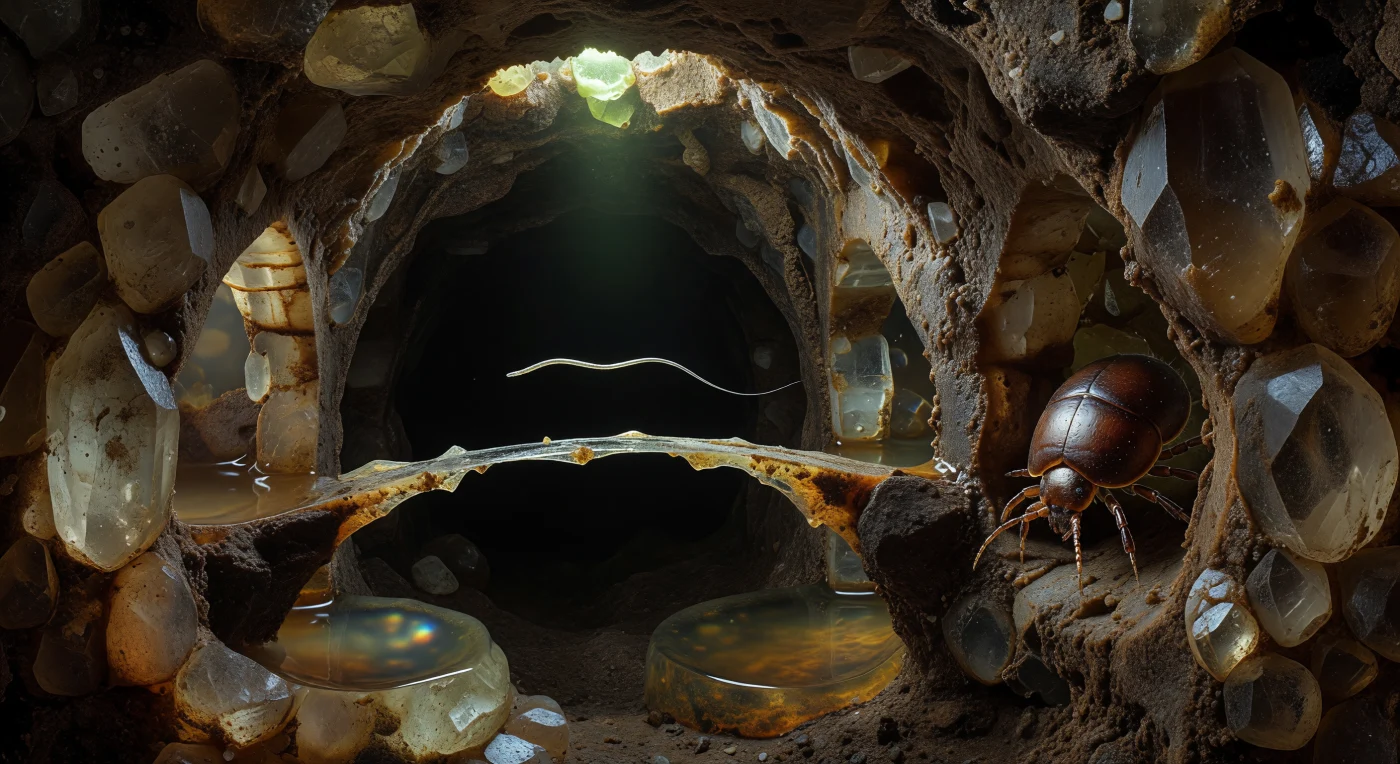
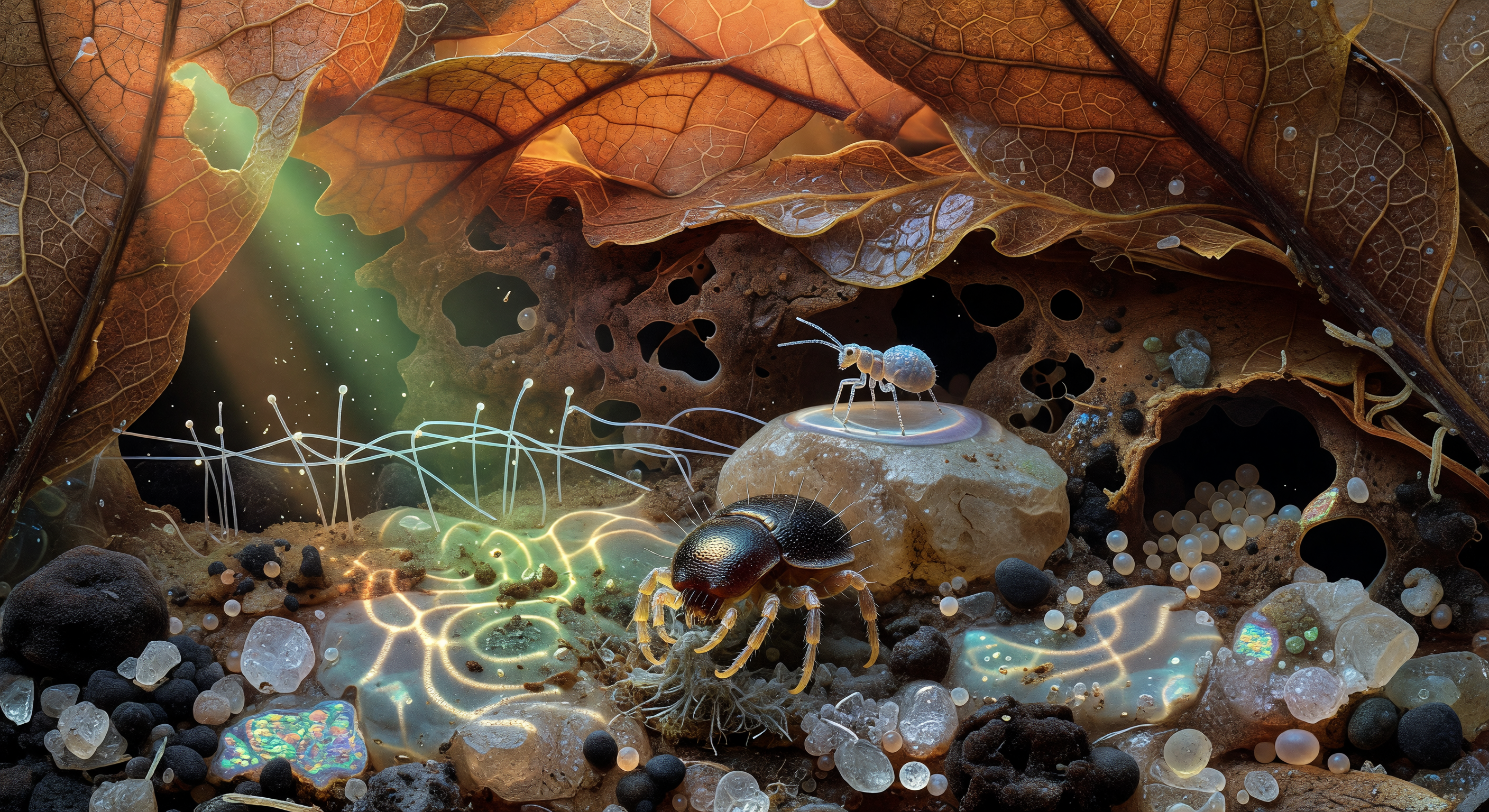
You are suspended inside a gothic vault of compressed mineral darkness, five centimeters beneath the forest floor, where no light has reached in weeks — a single pale thread filtering down from a distant pore opening above being the only evidence that a world exists beyond this chamber. The walls enclosing you are angular quartz grains the scale of apartment buildings, their fractured faces lacquered in clay minerals and humic colloids that transform raw geology into something resembling varnished bone, while papery clay-humus bridges arch between them, trembling with the physics of surface tension rather than any wind. To your right, an oribatid mite — its sclerotized notogaster a deep mahogany gloss, its eight legs working independently against a colloid-filmed wall — squeezes through a bottleneck pore measured precisely to its own body width, pretarsal claws leaving invisible micro-scratches as it navigates a passage that reads less like locomotion and more like a tank threading a doorframe. Deeper in the void, a nematode filament hangs suspended in a meniscus bridge stretched between two quartz faces, its body transmitting that single overhead light internally like a fiber-optic thread — pale silver against absolute black — while the curved water surfaces surrounding it act as natural lenses, magnifying the mineral architecture behind them into blurred amber abstraction. At this scale, capillary forces and Van der Waals adhesion govern every movement, gravity is a suggestion rather than a law, and the packed mass of the world above presses down in complete geological silence.
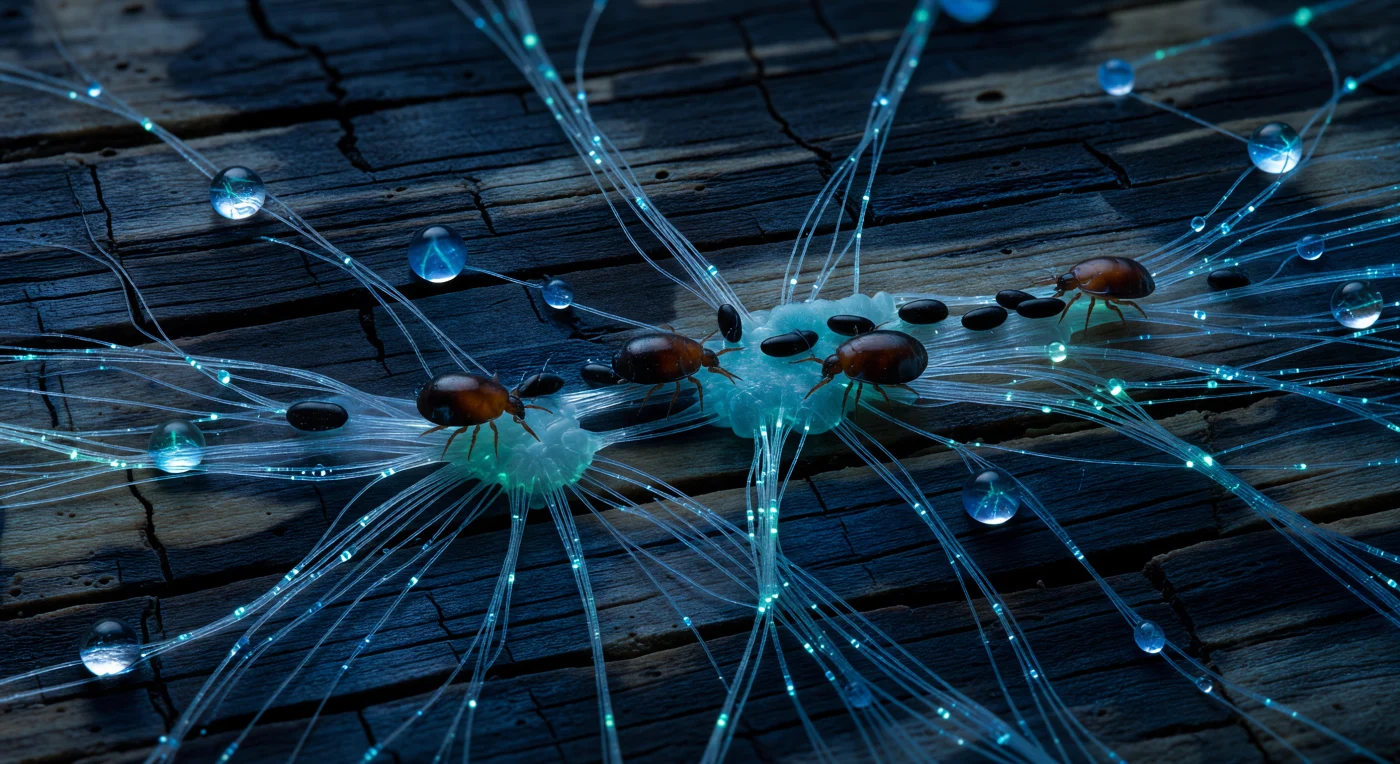
The scene opens in absolute darkness, broken only by cold blue-green fire: a bioluminescent mycelial mat carpets a decaying hardwood surface, its thousands of hyphal cables — each barely five micrometers across, no thicker than a bacterial colony — glowing like submerged fiber optics, their growing tips pulsing with a sourceless foxfire that shifts from electric cyan at the advancing fringe back through dimming teal into the tangled interior. Three oribatid mites move through this luminous lattice, their heavily sclerotized notogaster shields a deep polished mahogany that catches the cold radiance in caustic streaks, each dome a lacquered carapace evolved over hundreds of millions of years to protect against the crushing pressures and fungal enzymes of the soil microhabitat they colonize. At this scale, the wood grain beneath them is a geological landscape — parallel ridges of compressed cellulose stained jet-black and ink-blue by *Ophiostoma* fungal blotching running like fault escarpments toward a lightless horizon, every surface pore a lignin-rimmed crater. Along each hyphal cable, spherical water droplets ranging from thirty to two hundred micrometers cling by surface tension alone, acting as perfect fisheye lenses that concentrate and refract the bioluminescence into self-contained glowing worlds — a reminder that at this scale, gravity recedes and capillary forces, Van der Waals adhesion, and the optical physics of water films govern every movement, every feeding strike, every pellet left behind like an obsidian bead on a cold luminous thread.
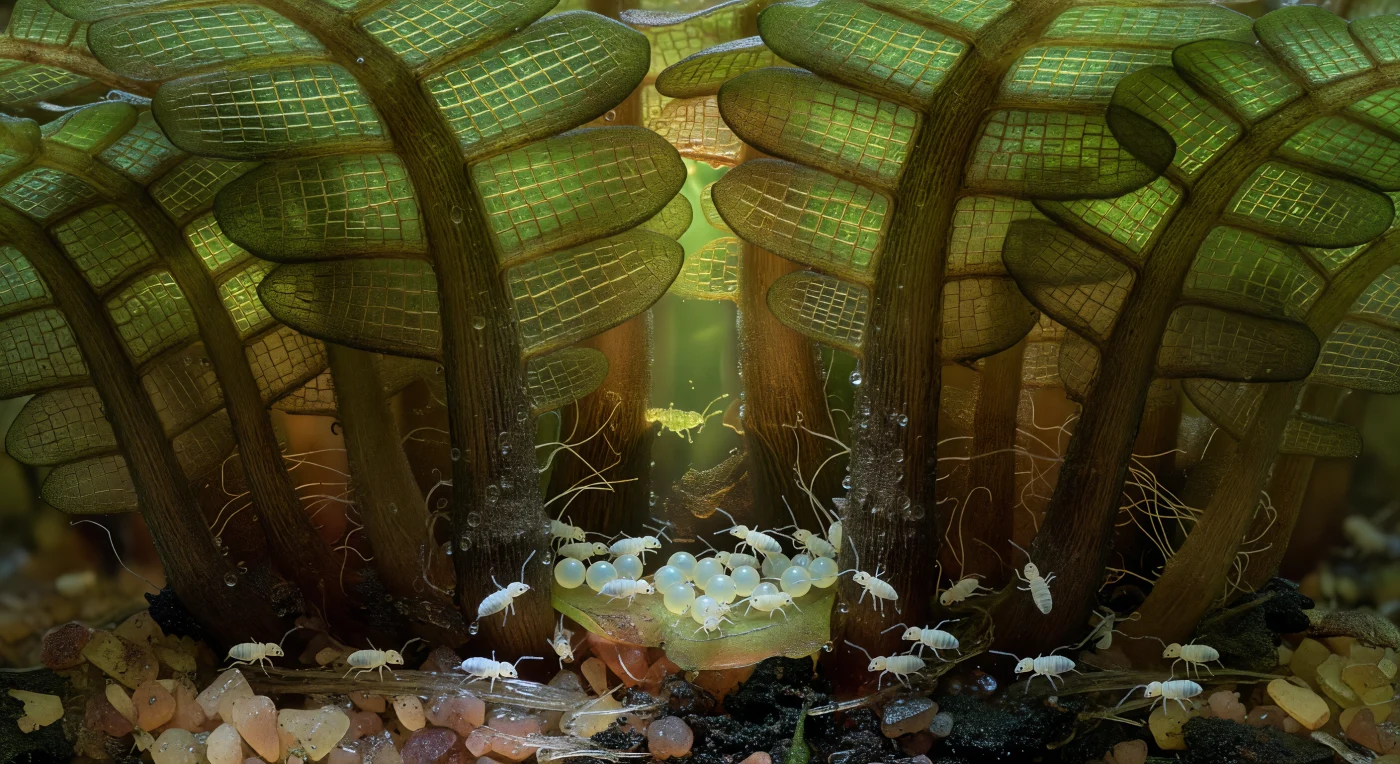
You crouch at the junction where Polytrichum stems meet the soil, dwarfed to the length of a single rectangular cell in the translucent phyllids arching overhead like stained-glass panels in a submerged cathedral — each green chamber bounded by luminous yellow-green walls, the cells themselves an architectural lattice through which diffuse daylight filters down in stacked olive shadow planes, broken only by one warm amber-green shaft pouring through a gap where a phyllid is absent. At this scale the moss stems are vast brown-green pillars of sclerotized cellulose, their surfaces ridged and faintly waxy, rising out of sight while the soil beneath resolves into compressed geology: angular quartz grains, black humus aggregates, shredded plant fibers, everything filmed in a thin reflective meniscus of water that governs movement here far more than gravity does, capillary forces and surface tension shaping every pathway. Clustered in the sheltered angle where two stems press together, a crowd of Folsomia springtails — opaque cream-white bodies with faint abdominal translucency, antennae quivering forward over finely granular hydrophobic cuticle that beads surrounding water films into glassy spheres — have gathered around a clutch of opalescent eggs nestled in decomposing phyllid material, each sphere roughly eighty micrometres across, iridescent as moonstone, held in place by adhesive secretion against the capillary pull of the water film. The layered green twilight deepens toward the root collar where fungal hyphae trace pale cables across the substrate, the light transitioning through registers — amber shaft, chloroplast-filtered green wash, warm brown shadow — measuring depth not in distance but in the accumulation of overlapping leaf shadows and the slow extinguishing of that single brilliant column of air above.
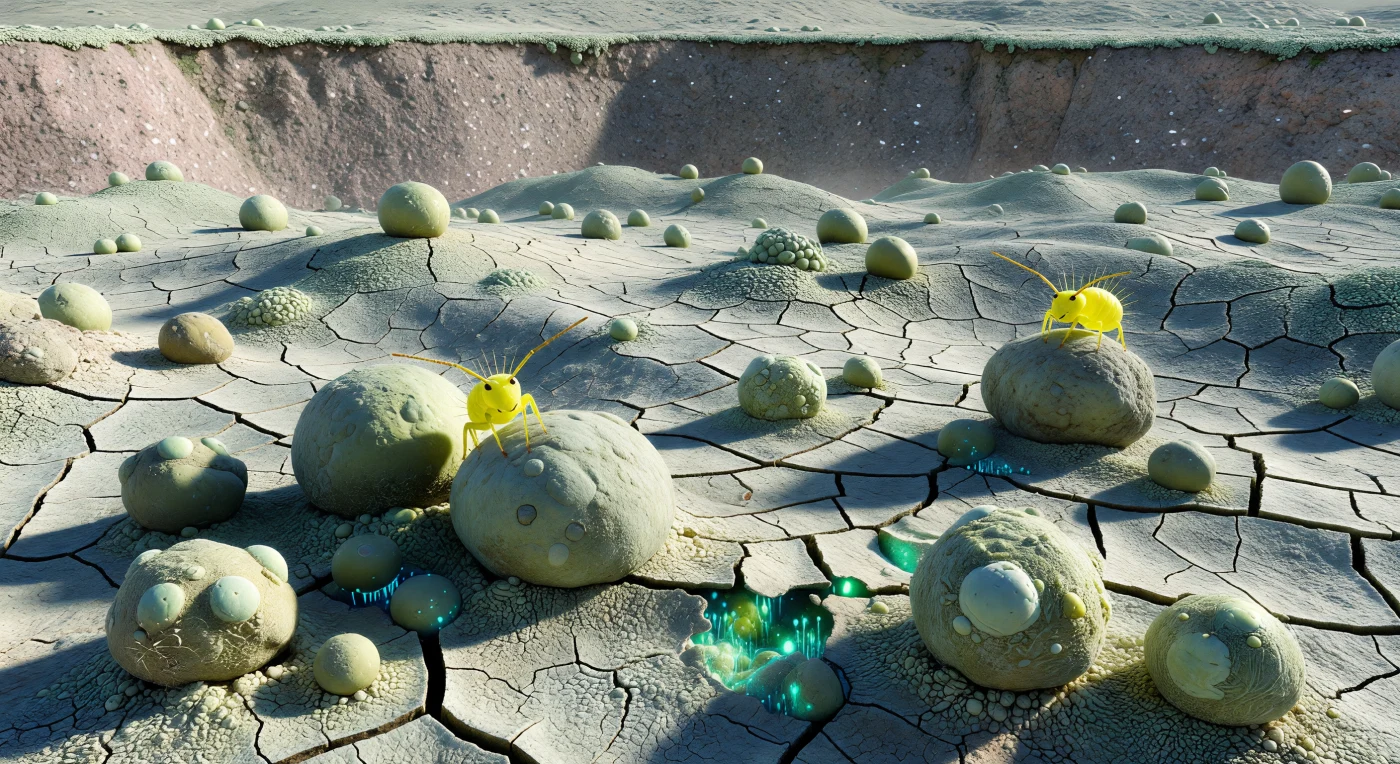
You stand at the height of a grain of sand, gazing across a cracked and fractured plateau that stretches to a sheer cliff horizon, where the crust of a crustose lichen simply ends and pale pink granite plunges away into open air. Beneath your feet, the fungal cortex splits into polygonal tiles like a drought-parched lakebed scaled down to the cellular, and in each fissure the exposed photobiont layer glows with a cold teal light — clusters of algal cells whose chloroplast-dense walls transmit wavelengths upward like fiber optics buried in mineral stone, a bioluminescent underlighting that wars with the unfiltered midday sun raking hard and white across the plateau above. Around you, soredia rise as boulders and monoliths — each granule a self-contained propagule, a compressed alliance of fungal hyphae and captive algae coated in powdery wax that scatters the solar glare into a ghostly aureole, the lichen's primary dispersal strategy made physical and mountainous at this vantage. Two Sminthurus springtails thread between the largest granules like phosphorescent yellow boulders themselves, their fused globular bodies — a derived body plan unique among Collembola — carrying six-segmented antennae that sample the chemical microclimate of the cortex surface, while the coiled furcula locked beneath each abdomen holds potential energy enough to launch them one hundred body-lengths into open air in under two milliseconds. At this scale gravity is a minor inconvenience, but surface tension is a wall: the thin water films pooling in cortex fractures are highways and traps simultaneously, and every step the springtails take is a negotiation between adhesion, capillary force, and the waxy hydrophobic cuticle evolution has given them to resist it.
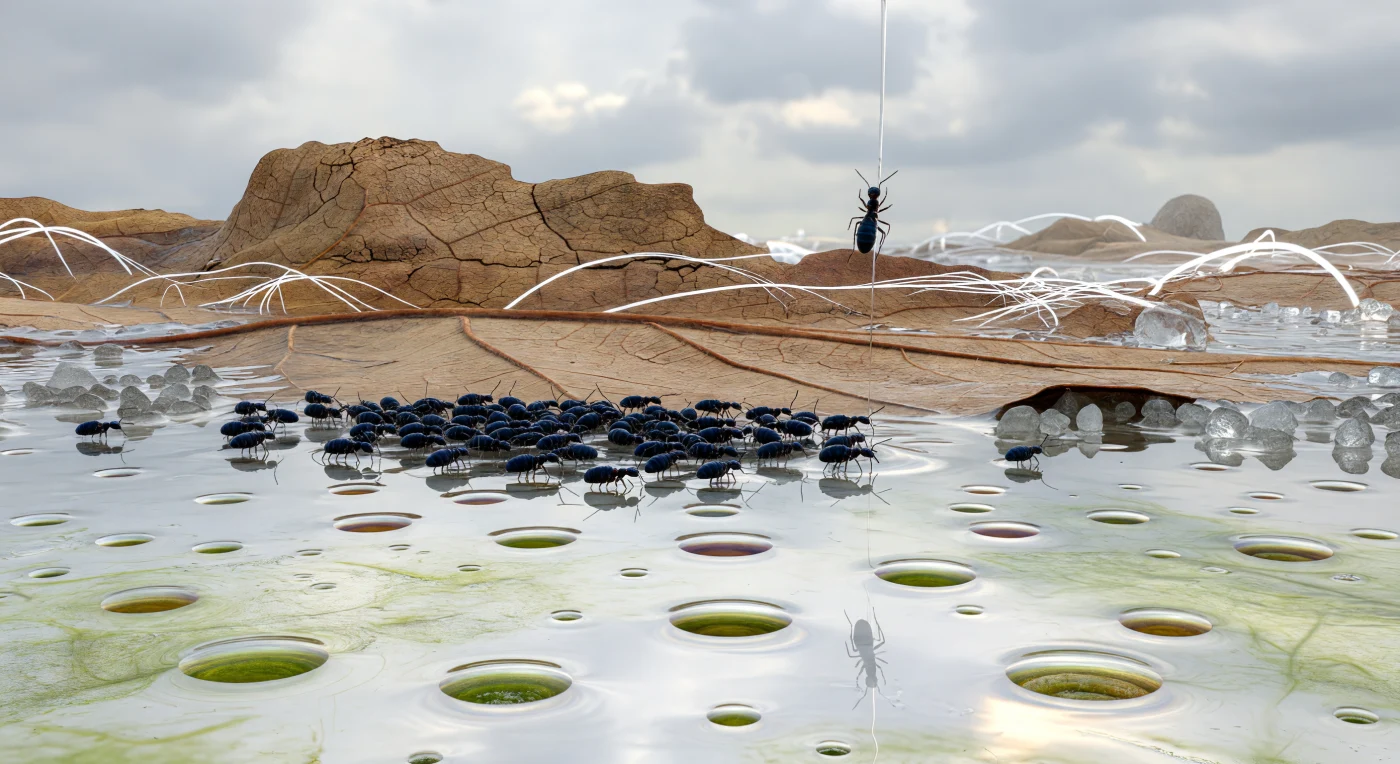
At the moment captured here, a dense raft of blue-black *Hypogastrura* springtails crowds the surface of a partially flooded decomposing oak leaf, their bodies — each roughly a millimeter long — pressed close enough that individual antennae overlap, the collective mass dimpling the water interface with dozens of tiny meniscus depressions ringed by faint iridescent interference halos of pale gold and blue. The water film itself, only tens of micrometers thick across much of the leaf's amber topography, behaves here less like liquid and more like a taut elastic sheet, its surface tension powerful enough at this body mass to support the entire aggregation as though on glass — while raindrop spheres frozen mid-impact serve as perfect refracting lenses, each compressing an inverted panorama of green algal crust and rotting cellulose into a single glassy bead. At the aggregation's edge, one individual has triggered its furcula in the fastest muscular event in this entire ecosystem — a one-to-two millisecond release that sends the body vertically upward, a capillary filament of water stretching behind it like a liquid needle refracting the overcast sky into a column of concentrated light before the surface tension finally breaks. The leaf beneath, its reticulate venation magnified by proximity into cliff faces and dried-mud plateaus, and the fungal hyphae strung across its surface like backlit cables, form the entire geography of a world in which gravity is nearly irrelevant and every film of water is simultaneously a highway, a trap, and a mirror.
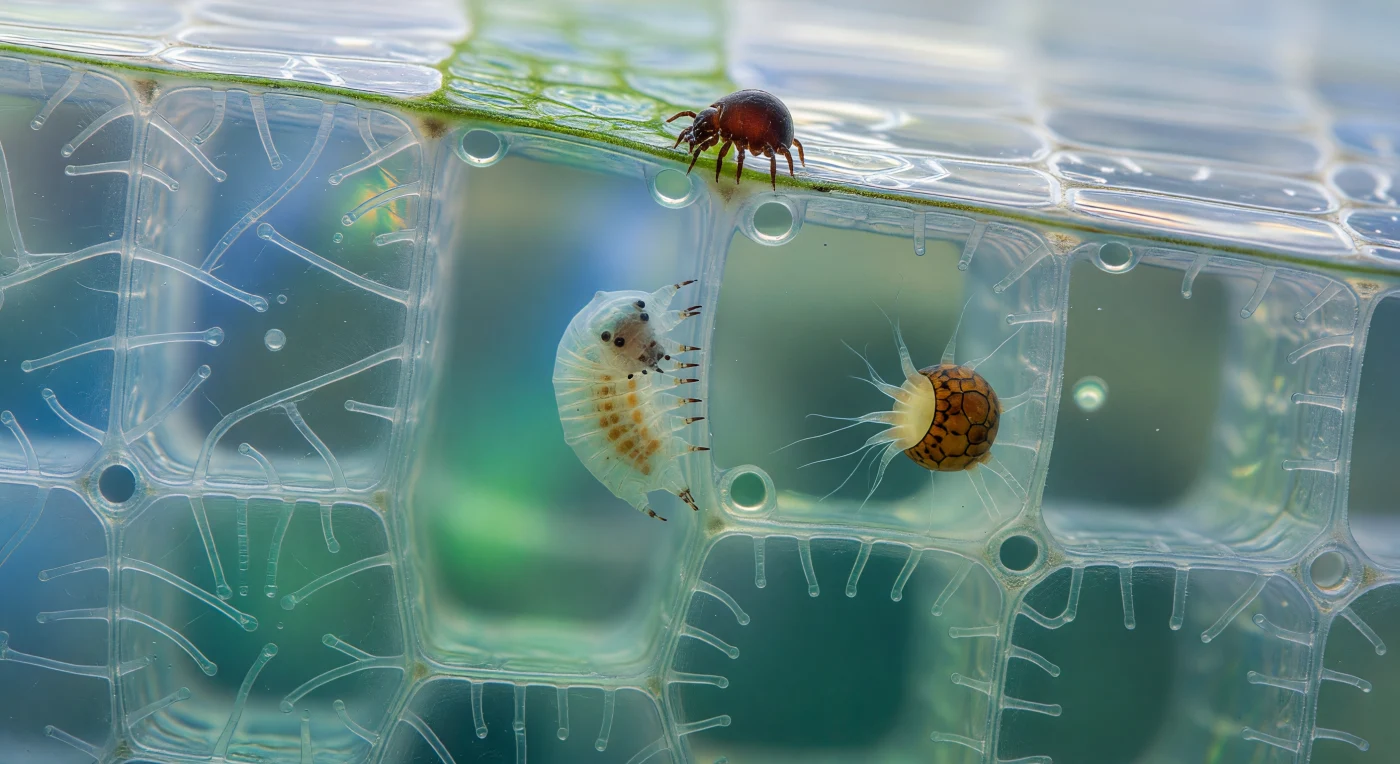
You hover suspended in the flooded interior of a *Sphagnum* hyaline cell, surrounded by towering rectangular chambers of living glass whose cellulose walls are so thin that blue-green light passes through them almost unimpeded, refracting into soft fan-shaped beams that rake diagonally through the water column while helical fiber struts — the structural reinforcements spiraling up each cell wall — catch the light on their curved faces and scatter faint prismatic halos into the surrounding water. The cells are dead by design, their contents replaced entirely by water, functioning as a biological reservoir that allows *Sphagnum* to hold up to twenty times its dry weight in moisture, and the perfectly circular pores interrupting each wall at regular intervals are not accidents but evolved connections between adjacent chambers, creating a hydraulic network of breathtaking geometric precision. In the middle distance a tardigrade grazes with methodical patience on the outer face of a cell wall, its barrel body near-transparent, its eight clawed legs pressing one at a time against the smooth cellulose surface in a slow walk governed not by urgency but by the physics of adhesion at this scale, where surface tension and Van der Waals forces matter far more than gravity. Nearby, a testate amoeba extends trembling pseudopodial threads of cytoplasm from the aperture of its mineral-plated amber shell into open water, each filament a silver flicker in the refracted light as it hunts bacteria too small to resolve here. Above the sharp diagonal line of the meniscus — a curved glass ceiling of surface tension separating flooded cathedral from open air — a mahogany-domed oribatid mite grips the leaf margin with all eight legs, its polished notogaster mirroring distorted blue-green rectangles of the cell walls it has never entered, standing sentinel at the precise boundary between two worlds.
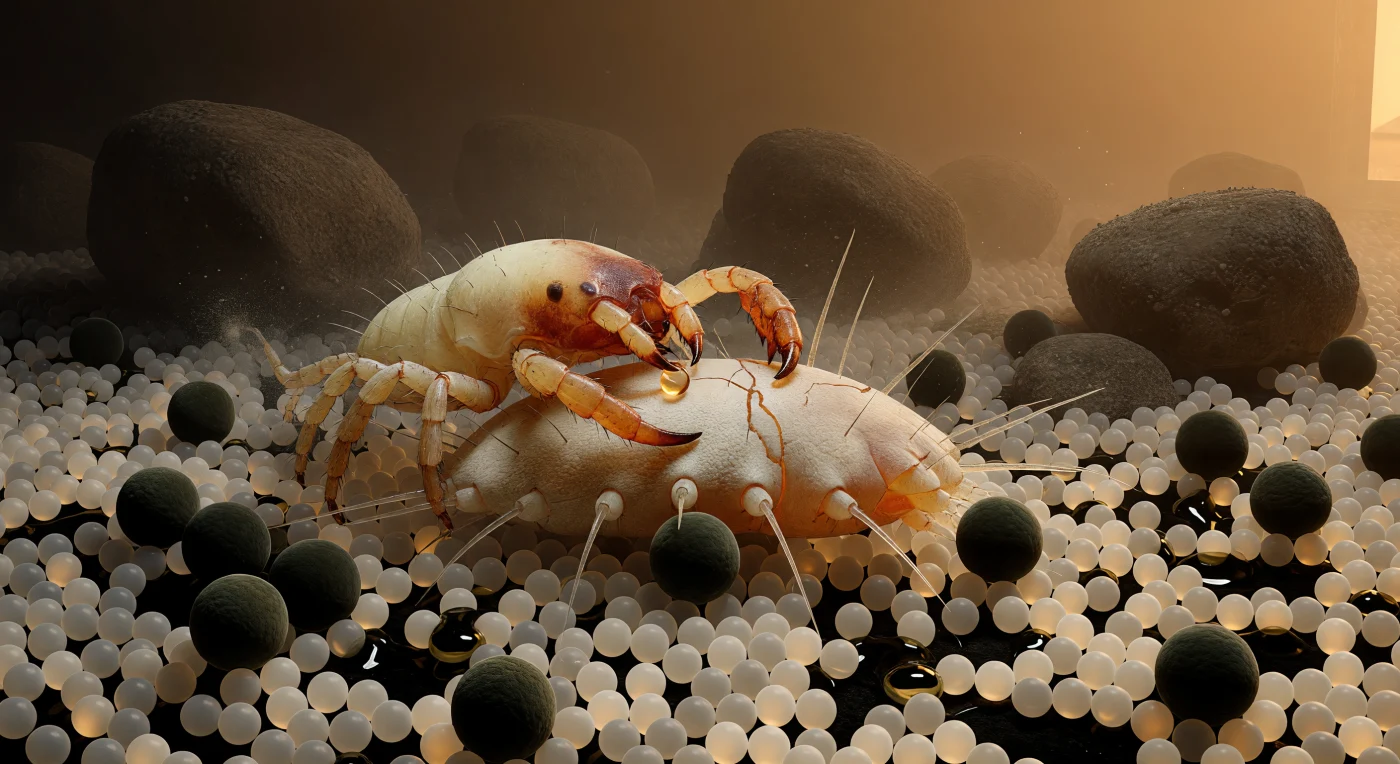
At the moment captured here, a *Cheyletus* predatory mite — cream and rust-colored, built like siege machinery — has locked its oversized palpal claws around a much softer grain mite (*Acarus* or kin), cheliceral stylets already driven through the yielding cuticle in a predation strike lasting perhaps 100 to 200 milliseconds in real time. The prey's granular integument dimples and splits under compression, its long dorsal setae pressed sideways or still trembling upright against the backlight, while a bead of digestive fluid gleams at the cheliceral tips — *Cheyletus* practices extra-oral digestion, liquefying the prey's contents before ingestion, a strategy common across predatory prostigmatan mites. The floor on which this arrest takes place is a dense mosaic of 25-micrometer starch spheres, each one a near-translucent globe that to these animals is a boulder requiring navigation, separated by black inter-particle crevices where capillary water films form curved menisci bridging contact zones — geometry that at this scale behaves as barrier, highway, and feeding arena simultaneously. Scattered among the starch field, *Aspergillus* spores the size of large marbles sit wedged between substrate particles, their olive-black ridged surfaces catching one hemisphere of warm light, their presence a reminder that the same grain-store microhabitat supporting this predator-prey encounter is simultaneously a fungal ecosystem operating on a parallel, overlapping scale. Everything here — cuticle failure, fluid transfer, spore adhesion, water-film architecture — is governed not by gravity but by surface tension, capillary force, and Van der Waals adhesion, the true physics of a world measured in fractions of a millimeter.
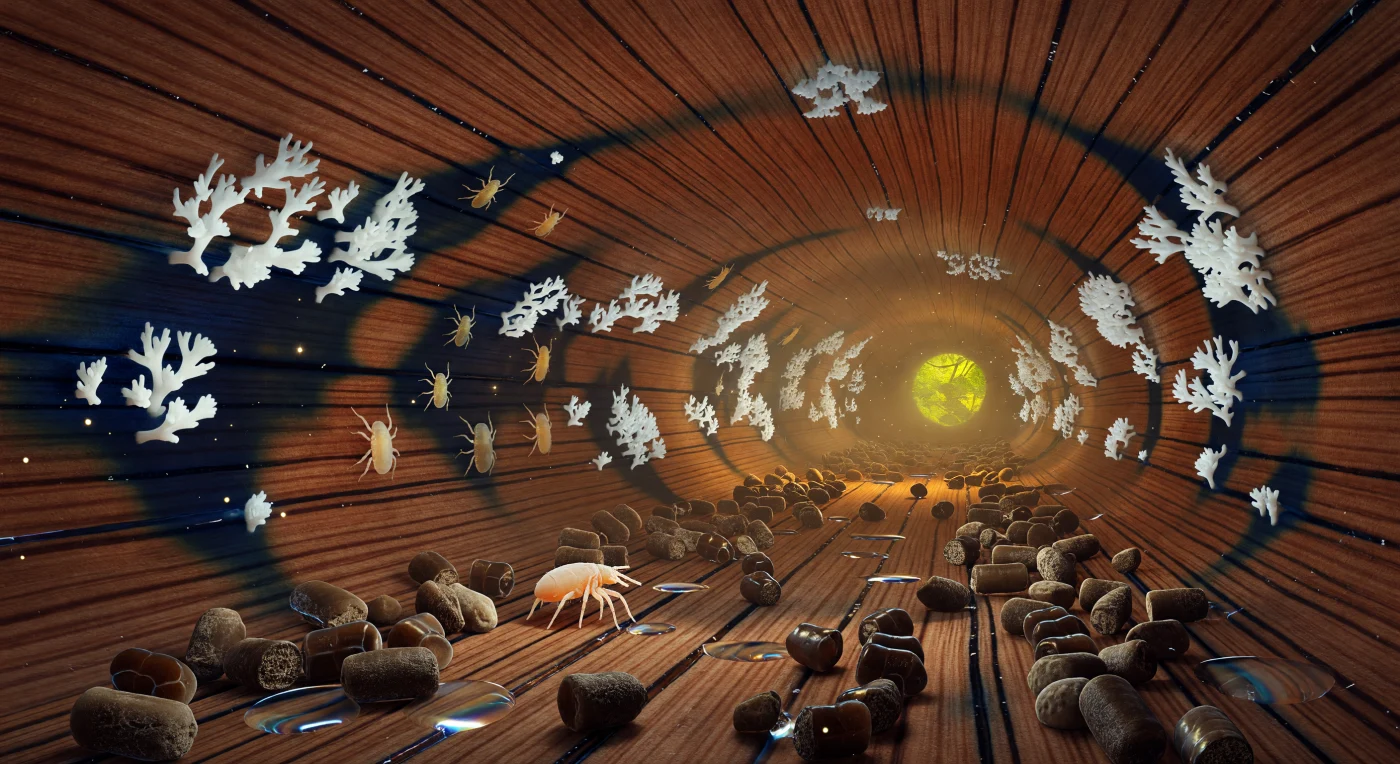
You are suspended at the threshold of a bark beetle gallery, a vaulted corridor of reddish-brown wood fiber curving overhead in a barrel arch whose walls are streaked with deep blue-black Ophiostoma fungal staining — pigment gradients spreading through the grain like bruised weather systems across a landscape measured in centimeters that are, at your scale, continental distances. Dense white tufts of ambrosia fungus erupt from the walls in irregular colonies, each hypha a branching cable thicker than your own legs, their waxy surfaces catching scattered photons from the distant gallery mouth and returning them as a cold, soft glow against the warm amber wood. The floor is a boulder field of compressed frass pellets, cylindrical and massive relative to your body, their interstices glazed with water menisci whose curved surfaces catch the tunnel's dim light into bright glass crescents — here, surface tension is a geological force, and a thin film of water is a wall. A predatory mesostigmatan mite crosses the foreground in rapid, deliberate strides, its pale cream-orange dorsal shield catching a warm highlight, chelicerae projecting forward and slightly parted, while behind it a cluster of hypopus mites clings motionless to the Ophiostoma-stained wall, their bodies reduced to translucent discs so smooth they mirror the dark wood grain like polished amber lenses. At the far end of the corridor, fifty or sixty body-lengths away, the gallery opens onto a small circle of warm yellow-green forest light, its glow diffusing inward through suspended wood dust and fungal spores into long crepuscular shafts that graze every fibrous ridge and cast elongated shadows behind each frass boulder — the only reminder that beyond this saturated, pressurized corridor of decay and symbiosis, a forest exists at an entirely different scale of time and light.
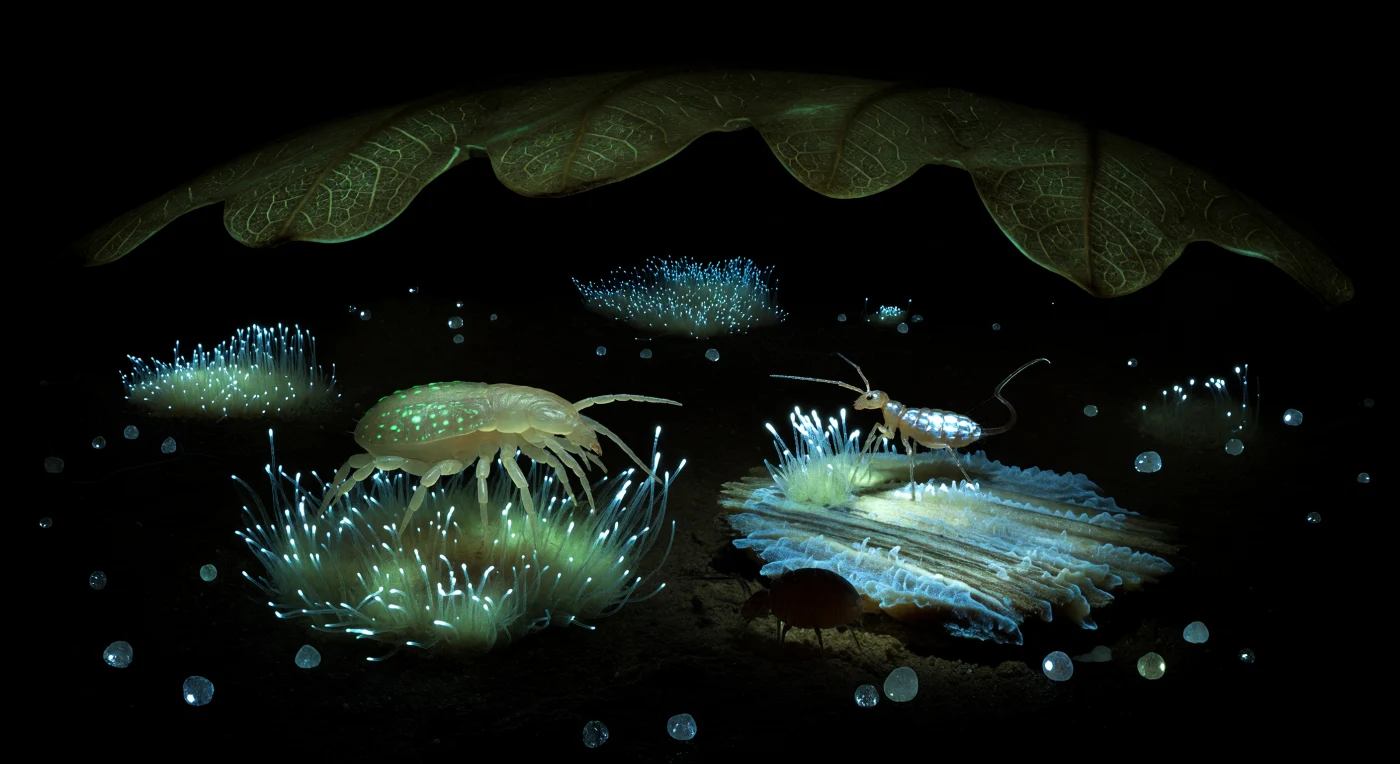
You exist in a universe where light is not given but earned — cold blue-green foxfire pooling across mycelium mats in the absolute darkness of a forest floor half a millimeter above the soil, the only illumination coming from bioluminescent hyphae of Mycena-type fungi, their individual filaments 8–10 micrometers wide glowing palest cyan along mature strands and burning almost white-blue at their actively growing tips, where the enzymatic chemistry of luciferin oxidation reaches its peak. Against this spectral underlighting, the forest floor's inhabitants become visible only as reflections and silhouettes: a mesostigmatan predatory mite, its pale opisthonotal shield and comma-shaped peritremes catching shifting green speculae with each urgent leg-stroke, hunts between luminous hyphal threads that serve simultaneously as landmarks, highways, and prey-sign, its leathery cuticle — ordinarily cream-orange — rendered entirely cold green by the only light that exists here. A meter-long continent of decomposing oak-leaf fragment arches overhead, its cellulose lattice filtering nothing, while a passing Entomobryomorph springtail crosses directly over the brightest mycelial node and for one instant ignites in blue-white fire, every iridescent overlapping scale flaring like a faceted mirror, antennae casting long shadows back across the glow-lake below — then it steps off the mat's edge and vanishes absolutely into the surrounding void, as though it never existed, because in this world darkness is not an absence but a substance, and the inhabited patches of cold fungal fire are all there is.
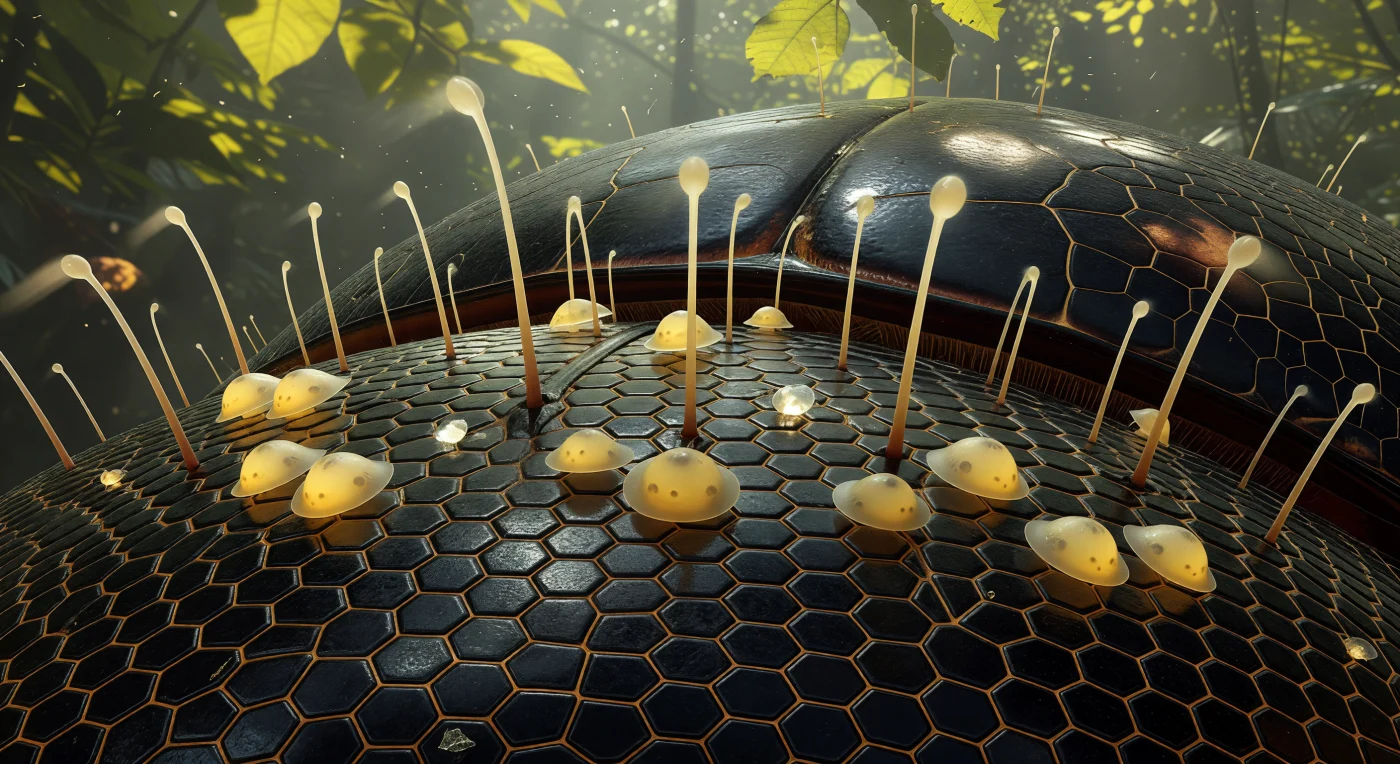
You stand on the geometric perfection of a beetle's hind leg, your feet pressing against hexagonal chitin tiles that stretch toward the animal's thorax like an obsidian city block rising at the horizon, every plate edged in amber ridge-lines and lacquered to a wet sheen. Ahead of you, twelve hypopi — the dispersal stage of a phoretic mite species — cling to the dorsal surface in pale amber clusters, their bodies flattened to near-transparency at the edges, held fast by ventral suckers in a grip so complete they require no muscular effort whatsoever: the hypopus is a physiologically suspended form, its legs folded inward and vestigial, its digestive system shut down, existing purely as a passenger optimized for attachment and endurance through the physics of adhesion rather than the biology of feeding. Around them, the beetle's mechanosensory setae rise like curved lamp-posts, their tips carrying the faintest smear of motion blur that betrays the vibration traveling up through the chitin from each footfall — a tremor you feel through your own feet while the hypopi above it remain absolutely, almost aggressively still. The dappled green-amber light filtering down through decomposing leaf canopy plays across the cuticle in slow-traveling pools of warmth, illuminating the faint ghost of organ masses visible through each mite's semi-translucent body wall — living cargo sealed inside amber resin, riding an unwitting host through a forest understory that, from here, feels as vast and architecturally complex as any human city.
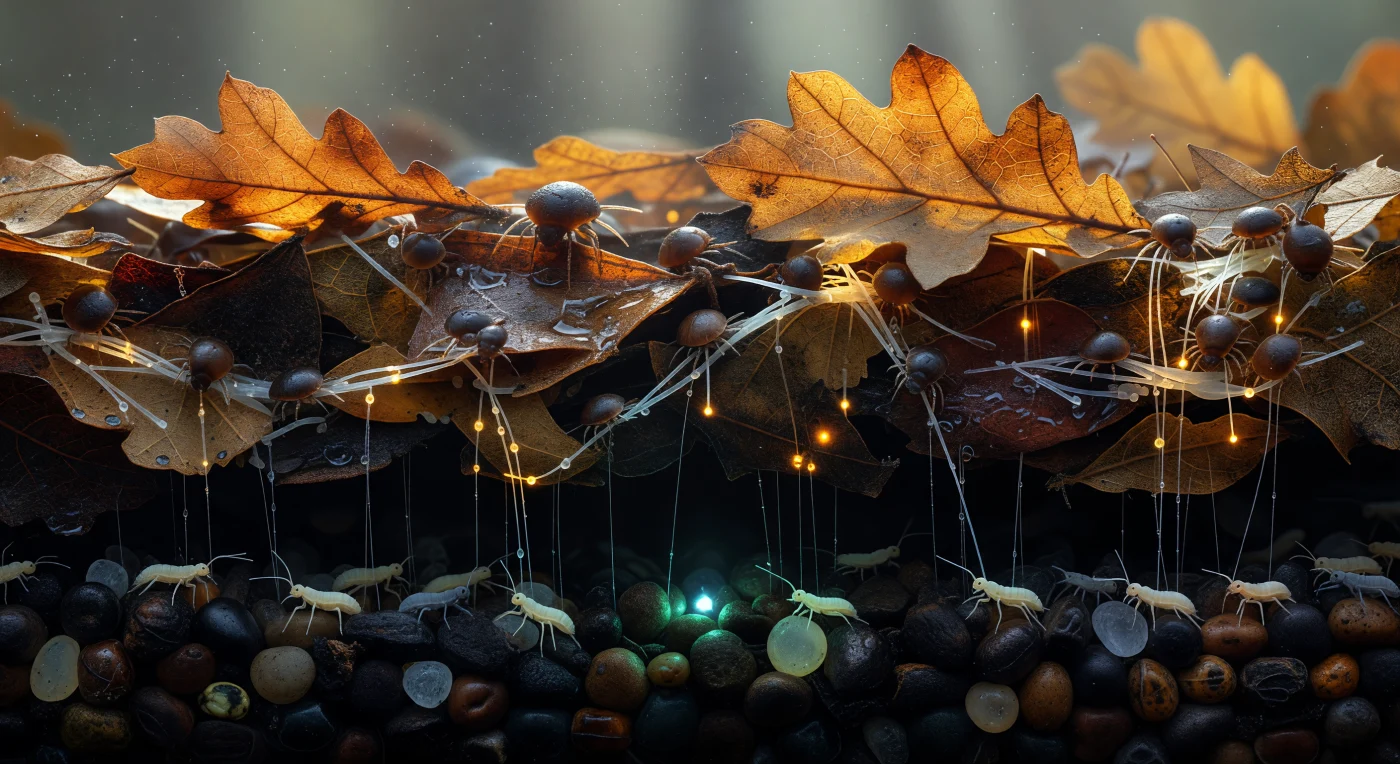
The cross-section before you reads like a geological core sample from another planet, compressed into five millimeters of vertical space: at the top, partially intact oak-leaf laminae transmit the last of the surface light through amber cellular architecture, each surviving cell wall a translucent hexagon glowing copper-orange where residual cellulose still holds structural form, while the remnant vascular network rises as darker ridges through the translucent tissue. Immediately below, the middle stratum belongs to the oribatid mites — members of the order Oribatida, their heavily sclerotized notogasters polished to a lacquered chestnut-black sheen that reflects the scattered cold light of fungal hyphae woven laterally through compacted leaf fragments, each hypha five to eight micrometers across and beaded with water films that coat every surface at this scale, where capillary forces and surface tension govern movement more absolutely than gravity. These hyphae are not passive structure but active decomposition infrastructure, secreting cellulases and lignin-degrading enzymes that chemically dismantle the leaf matrix while physically binding fragments into aggregates, and the oribatids move through this lattice as both consumers and engineers, their fecal pellets accumulating downward into the deepest stratum where the pale elongated bodies of collembolan springtails cluster at the humus-mineral interface, their soft cuticles scattering faint ambient light against the near-total darkness of compacted organic matter. Deep in that lowest zone, a single hypha emits a cold blue-green bioluminescent glow — a phenomenon documented in certain basidiomycete lineages and attributed to a luciferase-linked oxidative pathway — illuminating a radius of fecal aggregates and quartz grains with aquamarine light that makes the surrounding darkness feel, by contrast, absolute and geological.