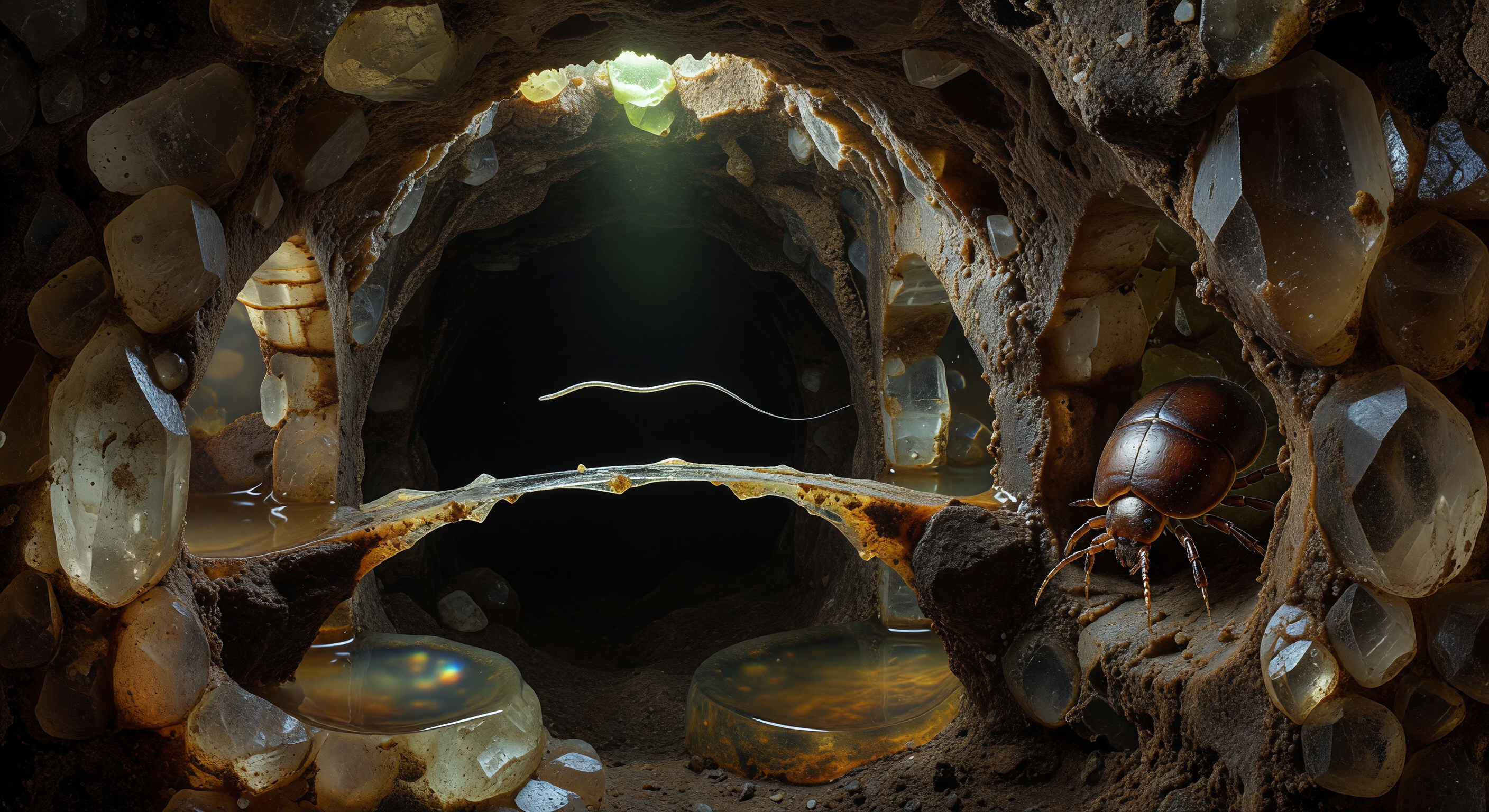
You are suspended inside a gothic vault of compressed mineral darkness, five centimeters beneath the forest floor, where no light has reached in weeks — a single pale thread filtering down from a distant pore opening above being the only evidence that a world exists beyond this chamber. The walls enclosing you are angular quartz grains the scale of apartment buildings, their fractured faces lacquered in clay minerals and humic colloids that transform raw geology into something resembling varnished bone, while papery clay-humus bridges arch between them, trembling with the physics of surface tension rather than any wind. To your right, an oribatid mite — its sclerotized notogaster a deep mahogany gloss, its eight legs working independently against a colloid-filmed wall — squeezes through a bottleneck pore measured precisely to its own body width, pretarsal claws leaving invisible micro-scratches as it navigates a passage that reads less like locomotion and more like a tank threading a doorframe. Deeper in the void, a nematode filament hangs suspended in a meniscus bridge stretched between two quartz faces, its body transmitting that single overhead light internally like a fiber-optic thread — pale silver against absolute black — while the curved water surfaces surrounding it act as natural lenses, magnifying the mineral architecture behind them into blurred amber abstraction. At this scale, capillary forces and Van der Waals adhesion govern every movement, gravity is a suggestion rather than a law, and the packed mass of the world above presses down in complete geological silence.
Other languages
- Français: Labyrinthe de Quartz Souterrain
- Español: Laberinto de Cuarzo Subterráneo
- Português: Labirinto de Quartzo no Solo
- Deutsch: Quarz-Labyrinth in der Tiefe
- العربية: متاهة الكوارتز تحت التراب
- हिन्दी: मिट्टी में क्वार्ट्ज भूलभुलैया
- 日本語: 土中の石英迷宮
- 한국어: 토양 속 석영 미로
- Italiano: Labirinto di Quarzo nel Suolo
- Nederlands: Kwarts Labyrint in de Grond