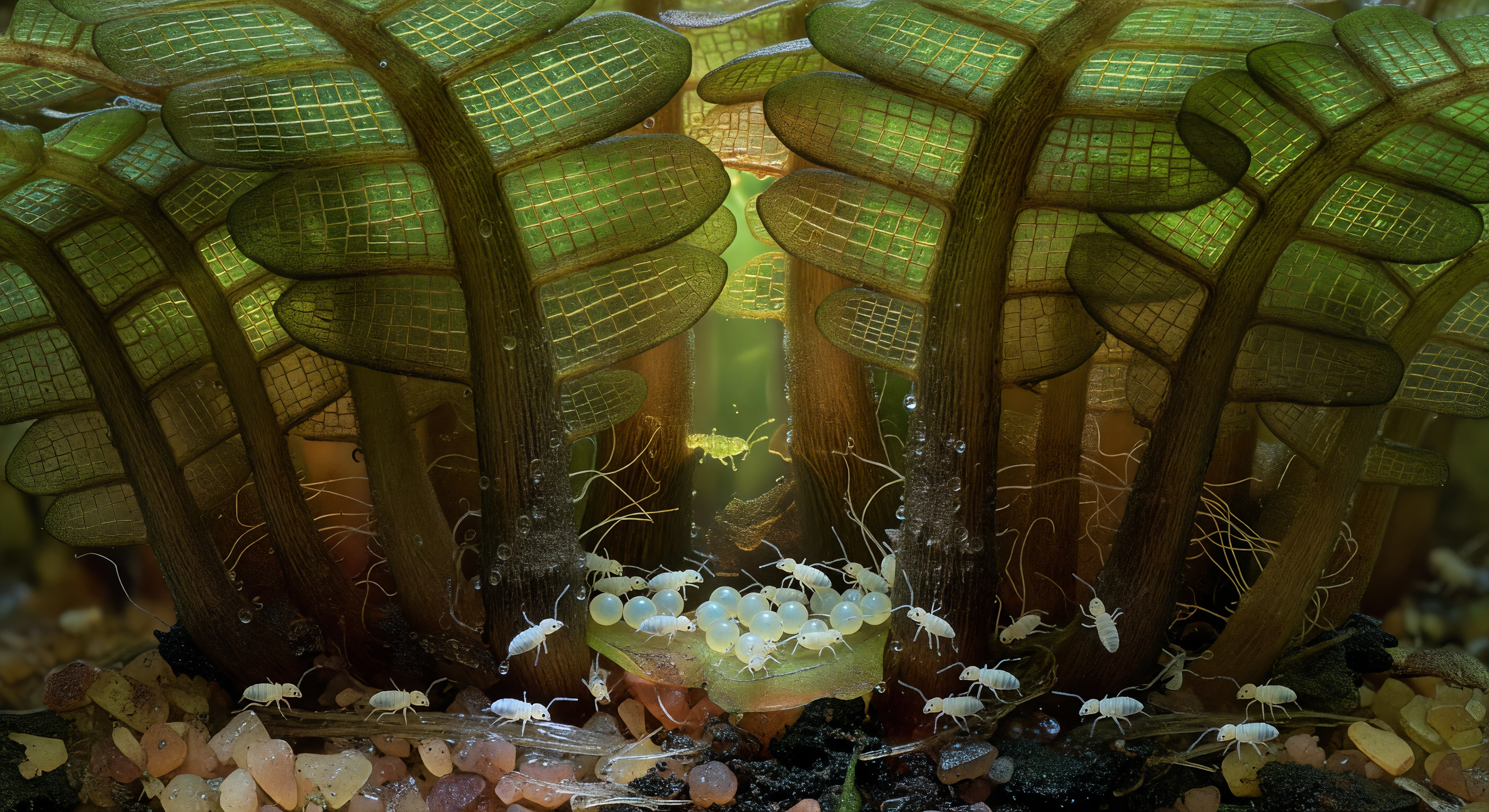
You crouch at the junction where Polytrichum stems meet the soil, dwarfed to the length of a single rectangular cell in the translucent phyllids arching overhead like stained-glass panels in a submerged cathedral — each green chamber bounded by luminous yellow-green walls, the cells themselves an architectural lattice through which diffuse daylight filters down in stacked olive shadow planes, broken only by one warm amber-green shaft pouring through a gap where a phyllid is absent. At this scale the moss stems are vast brown-green pillars of sclerotized cellulose, their surfaces ridged and faintly waxy, rising out of sight while the soil beneath resolves into compressed geology: angular quartz grains, black humus aggregates, shredded plant fibers, everything filmed in a thin reflective meniscus of water that governs movement here far more than gravity does, capillary forces and surface tension shaping every pathway. Clustered in the sheltered angle where two stems press together, a crowd of Folsomia springtails — opaque cream-white bodies with faint abdominal translucency, antennae quivering forward over finely granular hydrophobic cuticle that beads surrounding water films into glassy spheres — have gathered around a clutch of opalescent eggs nestled in decomposing phyllid material, each sphere roughly eighty micrometres across, iridescent as moonstone, held in place by adhesive secretion against the capillary pull of the water film. The layered green twilight deepens toward the root collar where fungal hyphae trace pale cables across the substrate, the light transitioning through registers — amber shaft, chloroplast-filtered green wash, warm brown shadow — measuring depth not in distance but in the accumulation of overlapping leaf shadows and the slow extinguishing of that single brilliant column of air above.
Other languages
- Français: Jungle Verte de Polytrichum
- Español: Selva Verde de Polytrichum
- Português: Selva Verde do Polytrichum
- Deutsch: Grüner Dschungel des Polytrichum
- العربية: غابة خضراء داخل الطحلب
- हिन्दी: पॉलिट्रिकम की हरी जंगल
- 日本語: コケの緑の密林
- 한국어: 폴리트리쿰 녹색 밀림
- Italiano: Giungla Verde del Polytrichum
- Nederlands: Groene Jungle van Polytrichum