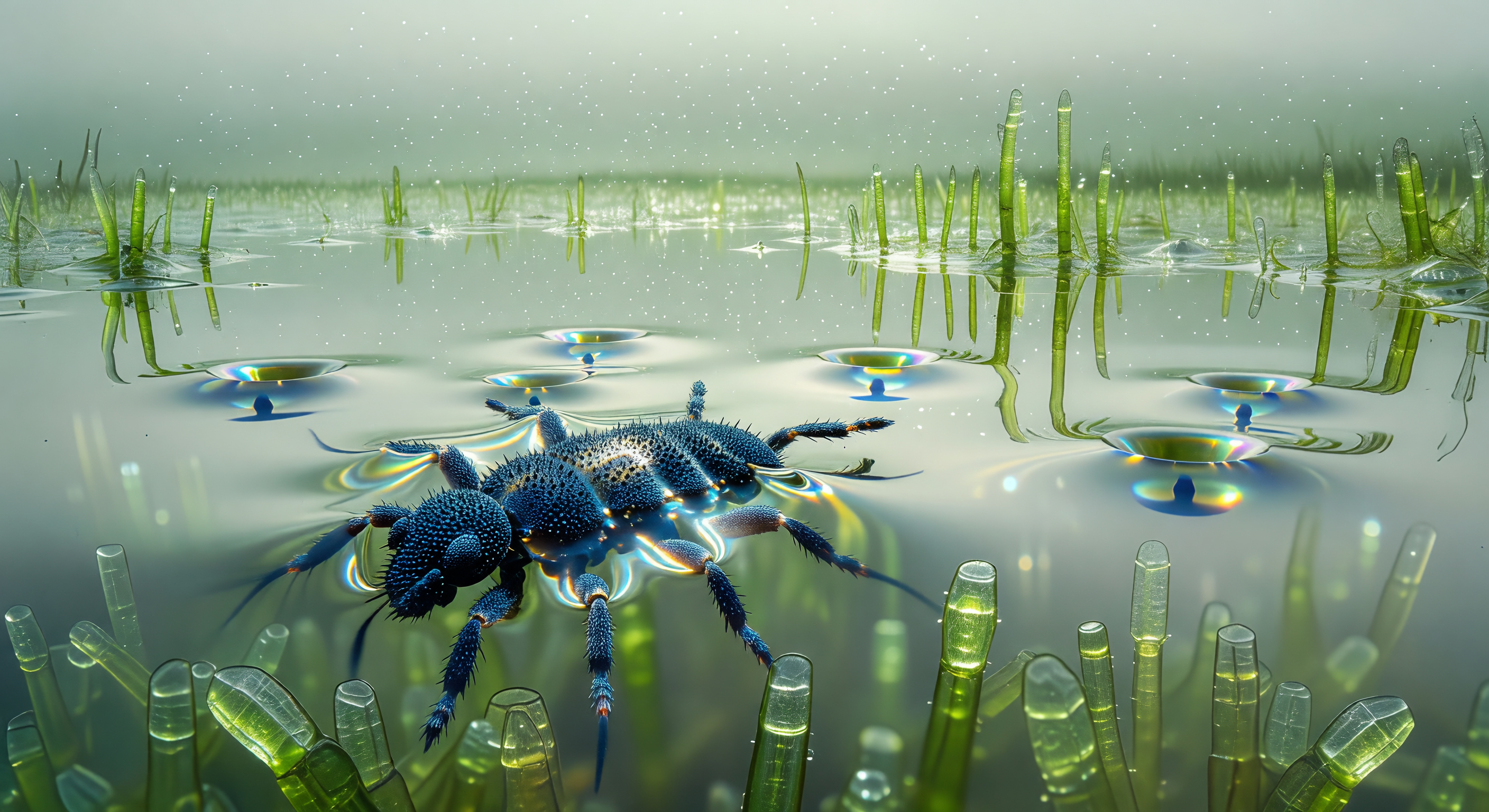
You are suspended at the level of the water's skin, eye-point a whisper above the mirror, looking across a flooded Sphagnum plain toward a creature that, from here, has the presence and mass of a dark boulder — *Podura aquatica*, a springtail barely a millimeter long, rendered enormous and geological by the intimacy of the vantage. Its cuticle resolves into a dense mosaic of granular micro-pillars, hammered obsidian catching diffuse green-white light, while around every contour of that body trembles the plastron: a continuous trapped-air film that reads as liquid silver and pale mercury, a physical consequence of the cuticle's hydrophobic nano-architecture preventing the water from collapsing inward and drowning the animal it sheathes. The water surface between you and the animal is not passive backdrop but a tensioned architectural membrane — an elastic film held taut by hydrogen-bond cohesion at roughly 72 millinewtons per meter — each of the six leg-contact points dimpling it into a smooth concave crater whose sloped walls refract diffuse daylight into faint prismatic rings, the shadow of each crater stretching long and blue across the silver-green mirror below like craters on a still lake seen from low orbit. Beneath that membrane, submerged Sphagnum hyaline cells — large, dead, water-storing chambers that give the moss its unmatched hydraulic capacity — glow jade and chartreuse like stained-glass lanterns set into a flooded cathedral floor, their reflection rising perfectly into the air above so that stem and mirror-image merge at the interface in seamless bilateral symmetry. Everything is frozen in the razor-still instant before the furcula fires, before the plastron shatters, before the mirror breaks.
Other languages
- Français: Reflet Plastron sur Eau Inondée
- Español: Destello de Plastrón en Inundación
- Português: Brilho do Plastrão na Enchente
- Deutsch: Plastron-Schimmer auf Flutfläche
- العربية: وميض البلاسترون فوق الفيضان
- हिन्दी: बाढ़ सतह पर प्लैस्ट्रॉन चमक
- 日本語: 浸水面に輝くプラストロン
- 한국어: 홍수 위의 플라스트론 빛
- Italiano: Bagliore del Plastron sull'Acqua
- Nederlands: Plastron Glinstering op Overstroming