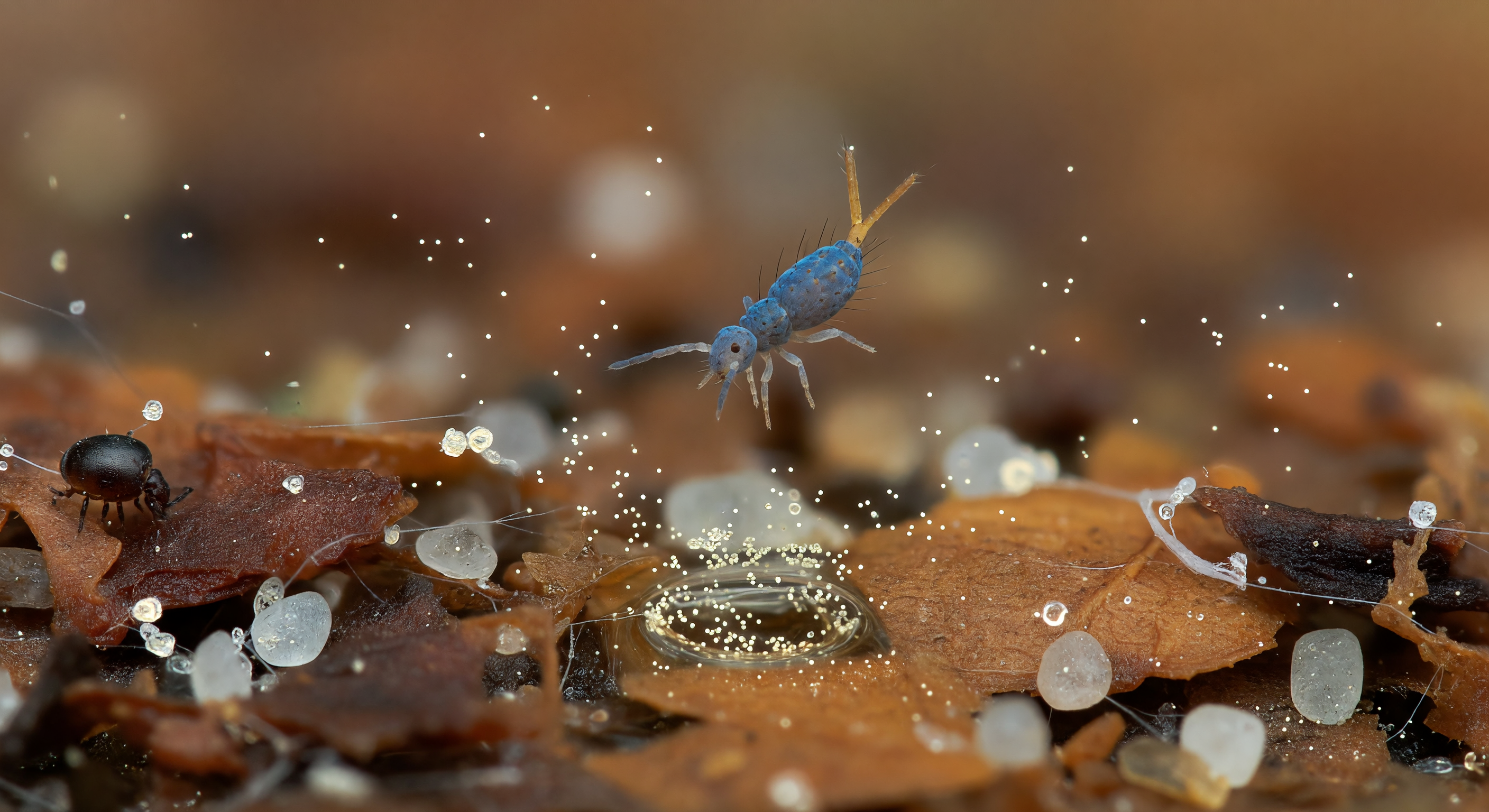
Suspended in the amber dark of the litter layer, an iridescent blue-gray springtail hangs at the precise millisecond of its escape — furcula still extended, body beginning its forward arc, six threadlike legs splayed outward as though startled by their own sudden freedom. The furcula itself, a translucent chitinous fork locked until this instant beneath a catch called the tenaculum, has just delivered its mechanical verdict: a release so fast — completed in under two milliseconds — that it ranks among the most violent accelerations in the biological world, launching a body of barely one milligram across a distance equivalent to a human clearing a twenty-story building. Below, the substrate dissolves into warm bokeh — compressed oak litter in burnt sienna and tobacco brown, pale quartz grains transmitting cool interior light, white mycelial cables strung taut between leaf fragments — and where the springtail's ventral collophore last pressed the surface, a halo of fungal spores drifts outward, each oblate sphere two to five micrometers across, catching the single cool shaft of cellulose-filtered daylight as pale gold motes. At the left edge of frame, barely resolved, a polished mahogany oribatid mite anchors the scene in ecology: these two animals share the same cathedral of decaying matter, one armored and deliberate, the other already gone.
Mites & springtails