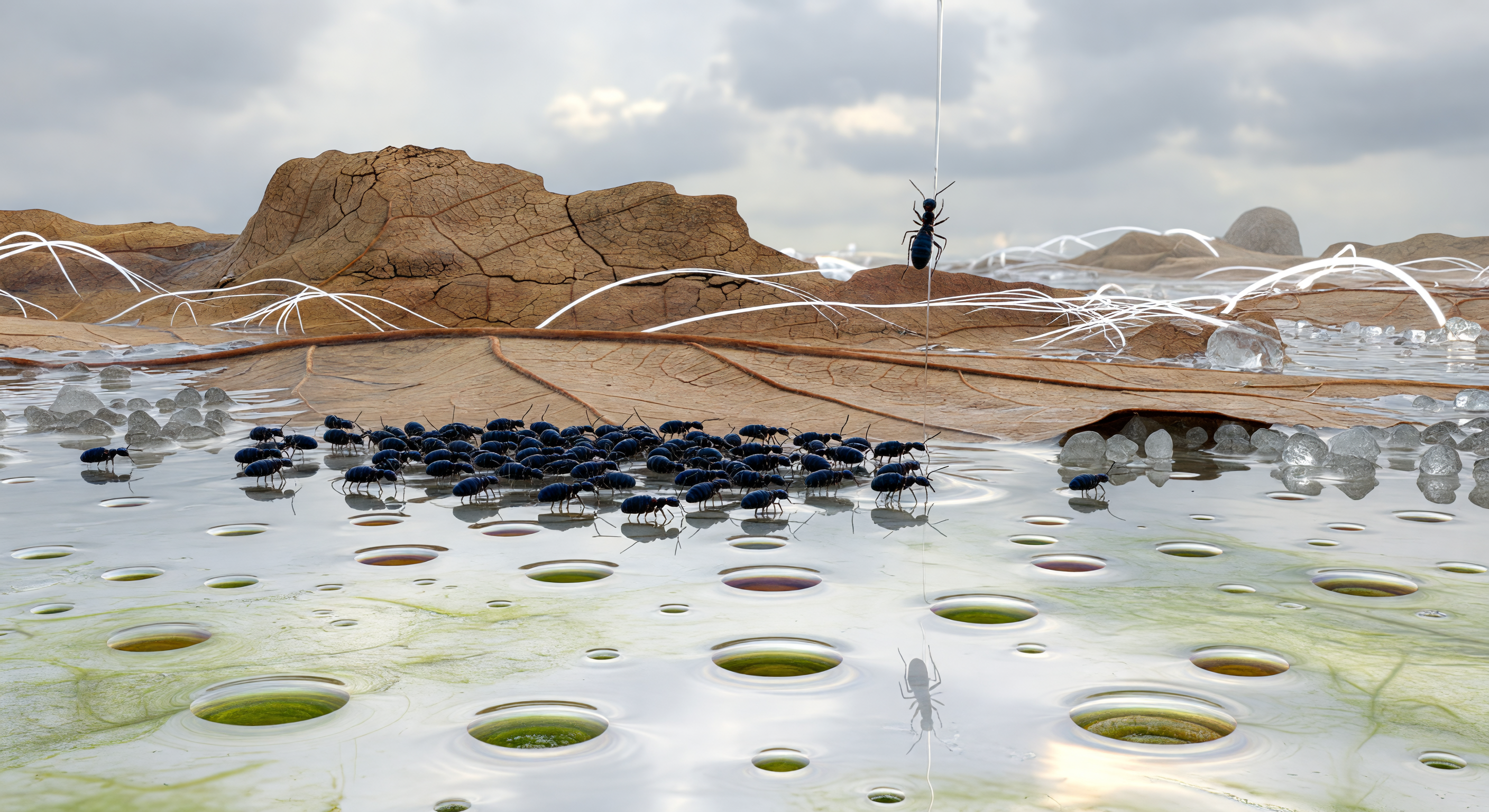
At the moment captured here, a dense raft of blue-black *Hypogastrura* springtails crowds the surface of a partially flooded decomposing oak leaf, their bodies — each roughly a millimeter long — pressed close enough that individual antennae overlap, the collective mass dimpling the water interface with dozens of tiny meniscus depressions ringed by faint iridescent interference halos of pale gold and blue. The water film itself, only tens of micrometers thick across much of the leaf's amber topography, behaves here less like liquid and more like a taut elastic sheet, its surface tension powerful enough at this body mass to support the entire aggregation as though on glass — while raindrop spheres frozen mid-impact serve as perfect refracting lenses, each compressing an inverted panorama of green algal crust and rotting cellulose into a single glassy bead. At the aggregation's edge, one individual has triggered its furcula in the fastest muscular event in this entire ecosystem — a one-to-two millisecond release that sends the body vertically upward, a capillary filament of water stretching behind it like a liquid needle refracting the overcast sky into a column of concentrated light before the surface tension finally breaks. The leaf beneath, its reticulate venation magnified by proximity into cliff faces and dried-mud plateaus, and the fungal hyphae strung across its surface like backlit cables, form the entire geography of a world in which gravity is nearly irrelevant and every film of water is simultaneously a highway, a trap, and a mirror.
Other languages
- Français: Agrégation Pluviale sur Litière Inondée
- Español: Agregación de Lluvia en Hojarasca Inundada
- Português: Agregação de Chuva em Serapilheira Inundada
- Deutsch: Regenansammlung auf Überschwemmtem Laub
- العربية: تجمع المطر على القمامة المغمورة
- हिन्दी: बाढ़ी कूड़े पर वर्षा संग्रह
- 日本語: 冠水落葉に雨の集積
- 한국어: 침수 낙엽 위 빗물 집합
- Italiano: Aggregazione Pluviale su Lettiera Allagata
- Nederlands: Regenaggregatie op Overstroomd Strooisel