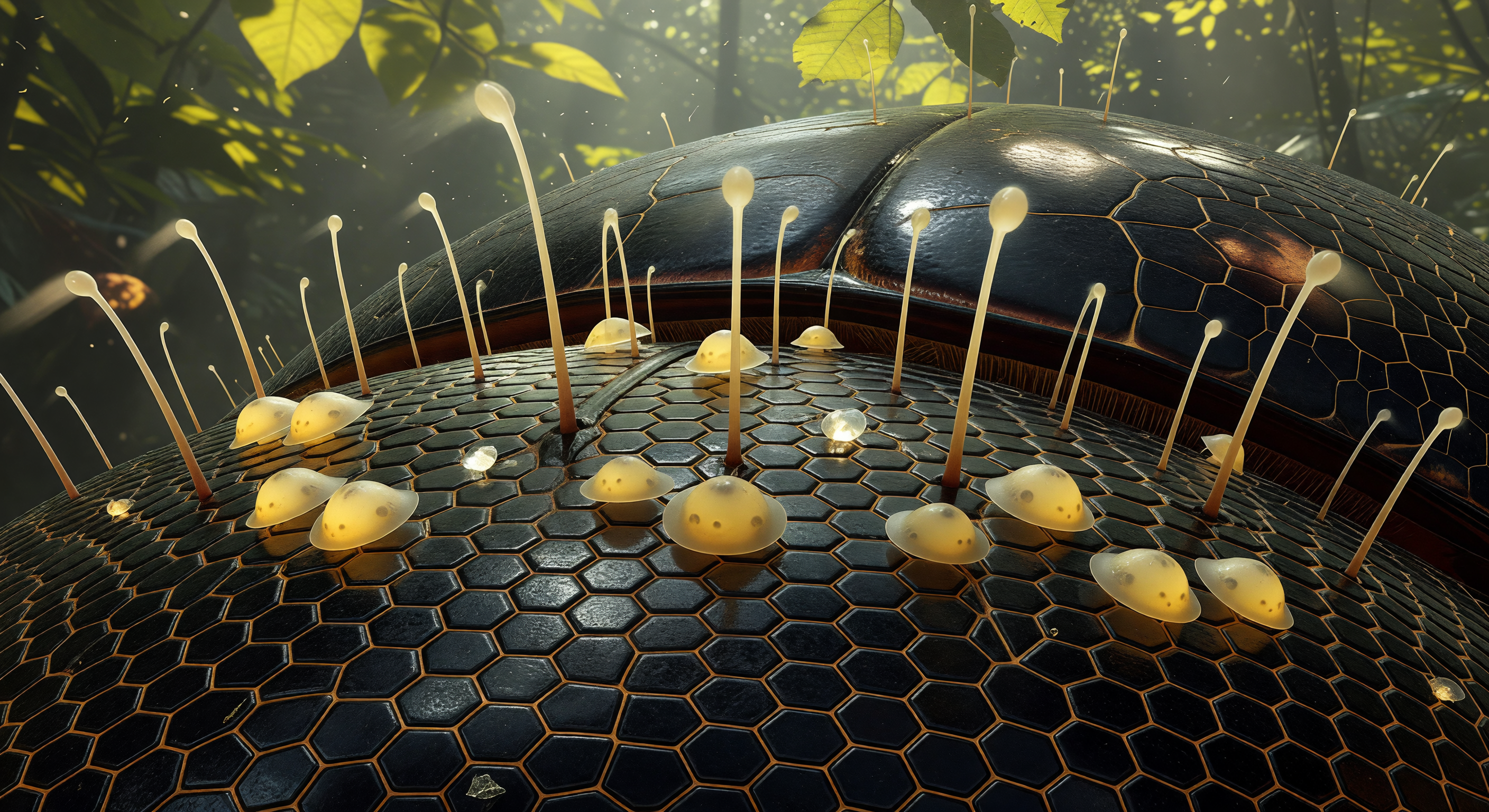
You stand on the geometric perfection of a beetle's hind leg, your feet pressing against hexagonal chitin tiles that stretch toward the animal's thorax like an obsidian city block rising at the horizon, every plate edged in amber ridge-lines and lacquered to a wet sheen. Ahead of you, twelve hypopi — the dispersal stage of a phoretic mite species — cling to the dorsal surface in pale amber clusters, their bodies flattened to near-transparency at the edges, held fast by ventral suckers in a grip so complete they require no muscular effort whatsoever: the hypopus is a physiologically suspended form, its legs folded inward and vestigial, its digestive system shut down, existing purely as a passenger optimized for attachment and endurance through the physics of adhesion rather than the biology of feeding. Around them, the beetle's mechanosensory setae rise like curved lamp-posts, their tips carrying the faintest smear of motion blur that betrays the vibration traveling up through the chitin from each footfall — a tremor you feel through your own feet while the hypopi above it remain absolutely, almost aggressively still. The dappled green-amber light filtering down through decomposing leaf canopy plays across the cuticle in slow-traveling pools of warmth, illuminating the faint ghost of organ masses visible through each mite's semi-translucent body wall — living cargo sealed inside amber resin, riding an unwitting host through a forest understory that, from here, feels as vast and architecturally complex as any human city.
Other languages
- Français: Passagers Hypopus sur Patte
- Español: Hipopus Viajeros en Escarabajo
- Português: Hipopus Passageiros na Perna
- Deutsch: Hypopus Reisende am Käferbein
- العربية: ركاب هيبوبوس على ساق خنفساء
- हिन्दी: भृंग टांग पर हाइपोपस यात्री
- 日本語: 甲虫の脚のヒポパス旅客
- 한국어: 딱정벌레 다리의 히포푸스 승객
- Italiano: Ipopus Passeggeri sulla Zampa
- Nederlands: Hypopus Reizigers op Keversbeen