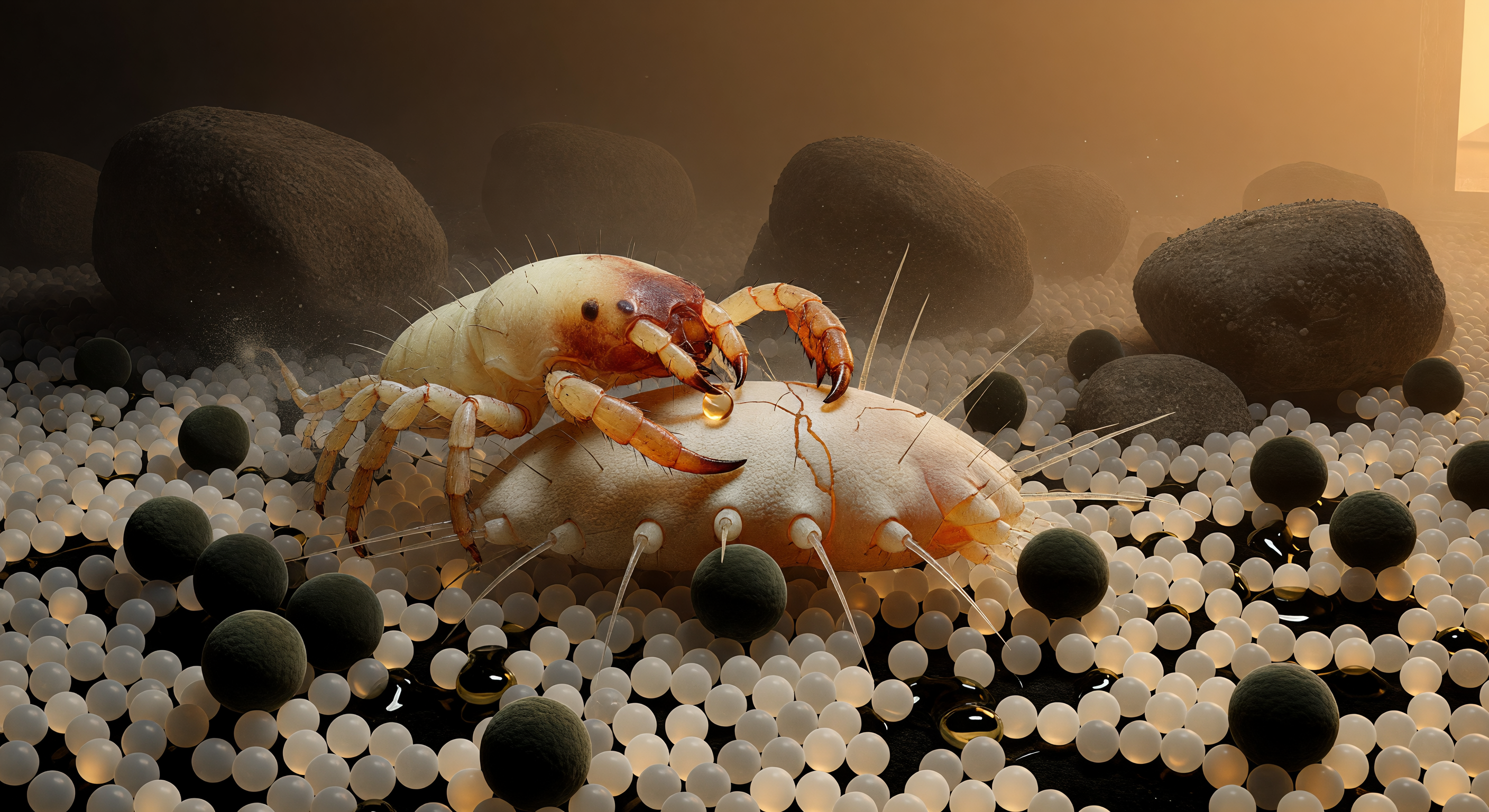
At the moment captured here, a *Cheyletus* predatory mite — cream and rust-colored, built like siege machinery — has locked its oversized palpal claws around a much softer grain mite (*Acarus* or kin), cheliceral stylets already driven through the yielding cuticle in a predation strike lasting perhaps 100 to 200 milliseconds in real time. The prey's granular integument dimples and splits under compression, its long dorsal setae pressed sideways or still trembling upright against the backlight, while a bead of digestive fluid gleams at the cheliceral tips — *Cheyletus* practices extra-oral digestion, liquefying the prey's contents before ingestion, a strategy common across predatory prostigmatan mites. The floor on which this arrest takes place is a dense mosaic of 25-micrometer starch spheres, each one a near-translucent globe that to these animals is a boulder requiring navigation, separated by black inter-particle crevices where capillary water films form curved menisci bridging contact zones — geometry that at this scale behaves as barrier, highway, and feeding arena simultaneously. Scattered among the starch field, *Aspergillus* spores the size of large marbles sit wedged between substrate particles, their olive-black ridged surfaces catching one hemisphere of warm light, their presence a reminder that the same grain-store microhabitat supporting this predator-prey encounter is simultaneously a fungal ecosystem operating on a parallel, overlapping scale. Everything here — cuticle failure, fluid transfer, spore adhesion, water-film architecture — is governed not by gravity but by surface tension, capillary force, and Van der Waals adhesion, the true physics of a world measured in fractions of a millimeter.
Other languages
- Français: Cheyletus attaque l'acarien des grains
- Español: Cheyletus ataca al ácaro del grano
- Português: Cheyletus ataca ácaro do grão
- Deutsch: Cheyletus greift Getreidemilbe an
- العربية: هجوم الشيليتوس على عثة الحبوب
- हिन्दी: चेलेटस का अनाज घुन पर प्रहार
- 日本語: チェイレタスが穀物ダニを捕食
- 한국어: 체일레투스의 곡물 진드기 공격
- Italiano: Cheyletus attacca l'acaro del grano
- Nederlands: Cheyletus valt graanmijt aan