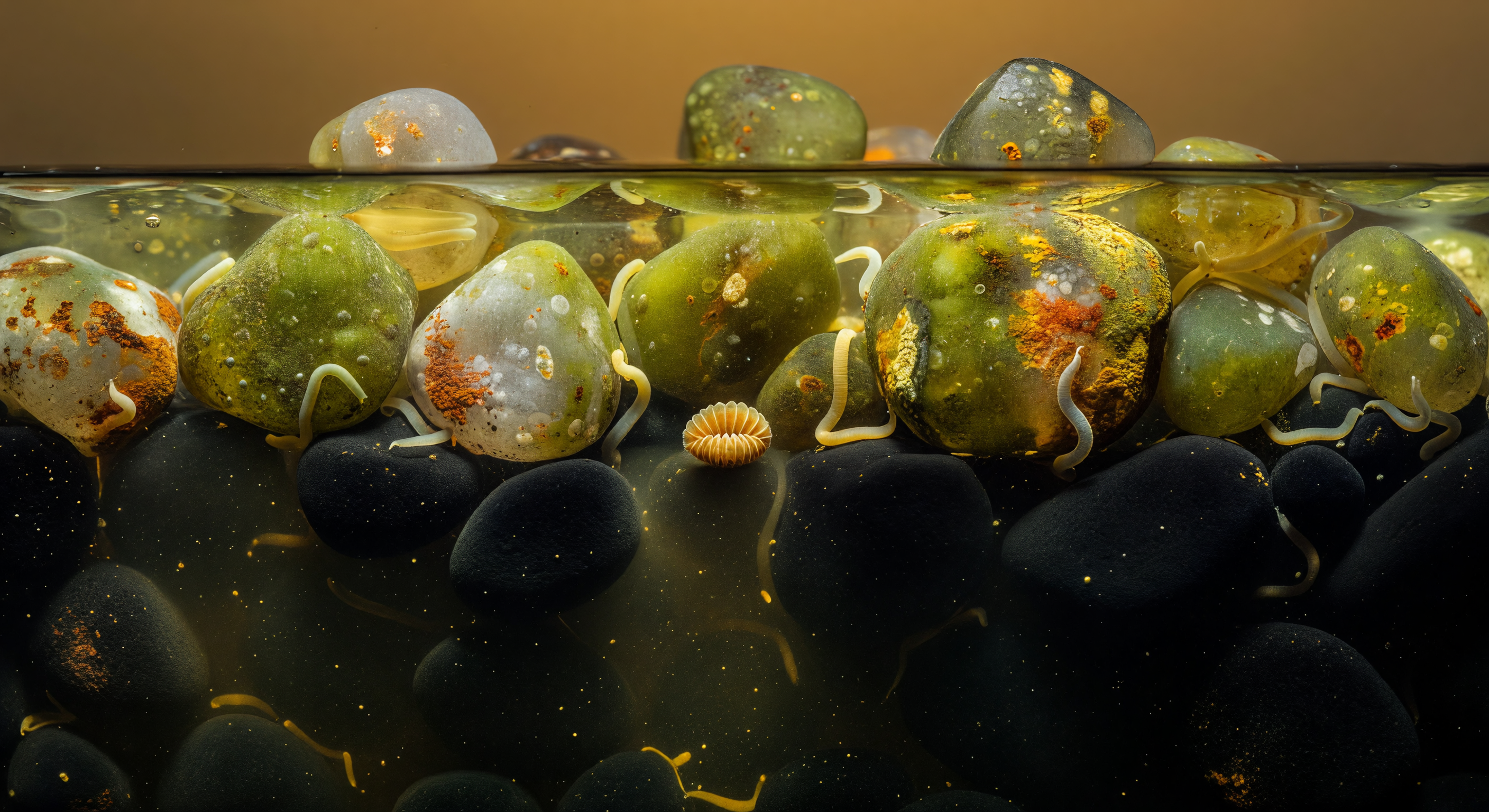
You hover at the edge of a chemical precipice, suspended in crystalline pore water between two irreconcilable worlds, looking down a cliff-face of sand grains that descends within a few hundred microns from teeming amber-lit life into jet-black mineral silence. Behind you, quartz grains the size of office towers carry their golden-green biofilm lacquer — living enamel built from diatoms, bacteria, and extracellular polymer — while nematodes the length of city blocks sinuate through water so oxygen-rich it almost glows; ahead and below, those same grains are coated entirely in iron monosulfide, FeS, a precipitate that absorbs all available light and renders every surface the color of wet coal, the product of sulfate-reducing bacteria exhaling hydrogen sulfide upward through the pore network in a continuous chemical scream. The transition zone between them — a mere two-millimeter band — represents one of the steepest redox gradients on Earth, a compressed geological drama where dissolved oxygen drops to zero, iron and manganese cycle through transitional valences, and biofilms bleach from living gold-green to ashen grey as anaerobic chemistry dismantles the architecture of the upper world. At the exact lip of the black layer, a single loricifera rests curled within its rigid cuticular lorica, overlapping plates sculpted like a miniature armored seed pod, its introvert retracted inward — a member of a phylum unknown to science until 1983, existing here at the boundary between oxygen and oblivion, the last macroscopic life visible before the sulfurous dark below swallows everything.
Other languages
- Français: Falaise Redox Vers Couche Noire
- Español: Acantilado Redox Hacia Capa Negra
- Português: Falésia Redox À Camada Negra
- Deutsch: Redox-Klippe Zur Schwarzen Schicht
- العربية: منحدر ريدوكس نحو الطبقة السوداء
- हिन्दी: रेडॉक्स चट्टान काली परत में
- 日本語: 酸化還元断崖から黒層へ
- 한국어: 산화환원 절벽에서 검은 층으로
- Italiano: Scogliera Redox Verso Strato Nero
- Nederlands: Redoxklif Naar Zwarte Laag