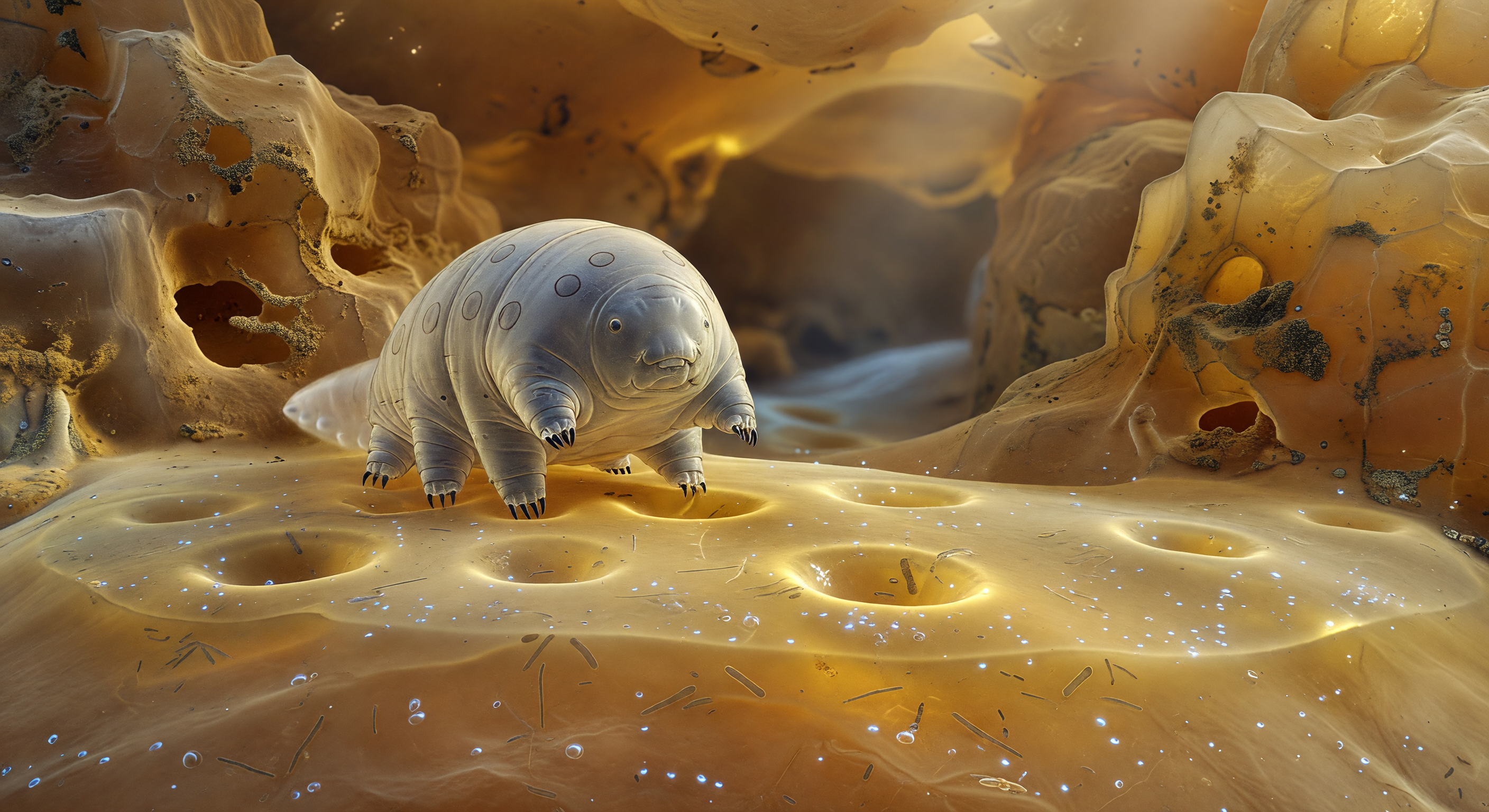
You are crouched at biofilm level, face-to-face with a creature whose barrel-shaped body fills your field of view like a pale luminous boulder — a Stygarctus tardigrade, roughly 400 micrometres long, moving with the unhurried deliberation of something that has never needed to rush. Its semi-transparent grey-blue cuticle reveals faint annular bands of circular musculature beneath, dark hoops visible through the pearl-like integument, while four grounded lobopods compress the amber extracellular polymeric substance layer into shallow craters, each cluster of curved claws sinking into the viscoelastic biofilm gel with the grip of grappling hooks — the claw tips vanishing below the golden meniscus as the EPS deforms and holds. The biofilm itself is the dominant material of this world: a continuous undulating sheet of amber-gold EPS secreted by the resident bacterial and diatom community, its matrix studded with silica diatom frustules that scatter the raking light into pale blue-white glints, while rod-shaped bacteria resolve as dark threads crossing the gel like veins in polished amber. Flanking the tardigrade, two quartz grains rise into the frame like sandstone mesa walls, their conchoidal fracture surfaces rough at this scale, their crests swept translucent caramel where the biofilm thins, while between them a pore-space corridor recedes into cool blue-grey shadow — interstitial water pooling in the throat beyond, a reminder that this gilded, cathedral-like surface opens immediately into a dark labyrinthine architecture of grain and void.
Other languages
- Français: Griffes de tardigrade en biofilm
- Español: Garras de tardígrado en biopelícula
- Português: Garras de tardígrado no biofilme
- Deutsch: Bärentierkrallen im Biofilm
- العربية: مخالب دببة الماء في الغشاء الحيوي
- हिन्दी: टार्डिग्रेड के पंजे बायोफिल्म में
- 日本語: クマムシの爪、バイオフィルムの中
- 한국어: 완보동물 발톱과 생물막
- Italiano: Artigli di tardigrado nel biofilm
- Nederlands: Waterbeerklauwen in biofilm