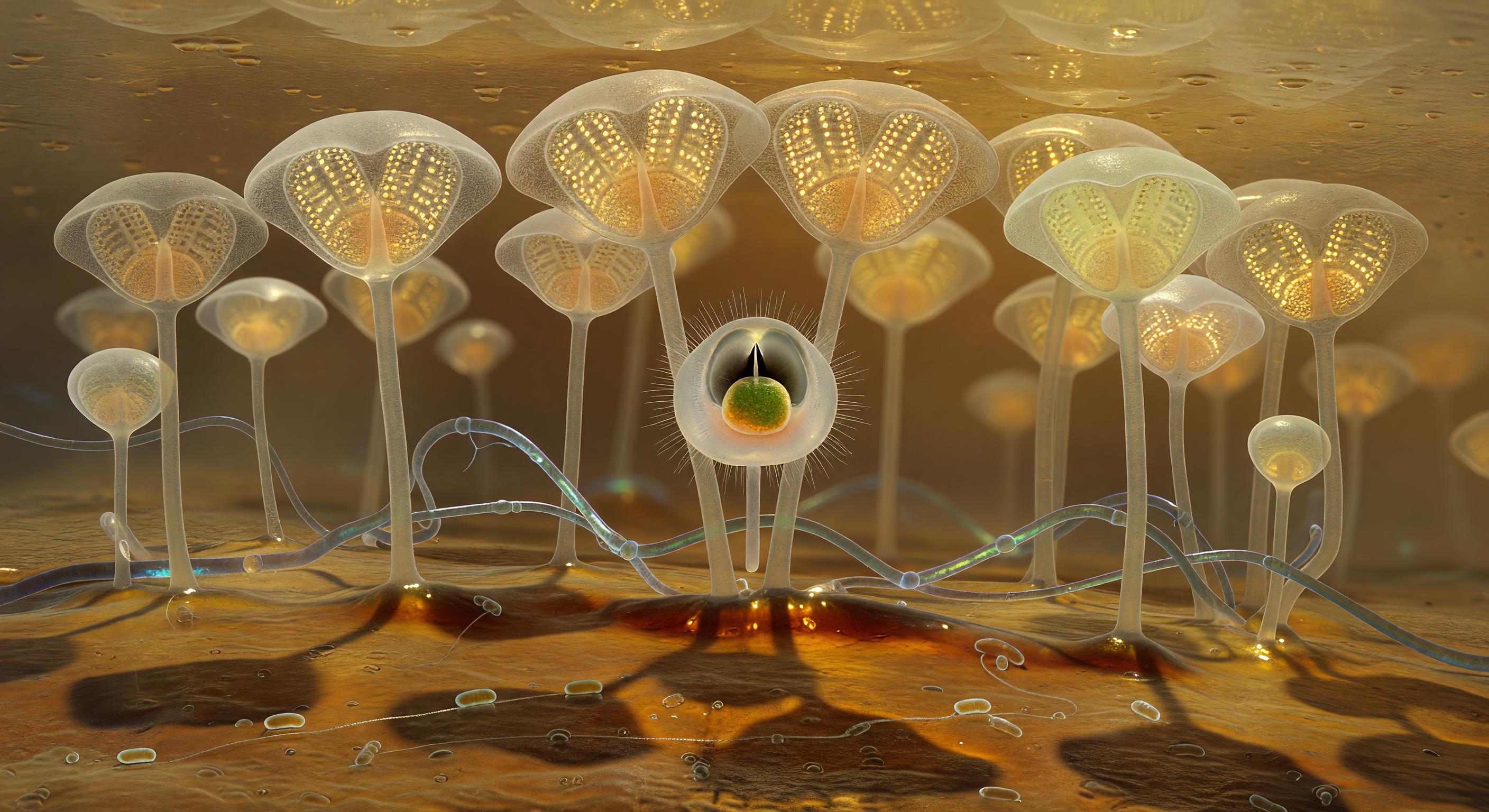
You are hovering at the base of a golden forest, eye-level with the anchoring points of translucent mucilage stalks that rise above you like the pillars of a flooded cathedral, each one crowned by a fan-shaped diatom valve whose silica frustule — etched with rows of submicron pores — blazes amber and frosted-cream where the oblique grain-filtered light catches it, while those facing away cast precise Y-shaped shadows across the lacquered extracellular polymeric substrate beneath your feet, a floor of compacted biological varnish that shifts from transparent amber in thin patches to deep burnt-ochre where the EPS matrix pools into glossy ridges. Pressed between two stalks at mid-canopy height, a Chaetonotus gastrotrich — a complete bilateral animal, organ systems visible through its milky cuticle as through frosted acetate — holds itself braced by posterior adhesive tubes against the torque of active feeding, its triradiate pharynx dilated to maximum aperture around a whole intact diatom cell whose silica valve is caught mid-compression at the buccal opening, the mechanics of ingesting a particle nearly as wide as the predator's own head playing out in a fraction of a second. Cyanobacterial filaments drape between stalk bases in blue-green loops, iridescent where a thin water film renders interference color, and comma-shaped bacteria inscribe glistening mucus trails across the varnish floor below — every surface here is simultaneously architecture, food source, and chemical signal, a world where viscosity and surface tension replace gravity as the governing forces, and where the entire known universe fits within the area of a fingertip pressed lightly into wet sand.
Other languages
- Français: Pâturage en forêt de diatomées
- Español: Pastoreo en bosque de diatomeas
- Português: Pastagem na floresta de diatomáceas
- Deutsch: Weide im Kieselalgen-Wald
- العربية: رعي غابة الطحالب الدقيقة
- हिन्दी: डायटम वन चराई दृश्य
- 日本語: 珪藻林の採餌風景
- 한국어: 규조 숲 방목 장면
- Italiano: Pascolo nella foresta di diatomee
- Nederlands: Begrazing in diatomeeënwoud