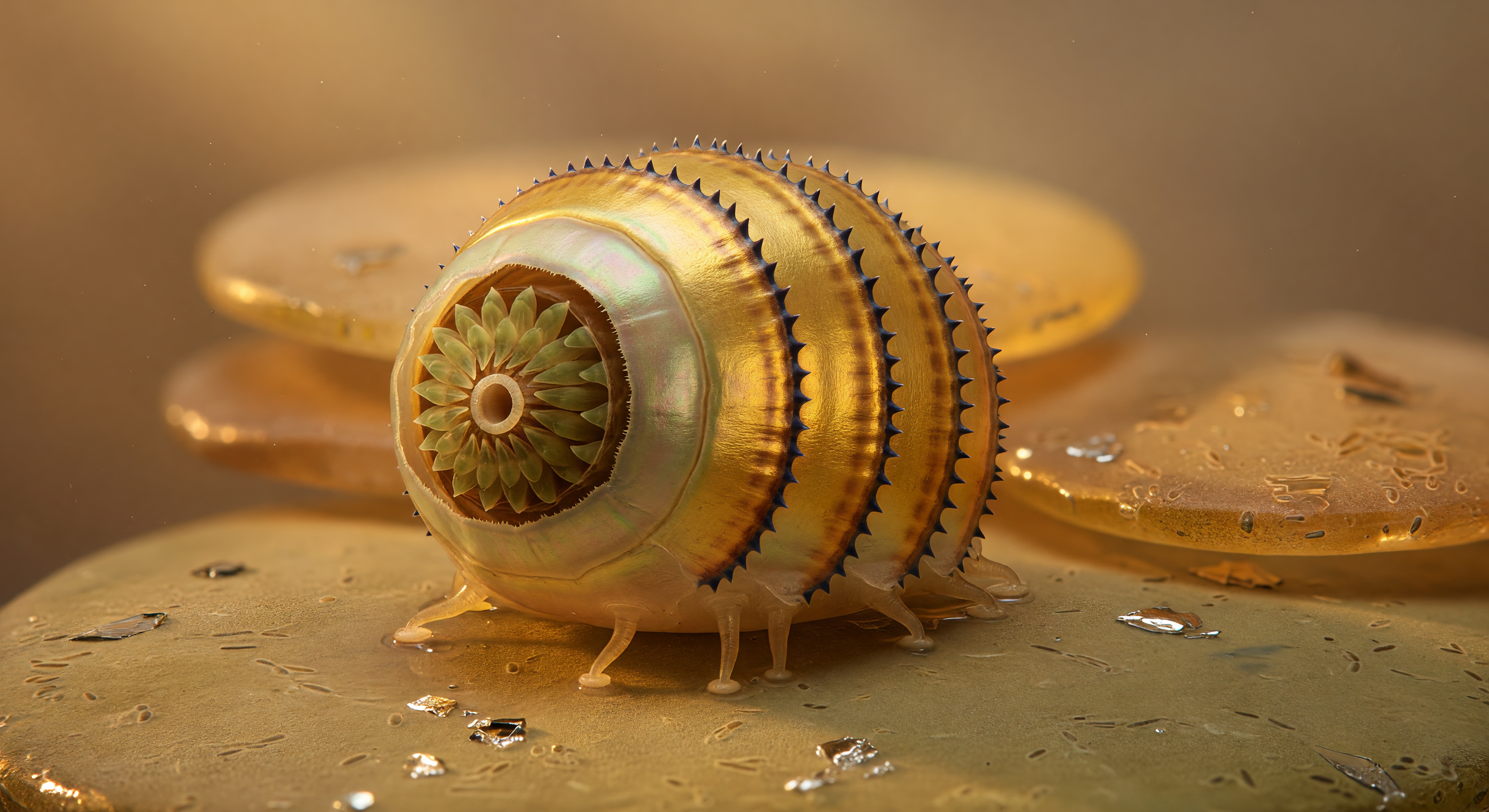
You are suspended at the equator of a single sand grain, face to face with a loriciferan — a creature whose phylum wasn't known to science until 1983, yet whose body plan has been refined across half a billion years of interstitial life. The animal fills your field of view like a barrel-vaulted fortress: six longitudinal lorica plates in deep honey-amber catch the raking oblique light as blazing brass ridges, while the channels between them plunge into mahogany shadow, the serrated overlapping margins casting micro-battlements of ink-blue notches each no wider than a single bacterium. At the anterior pole, the partially withdrawn introvert has bunched its concentric scalid rings into a folded rosette of translucent, chitinous-green spines — sensory and locomotory appendages that, when fully extended, anchor and pull the animal through pore throats barely wider than its own body — while at the base, two pairs of adhesive toes press slender discs flat against the biofilm-coated grain, each toe held in place by the same viscous meniscus forces that, at this scale, rival gravity entirely. The grain surface behind the animal dissolves into caramel bokeh threaded with micro-turbidity, the water column thick enough with dissolved organics and fine particles to read like fog at dusk, and the whole amber cavern carries the weight and silence of a place where surface tension, chemical gradients, and cuticular engineering are the only physics that matter.
Other languages
- Français: Portrait de Loricifera Cuirassé
- Español: Retrato de Loricifera Acorazada
- Português: Retrato de Loricifera Encouraçada
- Deutsch: Gepanzertes Loricifera Porträt
- العربية: صورة لوريسيفيرا المدرعة
- हिन्दी: लोरिसिफेरा कवचित चित्र
- 日本語: 装甲ロリシフェラの肖像
- 한국어: 갑옷 로리시페라 초상
- Italiano: Ritratto di Loricifera Corazzata
- Nederlands: Gepantserd Loricifera Portret