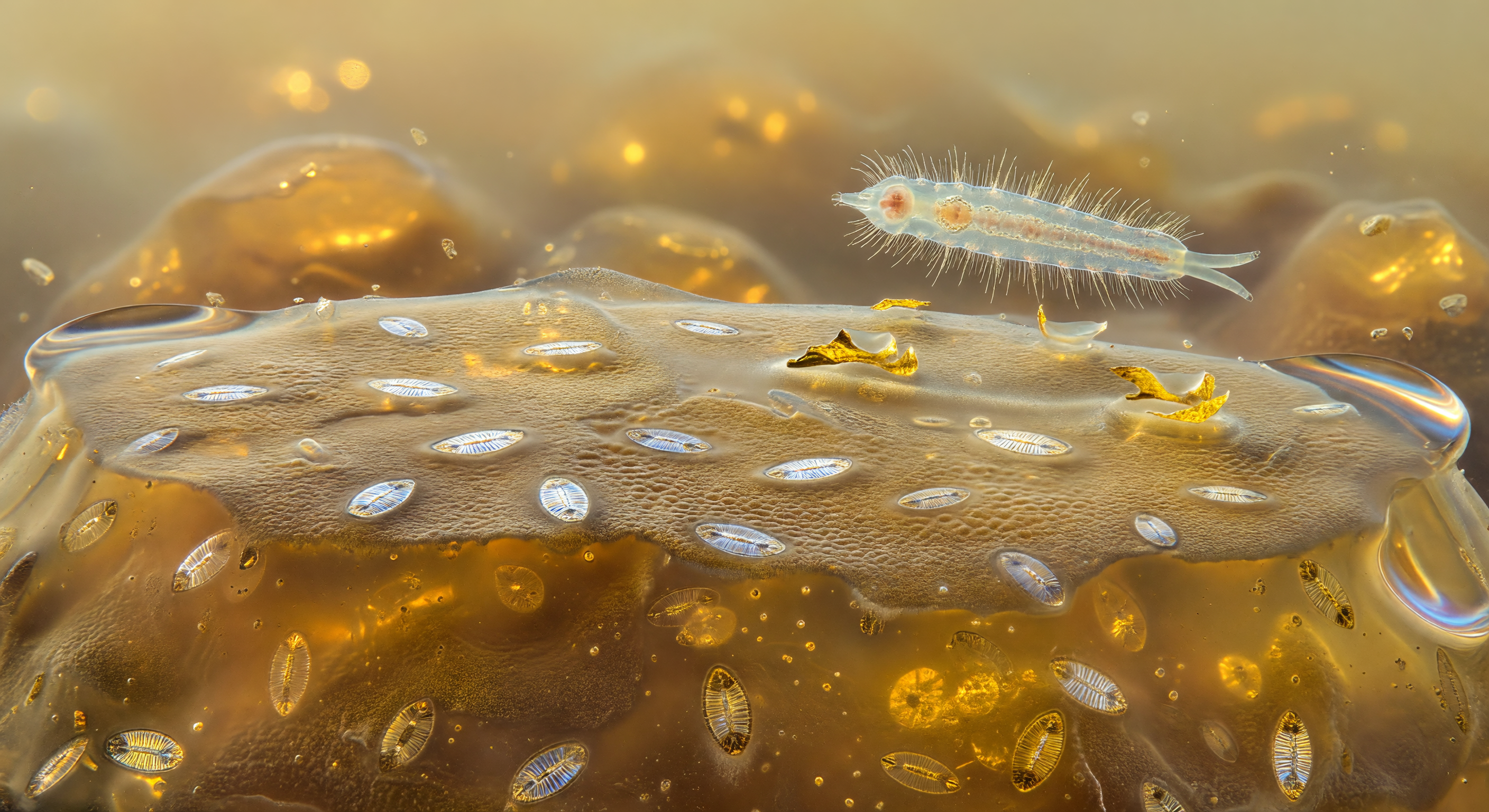
A single quartz grain dominates the view like a vast amber mesa, its translucent interior glowing with warm honeyed light refracted through layers of water and neighbouring grains dissolved into soft luminous boulders at the edges of perception. The grain's upper surface is not bare mineral but a living savanna of EPS biofilm — a gelatinous, gold-brown mat secreted by bacteria and half-buried diatoms, whose silica frustules flash cold geometric light like stained-glass fragments pressed into warm mucilage. Crossing this terrain from the upper right, a gastrotrich moves on two longitudinal bands of ventral cilia, each filament a silver hair caught mid-beat, the organism's transparent cuticle revealing the faint rose-amber shadows of a pulsing tri-radiate pharynx and granular gut within; behind it, two posterior adhesive tubes have just released the biofilm surface, leaving a pair of minute craters in the EPS where the glue-and-release mechanism operated, the mucilage still rebounding at the edges, catching amber backlight like crinkled foil. At this scale, surface tension and viscosity govern all motion — gravity is functionally irrelevant — and the thin concave menisci visible at the frame's periphery, where interstitial water clings to grain edges in faint blue-white curves, are forces powerful enough to trap or fling a body this size during tidal exposure. The entire scene breathes with the slow chemistry of a living sediment: oxygen diffusing downward through microns of overlying water, the biofilm mat metabolising, the gastrotrich grazing a landscape built equally of mineral and life.
Other languages
- Français: Savane de biofilm à marée haute
- Español: Sabana de biopelícula en pleamar
- Português: Savana de biofilme na maré alta
- Deutsch: Biofilm-Savanne bei Flut
- العربية: سافانا الغشاء الحيوي في المد
- हिन्दी: ज्वार पर बायोफिल्म सवाना
- 日本語: 満潮のバイオフィルム草原
- 한국어: 만조의 바이오필름 사바나
- Italiano: Savana di biofilm all'alta marea
- Nederlands: Biofilm-savanne bij vloed