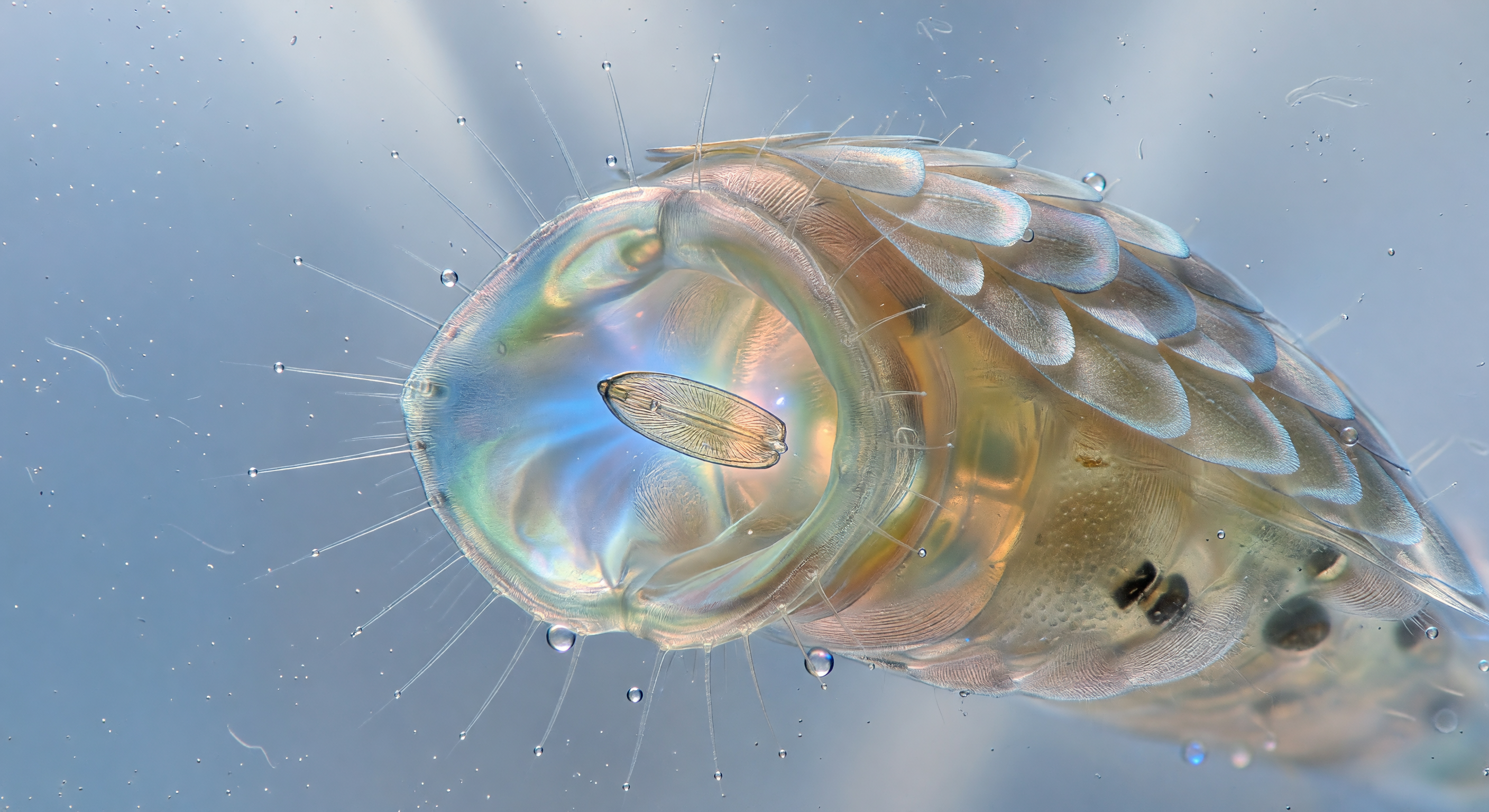
You are hovering microns from the face of an animal that has no right to look this monumental — a Chaetonotus gastrotrich in the act of feeding, its triradiate pharynx wrenched to maximum dilation, three muscular sectors splayed open like the petals of a carnivorous flower to form a triangular aperture barely fifteen microns across, yet framed so closely by transmitted blue-white light that it fills your entire visual field the way a cathedral rose window fills a nave. At the centre of that gape, a Navicula diatom frustule is already half-consumed, its silica hull glowing gold-tan and warm honey, its fine raphe striae still legible along the boat-shaped valve even as one blunt pole vanishes into pharyngeal darkness — a feeding strike unfolding in tens of milliseconds, driven by striated musculature whose tightly packed fibers read as rose-and-silver wood-grain under this collimated illumination, the whole system a pressurized hydrostatic pump refined across five hundred million years of meiofaunal evolution. Encircling the mouth, twenty buccal cilia project outward in a frozen metachronal halo, each hyaline rod tipped with an interstitial water meniscus that refracts the transmitted light into pinprick flares of violet and ice-blue, while behind them the dorsal cuticle recedes in overlapping rhomboid scales whose razor-thin keels produce thin-film interference in cold silver and dilute cobalt — structural iridescence compressed into geometry measured in single microns. The surrounding water is not empty but atmospheric, threaded with bacterial fragments, colloidal EPS strands, and mineral dust drifting like smoke frozen in glass, giving the open space between you and that dilated pharynx a depth and consequence entirely disproportionate to its physical size.
Other languages
- Français: Dilatation Pharyngée du Gastrotricha
- Español: Dilatación Faríngea del Gastrotrico
- Português: Dilatação Faríngea do Gastrotrico
- Deutsch: Gastrotrich Schlunddehnung Moment
- العربية: اتساع بلعوم الغاستروتريكا
- हिन्दी: गैस्ट्रोट्रिक ग्रसनी विस्तार क्षण
- 日本語: 腹毛動物の咽頭拡張瞬間
- 한국어: 복모동물 인두 확장 순간
- Italiano: Dilatazione Faringea del Gastrotrico
- Nederlands: Gastrotrich Keelholte Dilatatie