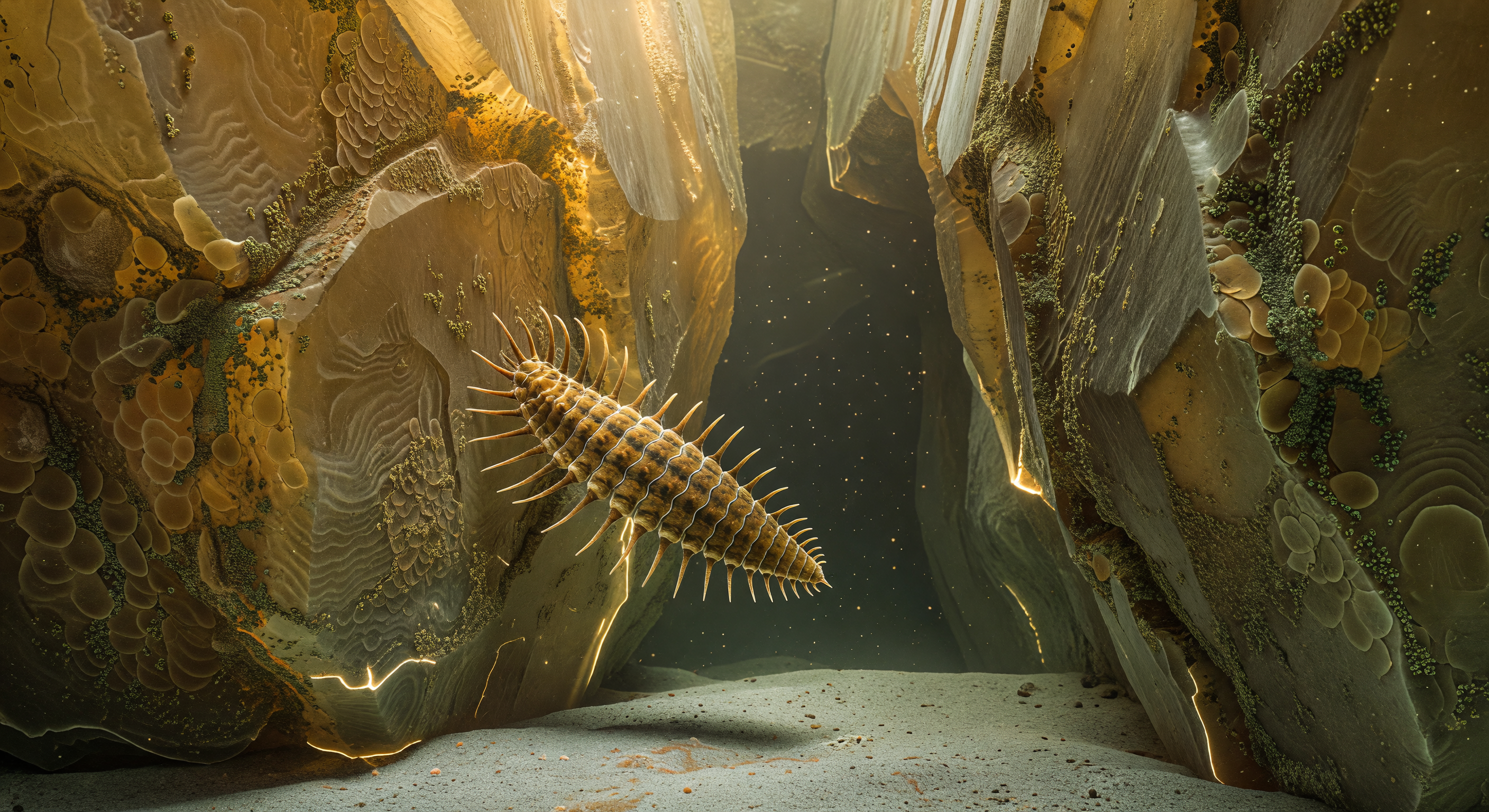
At the entrance to what might be a cathedral nave scaled down to the imperceptible, two massive quartz walls rise on either side — their faces geological in complexity, encrusted with flattened clay platelets like lichen on sandstone, glazed by a tawny-gold biofilm that catches diffuse amber light filtering through the translucent mineral itself. The passage ahead converges into a slot of near-blackness, olive-grey interstitial water filling the throat with faint turbidity, suspended detrital motes catching lateral light like dust frozen mid-fall in an airless room. Pressed against the left wall in the middle ground, a kinorhynch occupies this corridor as both traveler and structural element — its segmented amber-brown cuticle lacquered under rim illumination, each zonite bordered in a paler sclerite edge, while its fully extended introvert splays concentric rings of curved, chitin-tipped scalids directly into the biofilm surface, slightly deforming it, bracing the animal against a grain face the size of a building facade relative to its body. This is a world where gravity has surrendered authority to viscosity and surface tension, where chemical gradients invisible to any larger eye stratify the water column within fractions of a millimeter, and where the architecture of sediment — the pore throats, the biofilm veneers, the menisci seaming grain edges in bright curves — constitutes both landscape and ecological pressure in equal measure.
Gastrotrichs & meiofauna