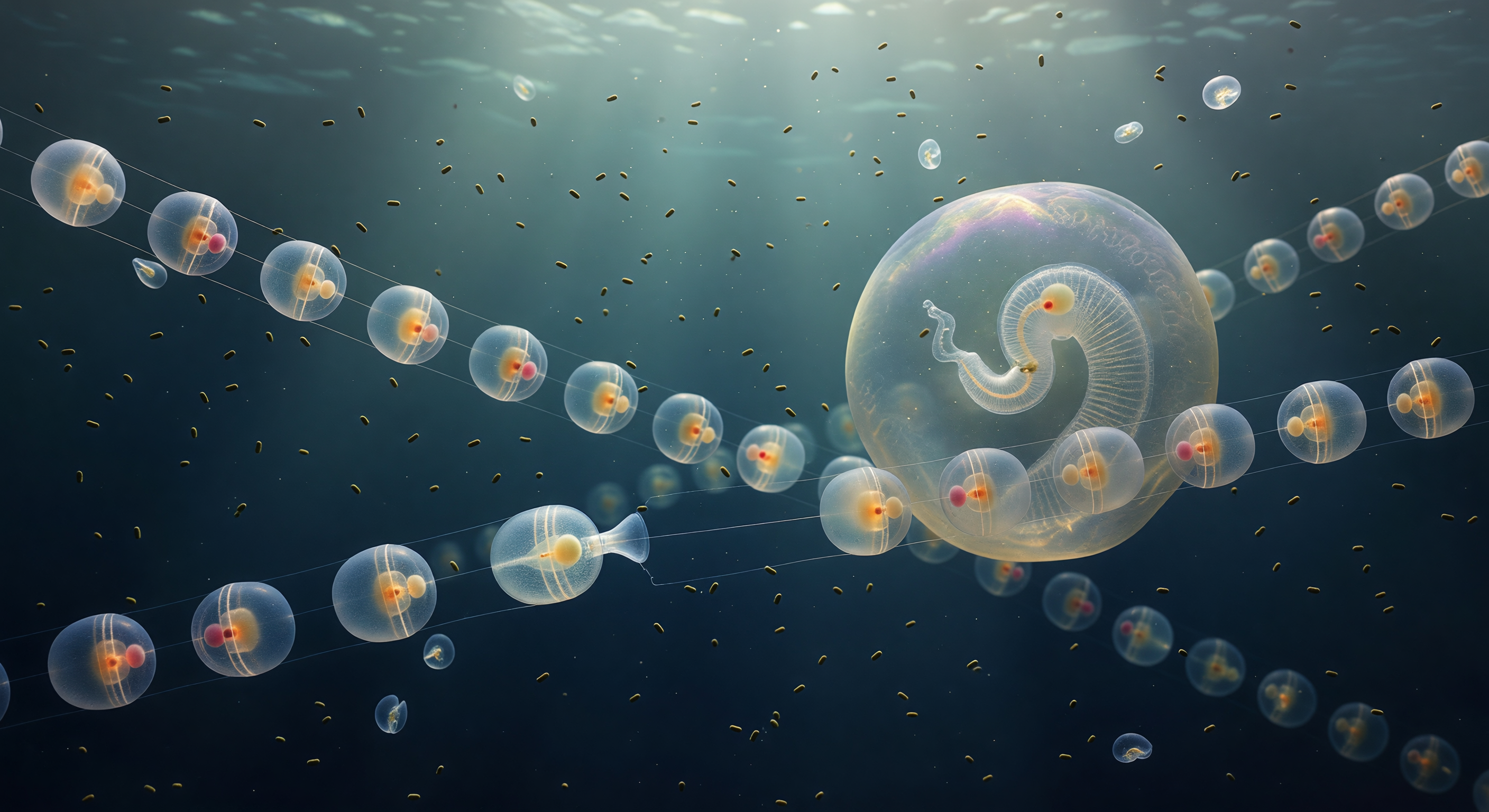
Scientific confidence: High
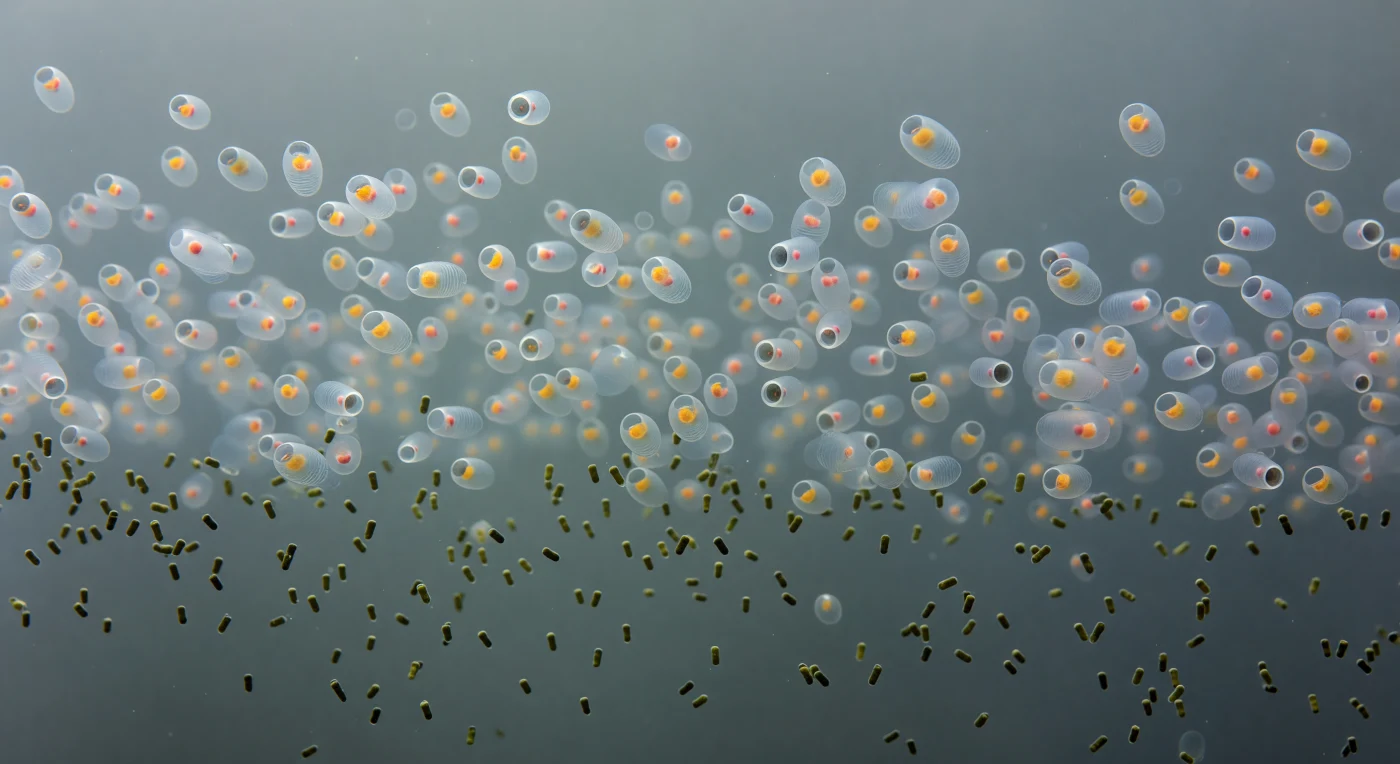
You are suspended inside a living snowstorm that has no edges, no floor, no ceiling — only an endless, pulsating milky interior where every half-meter of vision ends against another body before it can travel further. At one hundred individuals per cubic meter, the sub-Antarctic water column has been colonized so thoroughly by *Salpa thompsoni* that the ocean itself has changed phase: it is no longer transparent but opalescent, each photon arriving from the gray overcast surface scattered again and again by gelatinous cylinders until the light becomes sourceless, cold, and evenly pearl-white, broken only by the warm amber glow of each individual's gut — a concentrated smear of ingested phytoplankton burning like a small interior fire — and the faint coral-pink float of gonads suspended beside them like jewels in a medium that is ninety-six percent seawater. These animals are filter machines of extraordinary efficiency, their circular muscle bands contracting in slow rhythmic pulses at roughly two beats per second, drawing water through a pharyngeal mucous net fine enough to capture bacteria and picoplankton far below the capture threshold of any crustacean zooplankton, and together they are processing the entire illuminated surface layer at a rate capable of stripping it of primary production within days. Crossing your peripheral vision in continuous unhurried procession, dense dark olive-brown fecal pellets — membrane-wrapped cylinders packed with reprocessed phytoplankton — descend in near-vertical trajectories with ballistic purposefulness, each one a compressed parcel of surface carbon beginning its weeks-long journey toward the seafloor, constituting collectively a biological pump so efficient that a single bloom of this scale can transfer more fixed carbon to the deep ocean in one season than would otherwise sink in a year.
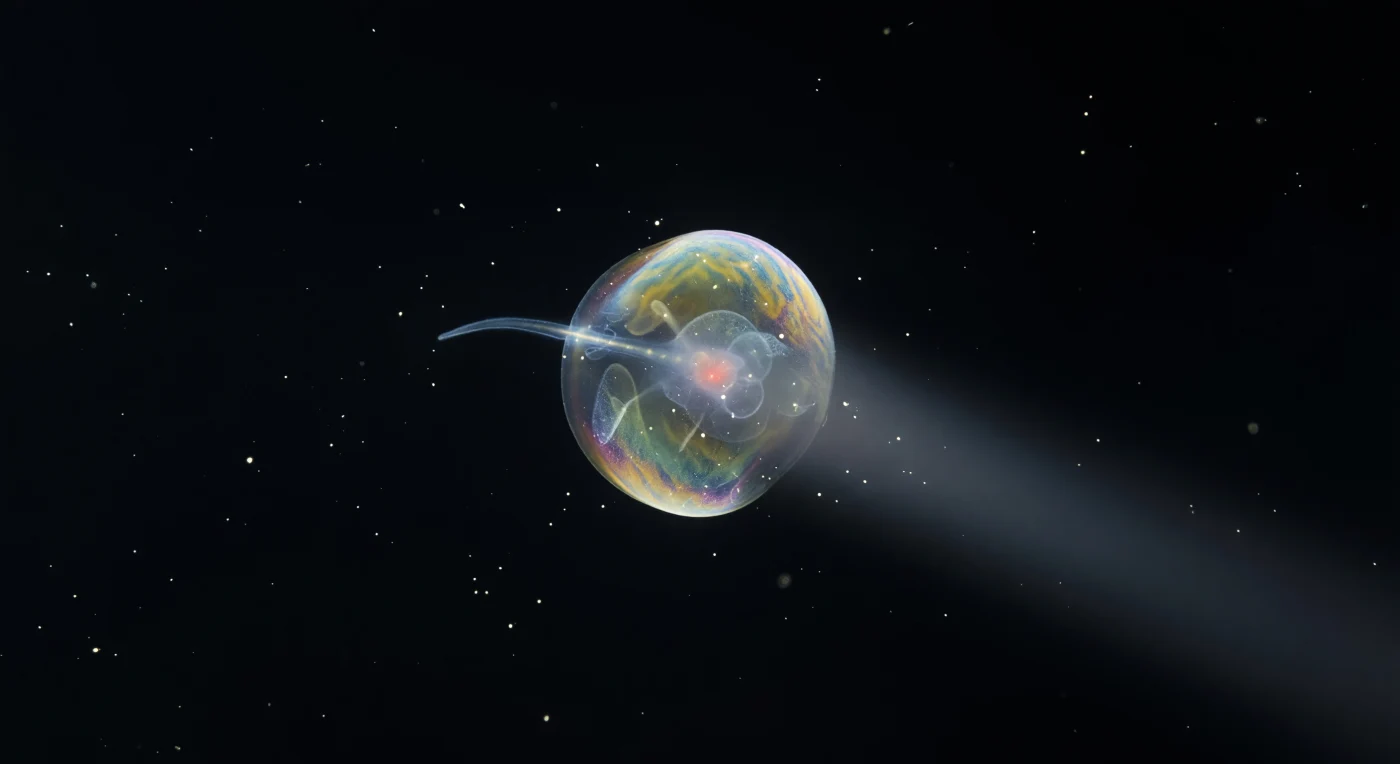
You are suspended in total oceanic blackness, five centimeters from a structure that barely exists — a three-centimeter sphere of mucopolysaccharide so optically matched to seawater that you perceive it only as a faint warping of the dark, a lens-like distortion at the threshold of nothingness, until an oblique LED beam finds its curved membrane and the entire house ignites in cascading interference color: pale arctic blue bleeding into amber gold bleeding into sea-foam green, bands shifting and reorganizing across the domed surface like a soap bubble inflated to the size of a grapefruit, each micron of mucus thickness producing its own spectral signature so that the iridescence breathes and trembles with every pulse of current. Beyond the illuminated crescent, the sphere falls into translucent shadow and the interior becomes briefly legible — a warm crimson heartbeat pulsing behind the larvacean's trunk wall like an ember seen through fog, and deeper still a glassy notochord rod sweeping in slow sinusoidal arcs that drive the hydrodynamic machinery of the entire house, each beat causing gossamer microfilter baffles of structured mucus to catch the beam and scatter it into a faint opalescent haze, revealing a nanoscale cathedral in gel that is simultaneously a functioning filter plant, a carbon pump, and a complete chordate life. Marine snow drifts across the beam in slow gravitational descent — detrital flakes of three to twelve micrometers flaring briefly white before vanishing back into the abyss — while the iridescent bands continue to reorganize across the membrane and the crimson heartbeat pulses on, quietly insisting that this barely-visible bubble of nearly-nothing has worked perfectly for five hundred million years.
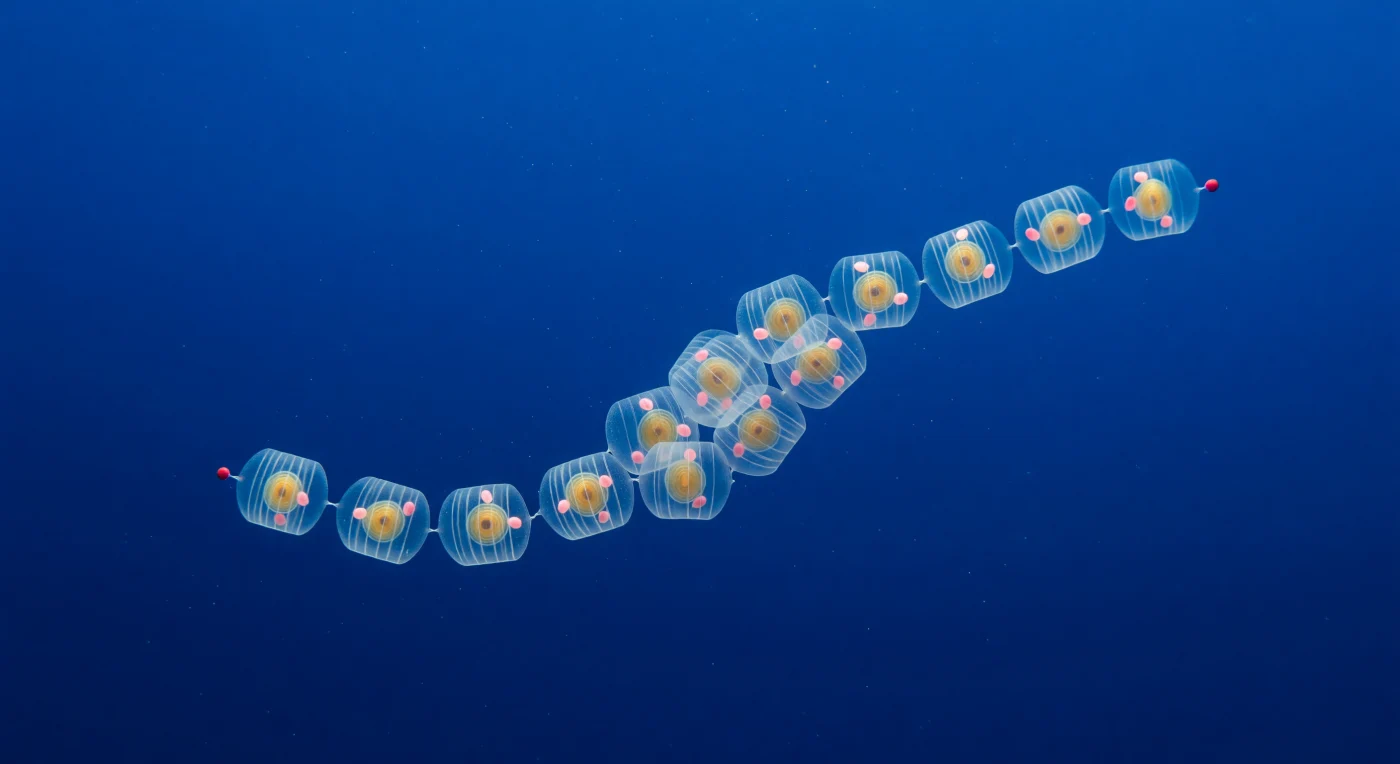
You hover motionless in open water, eye level with a chain of *Thalia democratica* zooids that stretches from just within arm's reach into a cobalt void so saturated it reads less as ocean than as deep space — each individual no wider than a large grape, yet resolved at this proximity into a complete architectural interior: eight ghost-white muscle hoops encircling a coiled amber-gold gut, paired pink lenticular gonads floating like rose-quartz drops, and a crimson heart the size of a pinhead pulsing visibly through the water-clear body wall. The transparency is not emptiness but precision — salp tissue refracts light at a refractive index barely distinguishable from seawater itself, making pigmented organs appear to hang suspended in nothing, while solar caustics restructured by fifteen meters of ocean project shifting geometric lace continuously across the chain's surface and through it, completing their blue-white patterns in the void beyond. Each zooid is connected to the next by stolonic tissue finer than spider silk, the whole aggregate reading as a translucent necklace through deep space, each bead glowing differently as passing caustic nets illuminate different angles — some barrels catching a full solar projection across their muscle bands, others reduced to a simple amber ember in the blue. These animals are filter-feeding continuously, their pharyngeal mucous nets capturing picoplankton — *Prochlorococcus*, *Synechococcus* — at cell sizes below two micrometers, organisms invisible to almost every other zooplankton, concentrating them into the luminous gut kernels visible now as warm filaments against cold infinity, before packaging the carbon in dense fecal pellets that will fall toward the seafloor weeks from now as one of the ocean's most direct biological pumps.
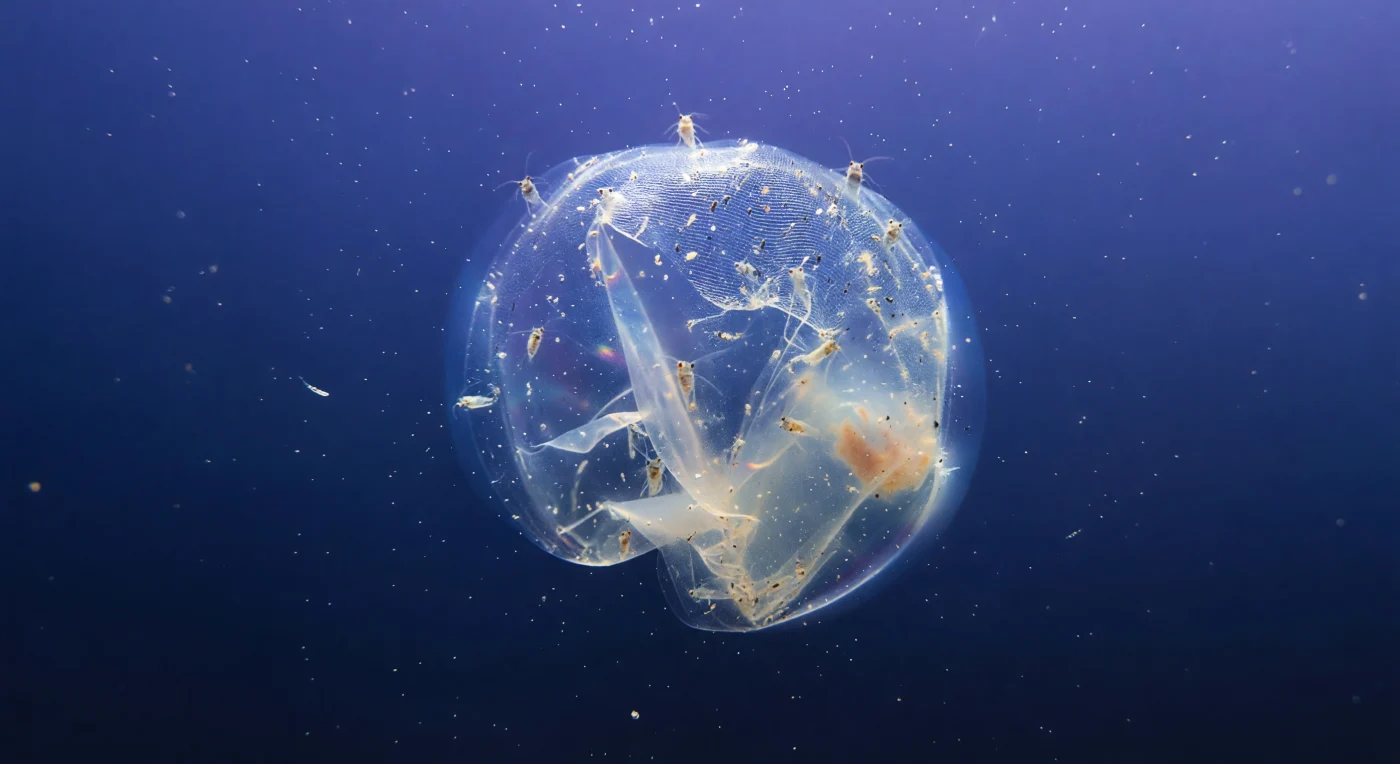
Looking upward through five meters of mesopelagic water, the viewer confronts a structure that reads like a collapsed celestial object — a mucus balloon forty centimeters across, crumpling in asymmetric slow motion as its internal pressure equalizes, one hemisphere already accordion-folded into elegant pleats while the other still holds a ghost of its original dome. This is a larvacean house, a filtering architecture secreted entirely from mucopolysaccharides by an animal smaller than a fingernail, abandoned when its inlet grids clogged beyond usefulness and now beginning its weeks-long descent toward the seafloor carrying a payload of trapped carbon — phytoplankton chains, fecal pellets, bacterial aggregates pressed into its collapsing membrane like insects in amber. Where the mucus remains taut it acts as a thin-film diffractor, splitting the last attenuated indigo daylight into transient iridescent arcs of violet and teal that migrate across the surface as the structure rotates, while clouded regions shift to milky cream and pale tan where accumulated particles have stolen the transparency, and at the perimeter a diffractive halo of blue-white light rings the entire structure like a drowned moon. Hovering at the sagging inlet grid above, copepods no larger than a grain of rice — their bodies so transparent that the deep cobalt water reads straight through them, only twin copper-sphere compound eyes and a dark gut trace betraying their presence — probe the clogged hexagonal mesh with maxillipeds too fine to resolve, opportunistically gleaning concentrated food from what the house's owner discarded. Between the observer and this sinking architecture, marine snow fills the entire water column in slow differential precipitation, each particle a luminous point at a different depth, making the space feel genuinely volumetric — a ghost ship dissolving through layered, inhabited darkness on its way to the abyss.
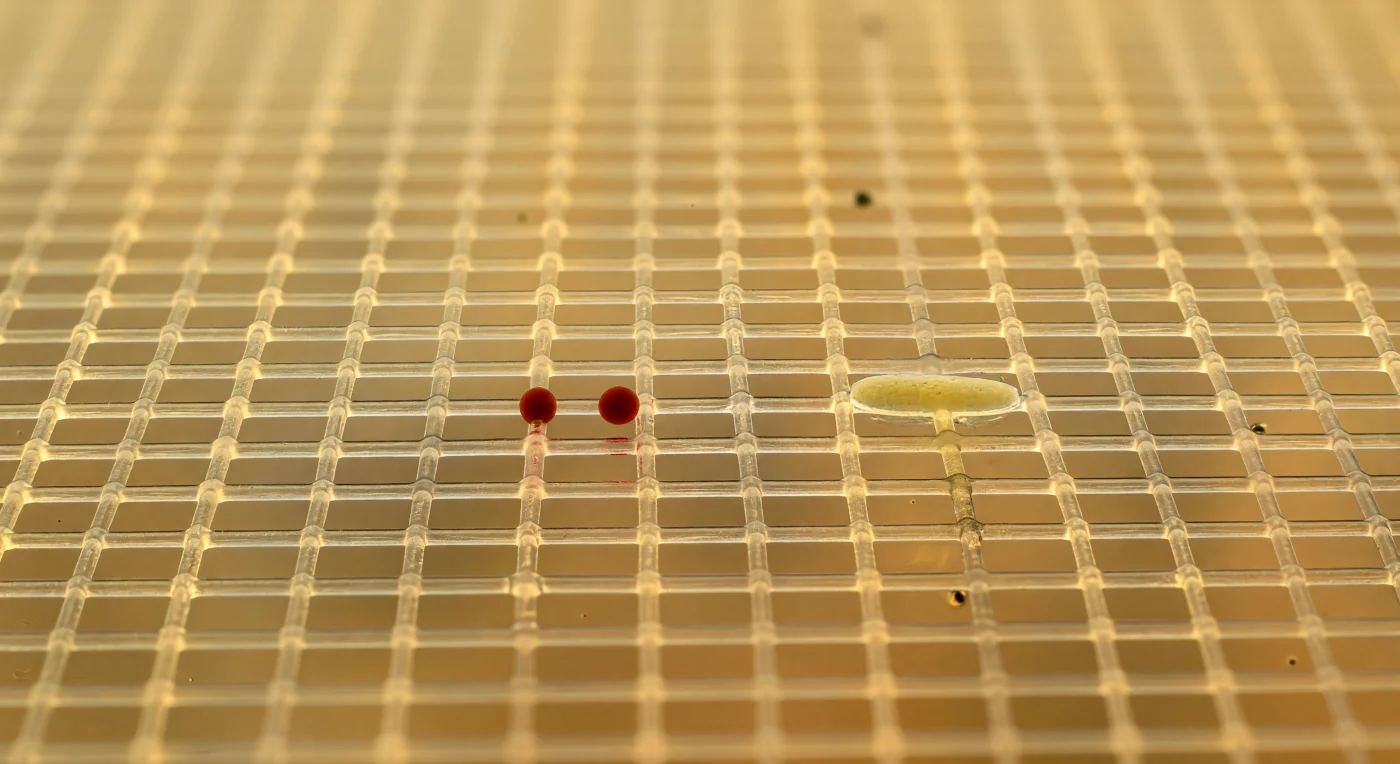
You are suspended inside what can only be described as a cathedral built from light and biological engineering — an infinite orthogonal lattice of mucopolysaccharide fibers stretching in every direction, each glistening strand roughly a bacterium's width in diameter, pulled taut and coated in a viscous near-invisible film that transforms transmitted pharyngeal light into spun amber glass. This is the interior of a salp's pharyngeal mucus net, secreted continuously by the endostyle, a living filter whose rectangular mesh apertures — each barely a micron across — are precisely sized to intercept the ocean's smallest photosynthesizers: *Prochlorococcus* cells, heterotrophic bacteria, viral particles riding the slow invisible current drawn through by muscular jet propulsion. Wedged at the nearest fiber junction, one such *Prochlorococcus* sphere sits like a deep crimson boulder, its 0.6-micron diameter making it proportionally massive here, while a pale bacterial rod adheres lengthwise to an adjacent strand through surface chemistry alone, both cells now committed to digestion by a creature whose tissue is so close in refractive index to seawater that the entire filtering apparatus — pharyngeal basket, mucus net, endostyle, and all — is essentially a ghost of organized biology visible only because amber light catches its geometry. Depth recedes in dissolving planes of gold and ochre, each successive layer of net slightly softer than the last, the lattice fading into warm luminous haze that holds within it the suggestion of more captured particles, more intersections, the whole structure simultaneously a micron-scale mesh and, from within, an endless radiant cosmos.
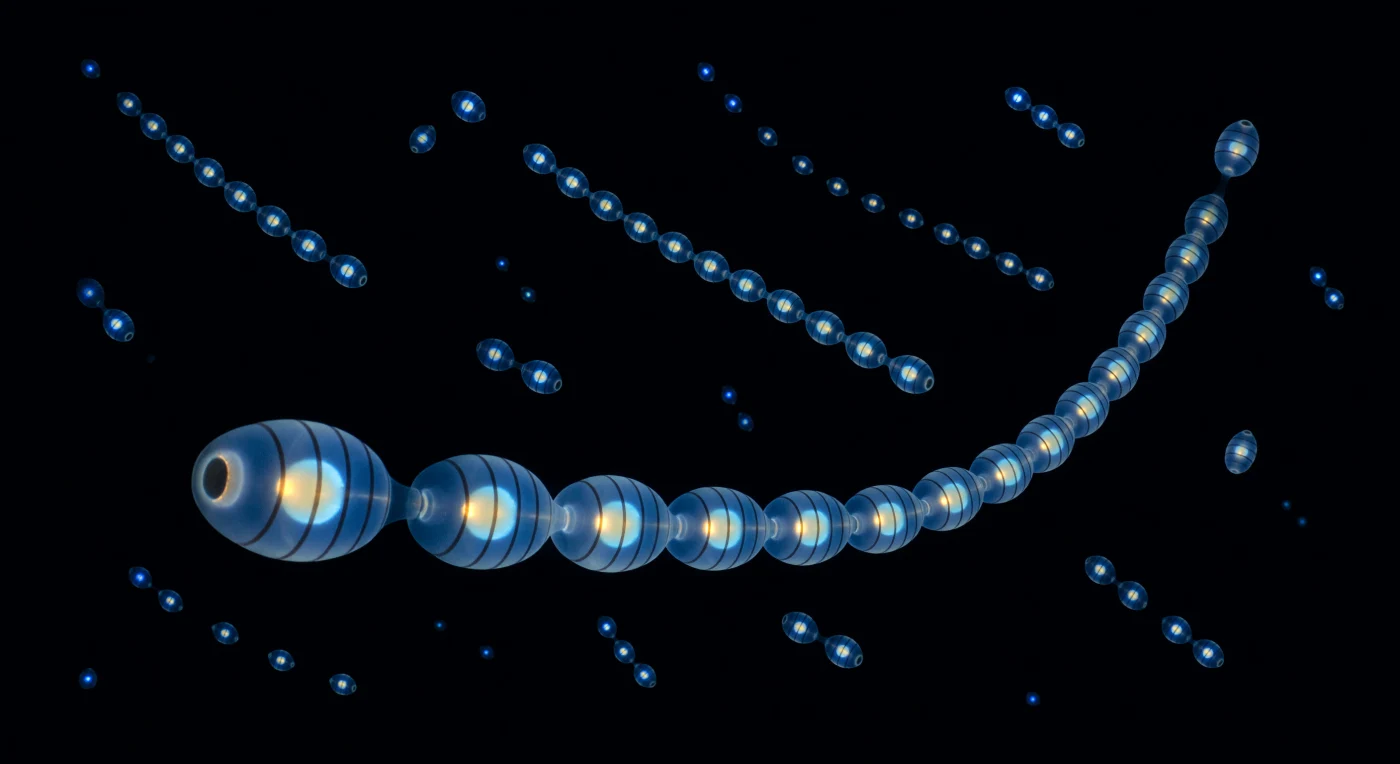
At two meters depth in absolute darkness, the water around you erupts into cold sequential fire: a salp chain of twenty-five zooids stretches across your field of vision like a chandelier assembled from living glass, each barrel roughly thumb-sized, and a bioluminescent pulse travels the length of the aggregate in a clean blue-white wave — 476 nanometers, a color so narrow and precise it registers less as illumination than as signal. Each 300-millisecond flash transmits through body walls whose refractive index barely differs from the surrounding seawater, so the light does not reflect off the organism but radiates from within it, revealing eight circular myomere bands as dark shadow-hoops stacked along the barrel's circumference and the gut content suspended in amber warmth against the cerulean core — two color temperatures meeting at a thin aureole of pale green-gold where the organism's interior bleeds into itself. The salp chain is a colonial tunicate aggregate, each zooid a jet-propelled filter producing mucous nets fine enough to capture bacteria and picoplankton invisible to any other predator in this column, and the bioluminescence propagating sequentially through their linked bodies likely represents a mechanically triggered alarm cascade — photophores firing down the chain's nervous connections in response to the pressure wave of your presence. Behind the nearest chain, at distances of one to several meters in every direction, other chains pulse in loose volumetric scatter, diminishing from structured beaded threads to pure blue spark-points before the seawater's absorption erases them entirely, and between every light and every other light is nothing at all — salt water, perfect void, and the weight of a midnight ocean pressing equally in every direction.
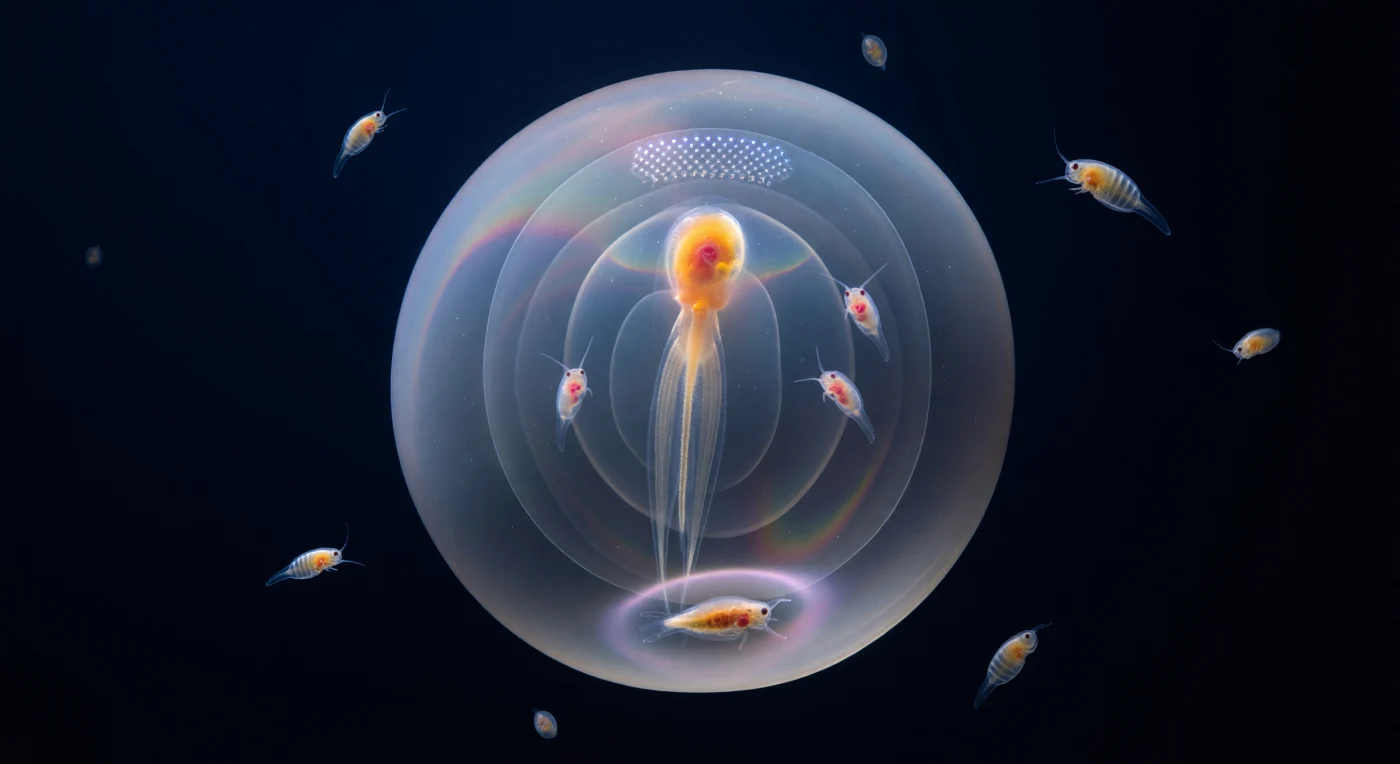
You hover one meter away in the mesopelagic dark, and the object before you occupies nearly your entire field of view: a sixty-centimeter sphere of mucopolysaccharide membrane, tensioned from within like a lung mid-breath, its surface scattering cold LED light into thin-film interference fringes of ice-blue, faint rose, and mother-of-pearl iridescence against water so dark it has no color at all. This is the house of *Bathochordaeus charon*, a giant larvacean — a tunicate no larger than a preserved apricot suspended at the geometric center of its own architectural creation, its ribbon tail beating in slow powerful strokes that drive water through concentric baffle layers of ghost-plane mucus toward the fine-mesh feeding filters at the anterior pole, each hexagonal cell of the inlet grid catching a pinpoint bead of blue-white light like a faceted window sixty microns across. The house itself is not a shell or a case but a living filtration machine, continuously secreted and structurally tuned to capture bacteria and picophytoplankton invisible to the naked eye, yet assembled at a scale that dwarfs most zooplankton in the surrounding water column. At the inlet grid, three copepods hover in cautious suspension — drawn by the feeding current, compound eyes dark ruby against the sphere's glow, bodies transparent enough to read their organs — while an amphipod pressed against the outer membrane leaves a dimple rimmed in pale violet interference light, a reminder that this luminous architecture is, despite all appearances, nothing more than water, protein, and the slow muscular will of a creature smaller than your thumb.
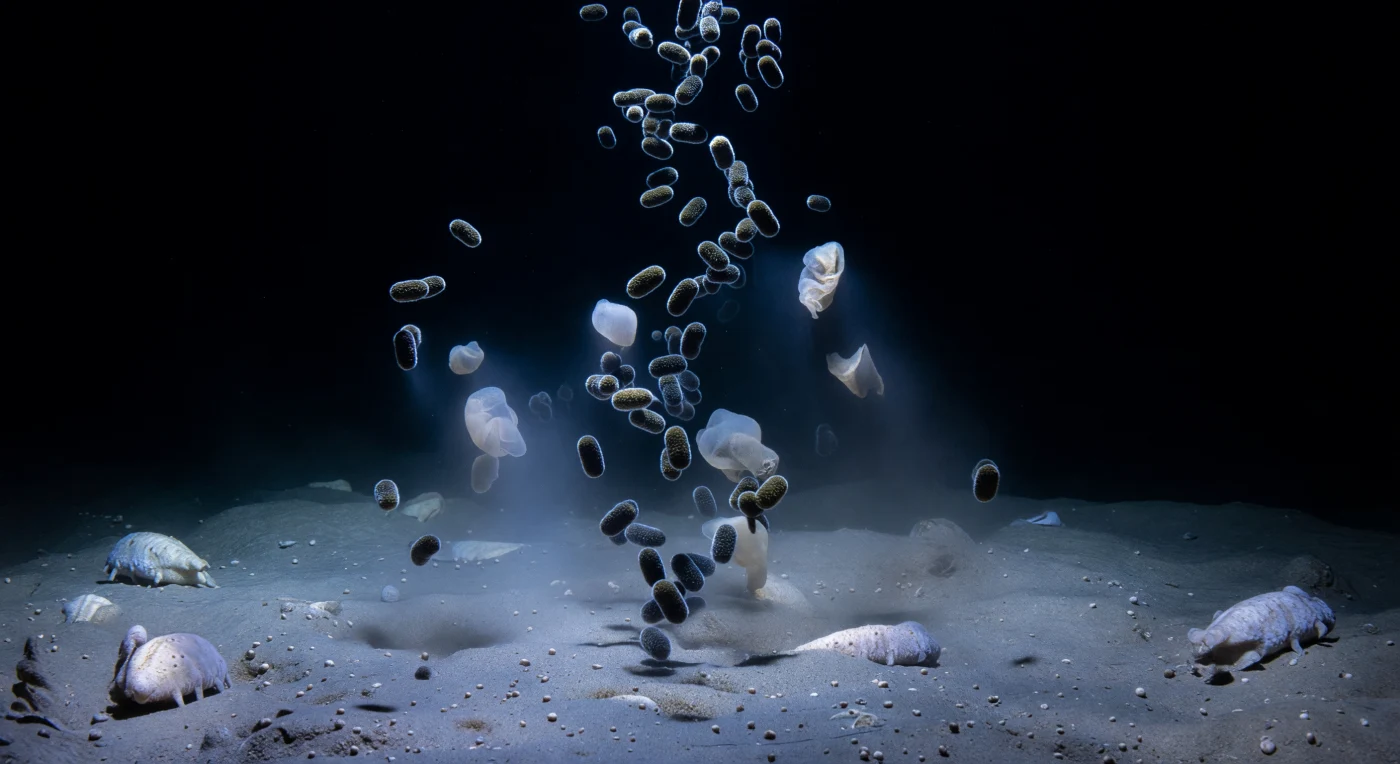
You are lying against the abyssal plain at 3,000 meters, your perspective flush with the sediment surface, gazing upward into a darkness so complete it registers less as an absence of light than as a physical presence pressing downward. The pale gray-tan biogenic ooze beneath you — a compressed record of foram shells and radiolarian tests accumulated over millennia — stretches outward to where holothurian bodies the color of old ivory lie half-dissolved into the sediment margin, their surfaces catching the only illumination available: a sourceless, monochromatic blue wash that seems less like light than like the idea of light, coloring everything within a single cold frequency somewhere between cerulean and void. Into this upward gaze descends the biological pump's slow currency: salp fecal pellets, dense olive-brown to near-black cylinders of 0.5 to 2 millimeters, each one a membrane-wrapped capsule of compressed picoplankton wrapped in a living bacterial biofilm that gives its surface the texture of dark velvet, falling in unhurried spirals that will take days to complete the final meters of a journey begun weeks ago at the sunlit surface. Between them drift the structural failures of salp carcasses — collapsed gel architectures whose muscle bands have dissolved into rumpled translucent sheets, each trailing a diffuse halo of dissolved organic matter, a faint chemical breath spreading outward at the speed of molecular diffusion into halos that overlap and intermingle, creating subtle turbid veils at successive depths. This is not emptiness but a slow rain of fixed carbon arriving in near-monochrome silence onto a pale and patient floor, each impact registered only as a microscopic crater in the ooze.
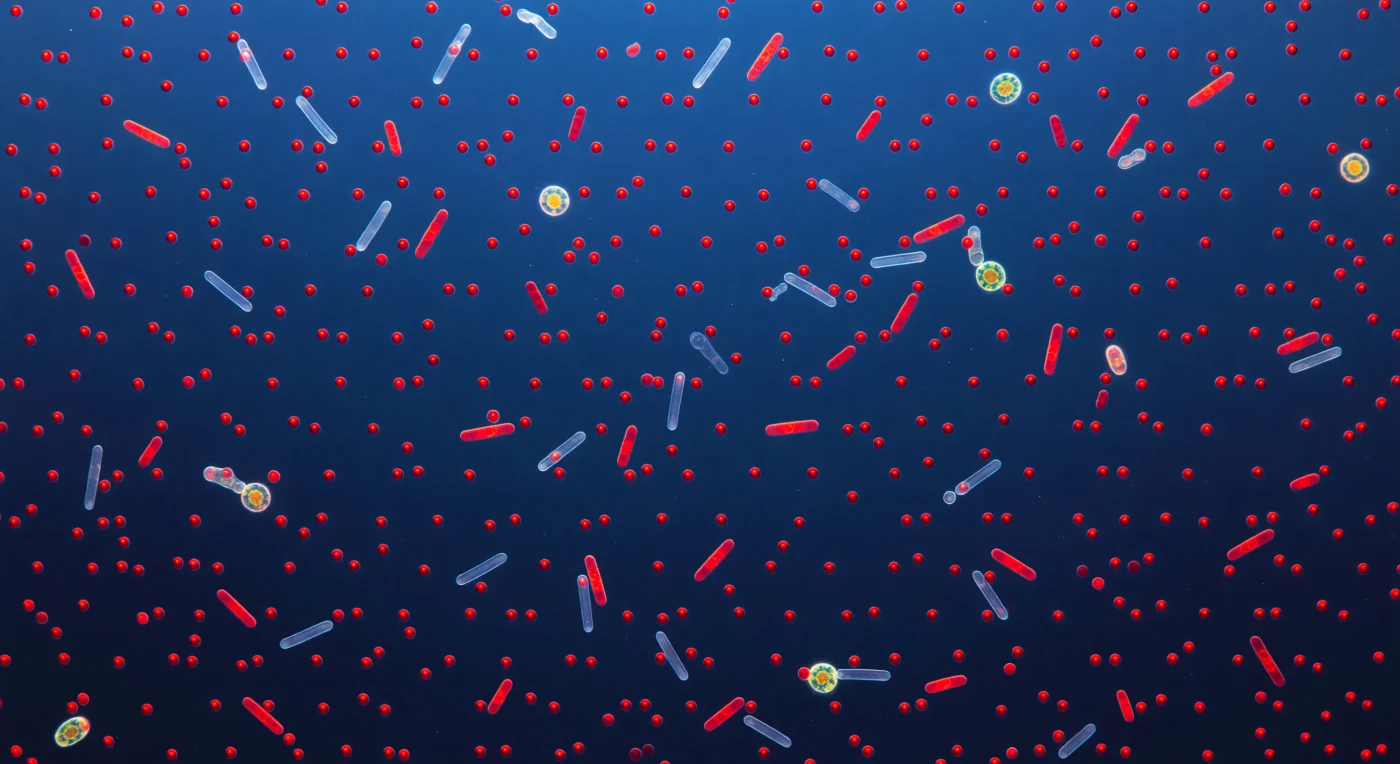
You are suspended inside what appears to be near-perfect emptiness, yet every cubic millimeter of this sunlit subtropical water holds a universe: deep-red *Prochlorococcus* spheres hang at regular intervals like self-luminous rubies in a sapphire medium, each one smaller than a wavelength of the red light it emits, glowing with warm chlorophyll fluorescence against the cold blue transmittance filtering down from the surface fifty meters above. Scattered among them, *Synechococcus* cylinders radiate a slightly warmer orange-red, their phycobilisome pigments giving each tiny capsule a heterogeneous internal blush, while ghostly bacterial rods drift in slow Brownian arcs — visible only as faint prismatic outlines where their membranes refract the ambient blue. This is the oligotrophic gyre at its most paradoxical: among the least productive waters on Earth by conventional measure, yet sustaining the most abundant photosynthetic organisms ever discovered, with *Prochlorococcus* alone reaching densities of 100,000 cells per milliliter and collectively fixing more carbon than any other genus on the planet. Somewhere far above this intimate ruby cosmos, the gelatinous filters of salps and larvaceans are sweeping this very water through mucus meshes finer than half a micron, harvesting these glowing beads one by one and compressing them into dense fecal pellets that will carry their fixed carbon in a single gravitational arc toward the seafloor — the biological pump made visible, its fuel hanging here in three-dimensional perfection.
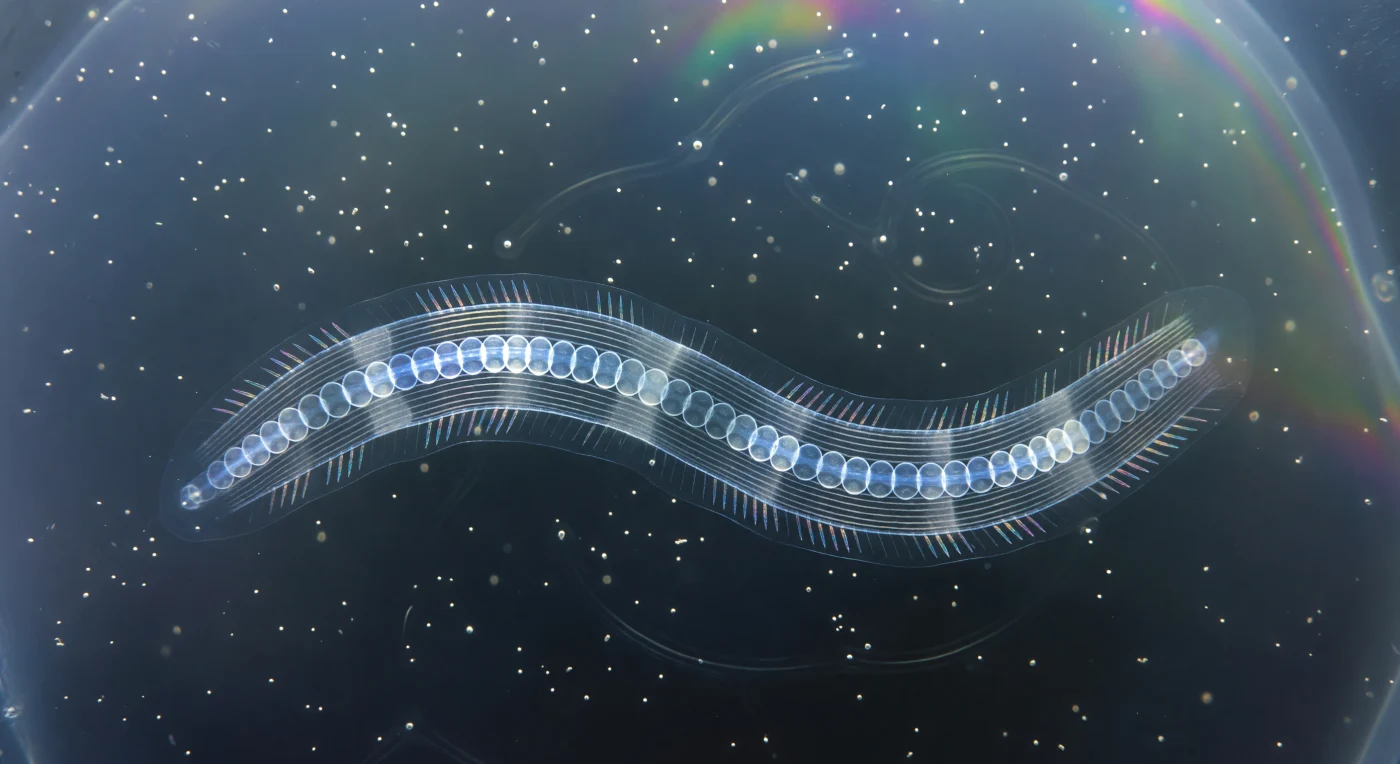
You hover within a universe three millimeters wide, surrounded by the faintly luminous interior of a mucus house, your entire perceptual field claimed by the frozen S-curve of an *Oikopleura dioica* tail suspended in cathedral blue-green light. This tail belongs to a larvacean — a tunicate no larger than a grain of rice — whose continuously beating appendage drives water through the surrounding mucopolysaccharide house, filtering bacteria and colloids smaller than two micrometers from the surrounding ocean while the animal remains anchored within its self-secreted architecture. At the structure's core, the notochord presents as a stacked column of vacuolated biconvex cells, each acting as a tiny fluid lens concentrating the transmitted ambient light into a crisp bright rod, flanked by thin sheets of striated muscle whose cross-banding records the molecular machinery of myosin and actin arrays operating at the scale of individual sarcomeres. The lateral fin membranes — so thin they manifest only as single diffraction fringes of iridescent cold violet and silver — mark the physical boundary between organism and ocean at the very limit of optical resolution, while behind the curved tail, orbital smears traced by suspended food particles ghost the vortex wakes of the last completed beat, hydrodynamic memory written in colloidal amber and gold against blue-black water already relaxing back toward stillness.
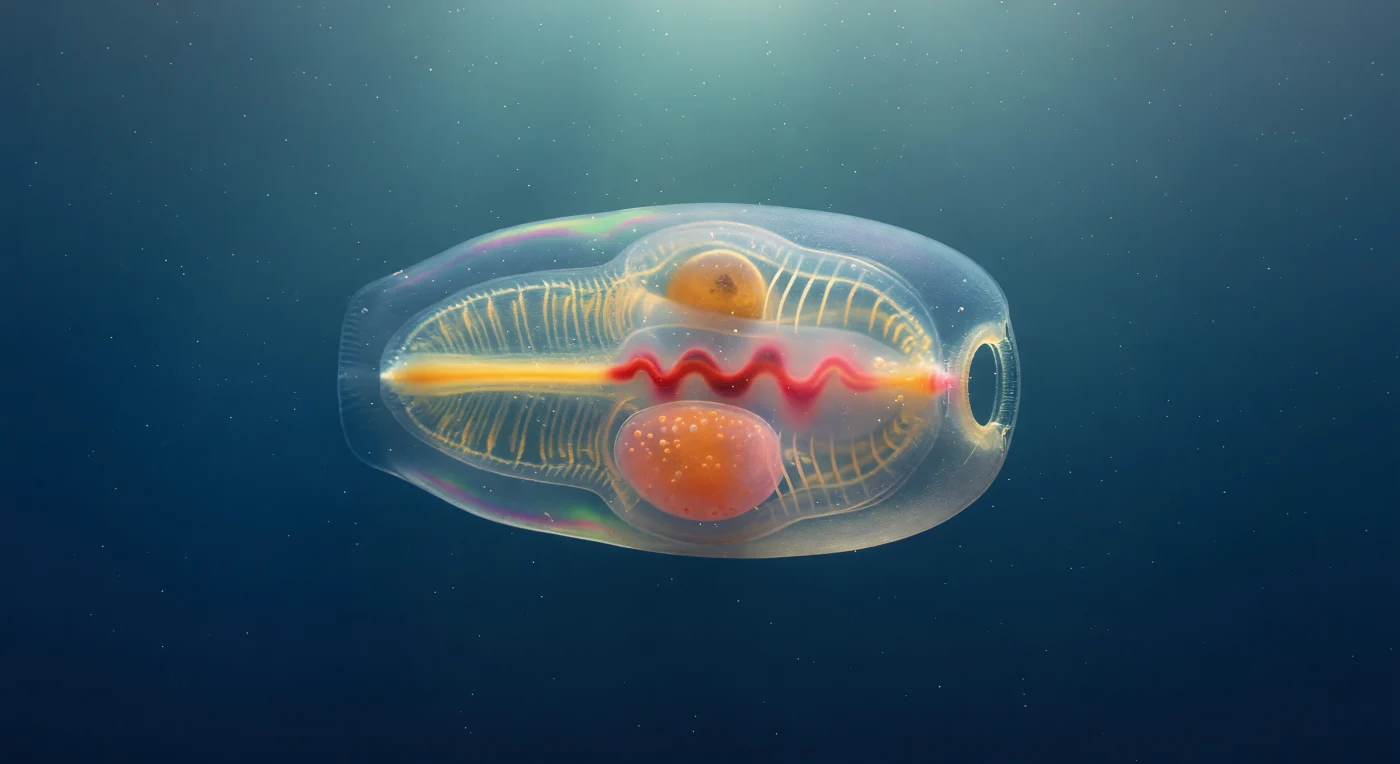
You are suspended two centimeters from the anterior face of a living *Pegea confoederata*, a solitary salp roughly eight centimeters long, drifting at forty meters depth in the tropical Atlantic where diffuse noon light descends as a soft, directionless cathedral radiance from the entire ocean sky above. The tunic wall surrounding you is so nearly identical in refractive index to the seawater itself that it announces its presence only as the faintest curved thickening of space — a skin of biological gel stretched taut and smooth as polished crystal, its boundary perceptible more as a subtle bending of the blue-green background than as any true surface. That backlight passes straight through the organism, converting it into a luminous still life: the pharyngeal basket glows with warm amber-gold iridescence as its continuously secreted mucous net — a filtering silk finer than any human manufacture, capable of capturing bacteria invisible to the naked eye — scatters transmitted light across the full width of the barrel, while the endostyle traces a bright ventral stripe of dense glandular amber from end to end like a vein of warm resin lit from within. At the body's center, three millimeters of crimson heart contracts in slow, perfectly visible peristaltic waves every half-second, its color shifting from dark arterial red at systole to translucent rose at diastole, each pulse propagating a faint ripple of compression through the surrounding gel, and beside it the orange-pink gonad reveals individual pale oocytes as faint translucent spheres embedded in warmer tissue — the entire architecture of a chordate life held in suspension inside a barrel of frozen seawater, organized by evolution into a glowing transparency that is, by any physical measure, almost indistinguishable from the ocean that contains it.
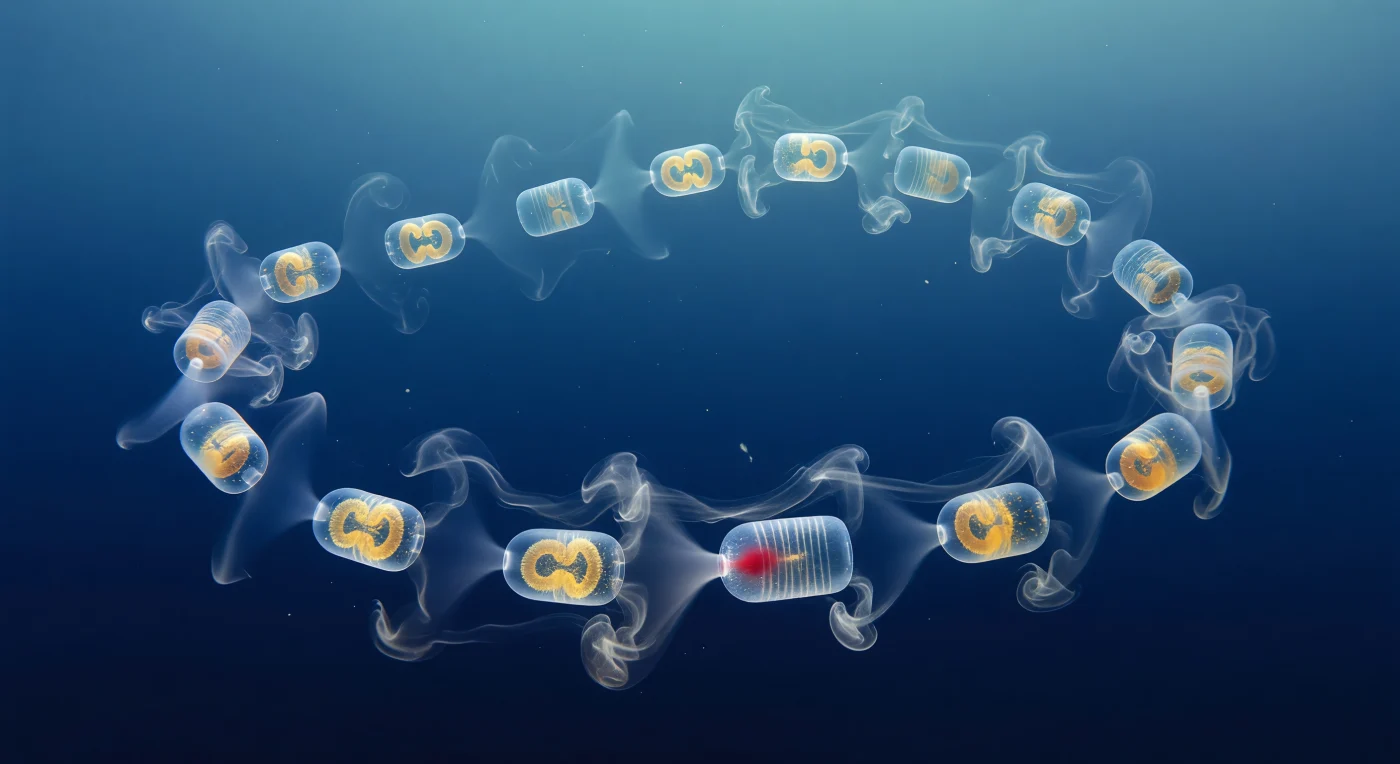
You hover face-to-face with a wheel-chain of *Cyclosalpa affinis* whose amber-lit barrels string across the cobalt water column like lanterns of living glass, each cylindrical zooid roughly finger-joint length and so nearly refractive-index-matched to seawater that they betray themselves only by a prismatic hairline where curved tunic wall bends deep light. The Schlieren optical setup transforms the surrounding water into a visible medium: from every atrial siphon a continuous exhaust plume billows rearward as silver-white smoke — thermal-breath wisps of very slightly warmer, particle-depleted water whose minuscule density difference is enough to bend light and reveal the otherwise invisible jet propulsion that drives each zooid and, collectively, the whole chain through the water column. Where neighboring plumes converge two body-lengths downstream they braid into a compound turbulent wake of overlapping refractive threads, while at the upstream oral siphons the optics resolve a subtler signature: shallow concave shadow-dimples marking inflow convergence zones where ocean water accelerates into the feeding barrel to be strained through a pharyngeal mucus net fine enough to capture bacteria smaller than two micrometers. The chain itself curves in a loose helix across the frame, near zooids crystalline and amber-cored, far zooids dissolving into translucent blue ghosts, the whole architecture a living filtration colony simultaneously mapping its own fluid dynamics in silver smoke against the silent indigo gradient of the open sea.
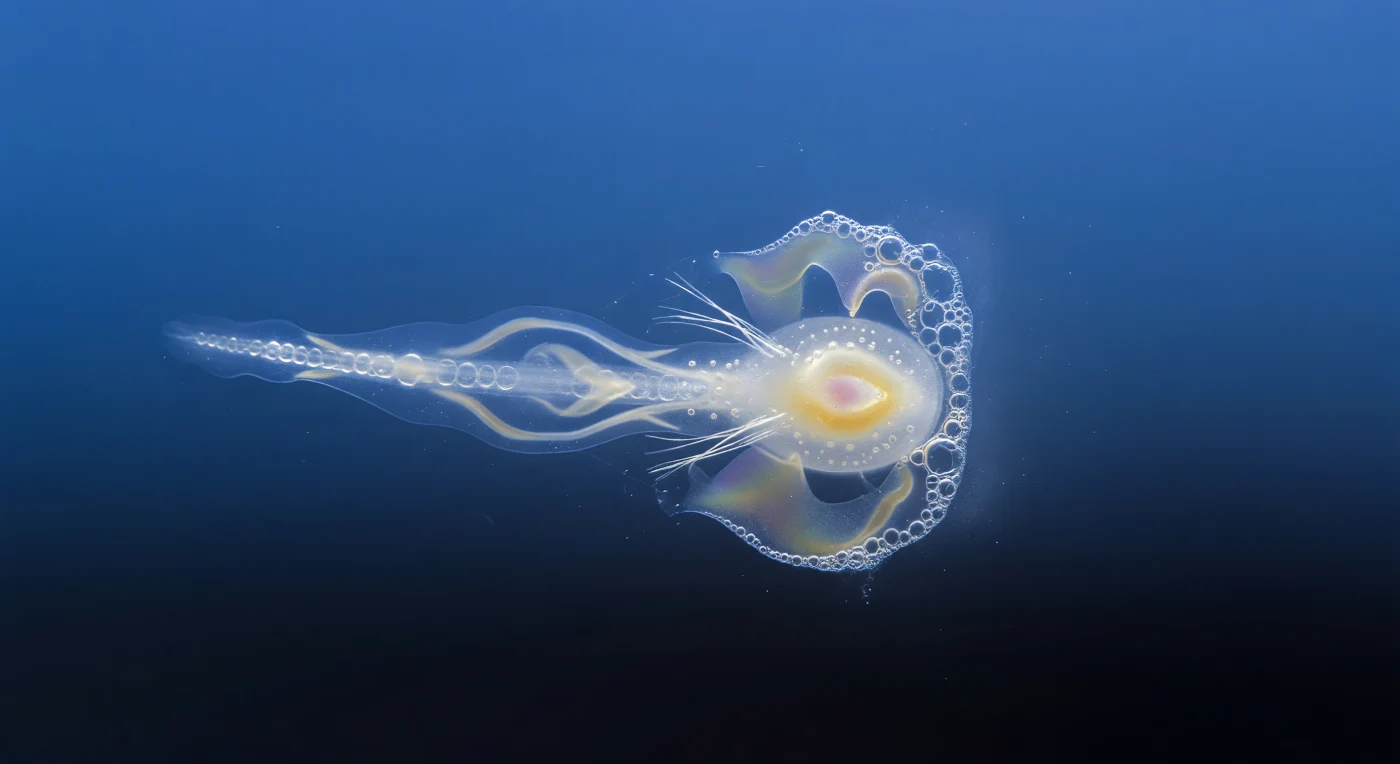
You are suspended one centimeter from the trunk of *Oikopleura longicauda* — a body no larger than a rice grain, yet so optically clear it reads as a bead of living glass, its amber gut crescent and faint rose gonad floating impossibly inside it like inclusions in polished crystal. From dozens of oikoplast gland cells dotting the pellucid skin, silver-white mucus filaments are extruding in real time, each thread no thicker than a cobweb before it meets the surrounding seawater and blooms outward, absorbing fluid and swelling into a semi-transparent membrane that curves away in every direction — a nascent house, already three millimeters across, still missing a quarter of its outer wall, its growing edge a lace of incompletely fused micro-bubbles catching the diffuse blue-cathedral light as a crescent of soft sparkle. Where two mucus sheets have fused and thinned to precisely the right optical thickness, thin-film interference colors drift and rearrange across the surface — pale gold grading to aquamarine, then a ghost of violet near the growth front — colors that are not pigments but physics, the same interference that paints oil on still water, arising here in a secreted architecture being raised molecule by molecule from glycoprotein and seawater. Slightly beyond the growth boundary, dissolved mucopolysaccharides diffuse outward in slow Brownian gradients, lending the surrounding volume a barely perceptible opalescence, as though the sea itself has been lightly frosted — a haze that marks the outer edge of construction, where living material dissolves back into the open ocean from which it will never be recovered.
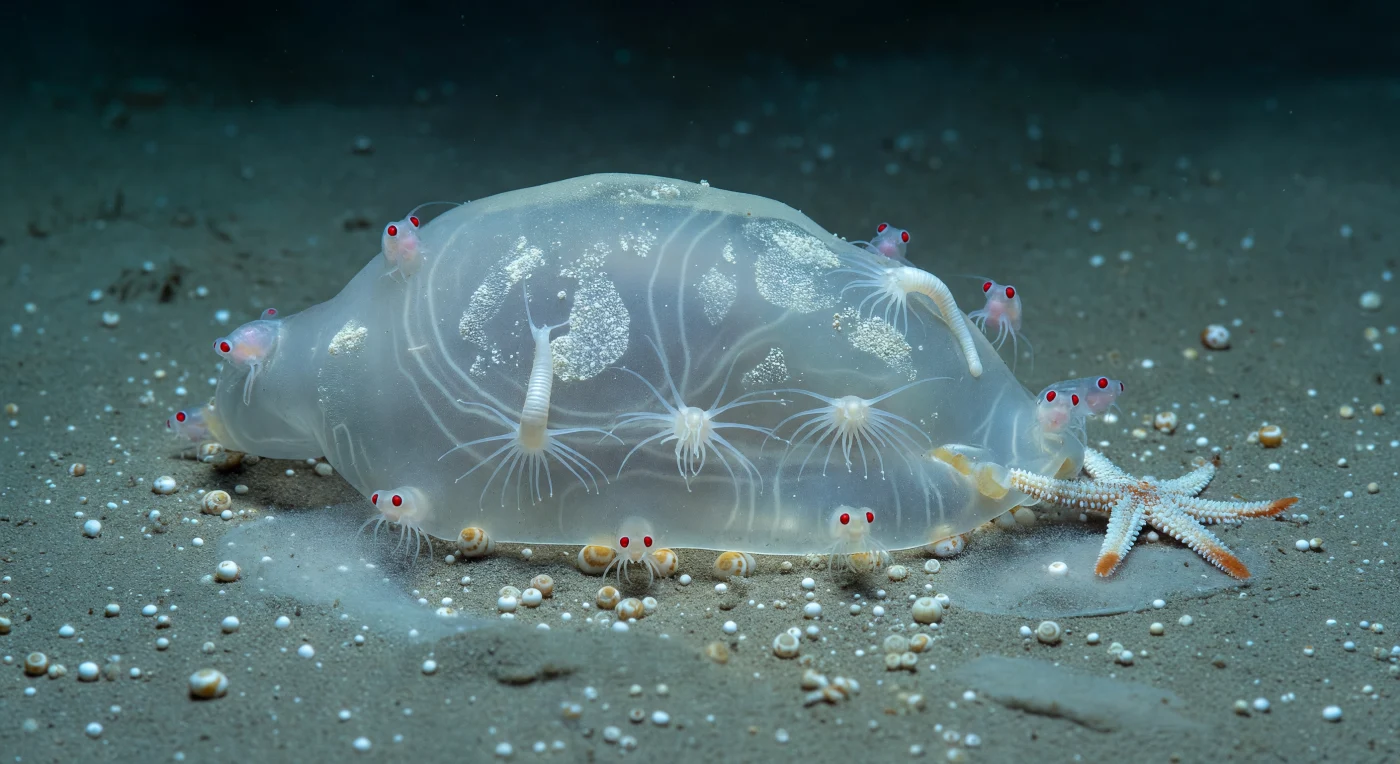
You float just above a pale ruin — a deflated salp, once a living jet-propelled barrel of near-invisible gel, now collapsed flat against the abyssal ooze at fifteen hundred meters, its circular muscle bands reduced to faint silver-gray striations beneath a skin of white bacterial biofilm. The carcass is the brightest thing in this entire world, catching the sourceless blue-green bioluminescent ambient glow and throwing it back as a soft luminosity against the gray-tan foraminifera-dotted sediment, each foram test a tiny chalk-white sphere or coiled disc pressed into silky silt. Around and across the carcass, an opportunist community has converged with the quiet efficiency of the deep: polychaete worms sweep feathery palps through the biofilm, a brittle star arm segments its way in from the sediment margin — ivory ossicles terminating in amber tube feet that press into the gel — and five amphipods rasp the carcass edge, their carapaces glassy enough to reveal pale viscera within but dominated by deep-red compound eyes that glow like tiny garnets against the cold monotone scene. This is the biological pump's final chapter played out at centimeter scale: a gelatinous body that sank from sunlit surface waters over days or weeks, carrying fixed carbon into permanent darkness, its substance now being partitioned among specialists adapted to exploit exactly this brief, unpredictable, irreplaceable windfall on an otherwise featureless plain.
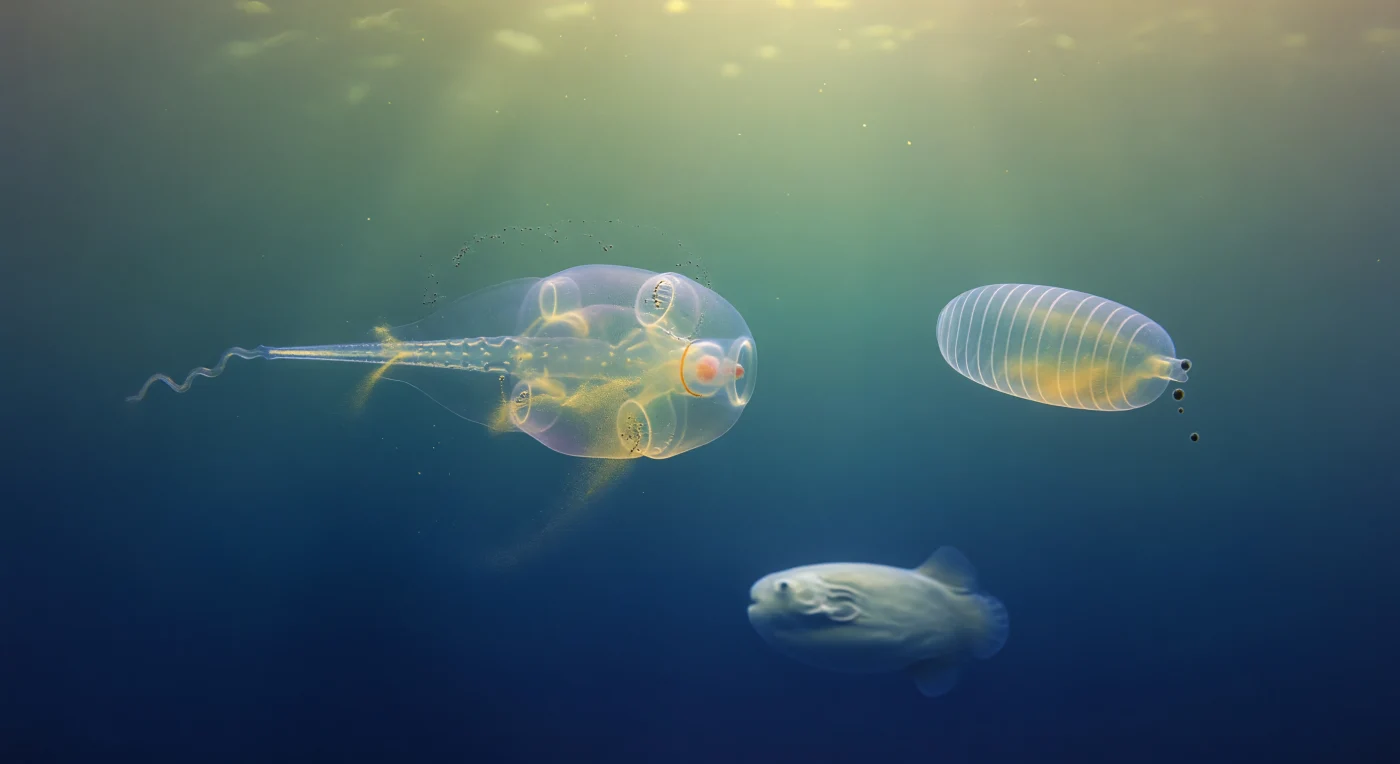
You are suspended at fifty meters in subtropical open ocean, weightless inside a water column that grades from pale jade-green overhead — where invisible picoplankton collectively warm the downwelling light toward something honeyed and sourceless — to an indigo so saturated it becomes its own darkness below. At the center of your visual field, a larvacean house occupies its own private optical universe: not a solid object but a trembling iridescent discontinuity, a soap-film ellipsoid of ellipsoidal chambers and inlet funnels catching oblique light only at its curved surfaces and producing thin interference colors — violet bleeding into gold bleeding into ghost teal — while inside, the animal itself beats its crystalline tail at two or three cycles per second, drawing the golden-green picoplankton shimmer through mucus meshes finer than any manufactured filter, each captured bacterium a link in a trophic chain that has no visible seam. To the right, a solitary salp pulses with slow peristaltic certainty, its eight muscle bands tightening and releasing around a gut glowing amber with captured cells, and at its posterior siphon two dark fecal pellets hang in the instant just after release, already beginning their weeks-long gravitational transit toward the seafloor, carrying fixed carbon downward in a process that moves more organic matter into the deep ocean than any other biological mechanism on Earth. Far below, resolving from the midnight-blue gradient like a silver dining table ascending through fog, the laterally compressed disc of a *Mola mola* rises with its small mouth open toward these translucent intermediaries — the entire alimentary bridge from half-micron cyanobacterium to three-hundred-kilogram fish made architecturally visible only by the ghost-glass bodies hanging between them in the green-gold haze.