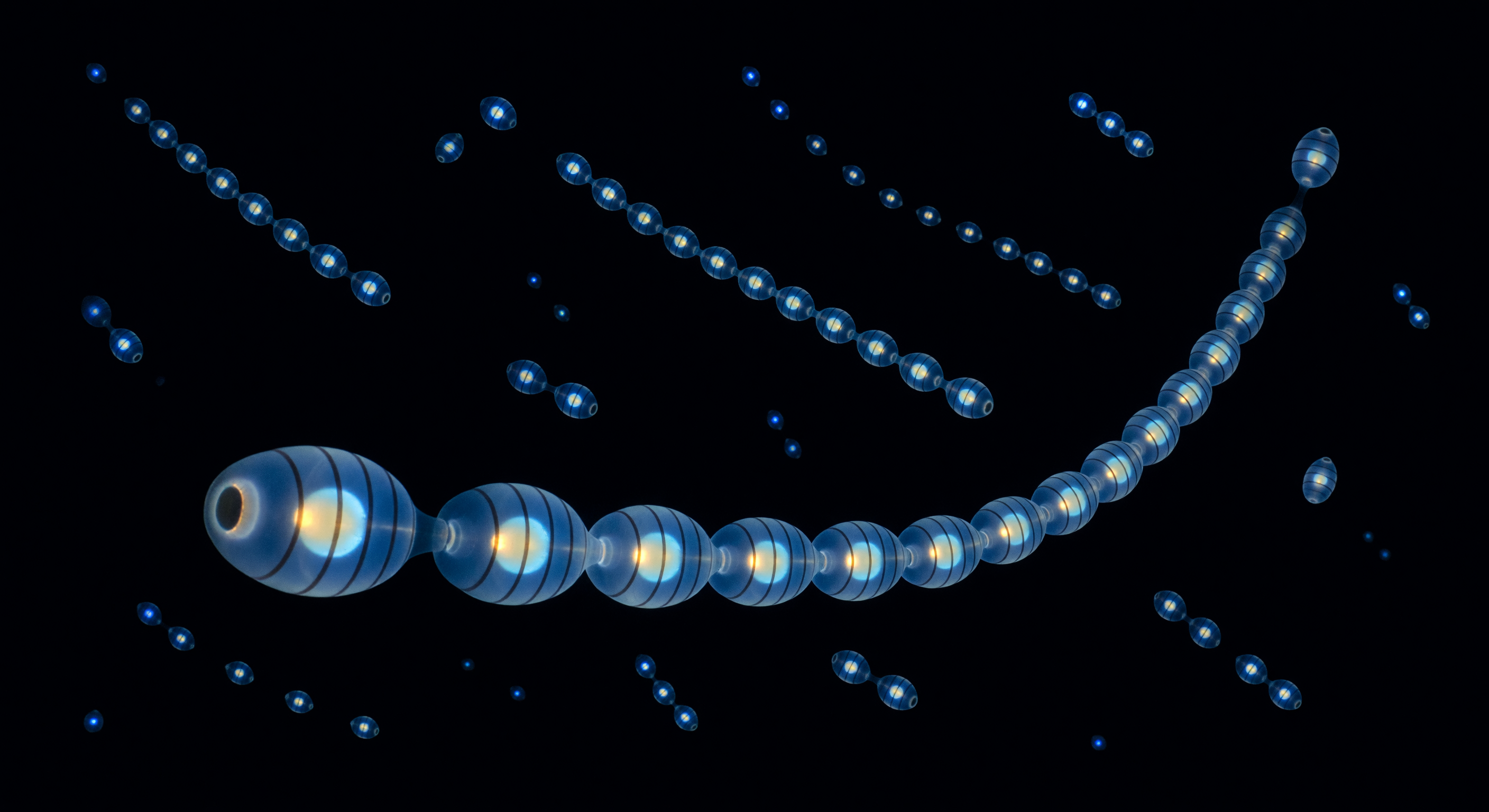
At two meters depth in absolute darkness, the water around you erupts into cold sequential fire: a salp chain of twenty-five zooids stretches across your field of vision like a chandelier assembled from living glass, each barrel roughly thumb-sized, and a bioluminescent pulse travels the length of the aggregate in a clean blue-white wave — 476 nanometers, a color so narrow and precise it registers less as illumination than as signal. Each 300-millisecond flash transmits through body walls whose refractive index barely differs from the surrounding seawater, so the light does not reflect off the organism but radiates from within it, revealing eight circular myomere bands as dark shadow-hoops stacked along the barrel's circumference and the gut content suspended in amber warmth against the cerulean core — two color temperatures meeting at a thin aureole of pale green-gold where the organism's interior bleeds into itself. The salp chain is a colonial tunicate aggregate, each zooid a jet-propelled filter producing mucous nets fine enough to capture bacteria and picoplankton invisible to any other predator in this column, and the bioluminescence propagating sequentially through their linked bodies likely represents a mechanically triggered alarm cascade — photophores firing down the chain's nervous connections in response to the pressure wave of your presence. Behind the nearest chain, at distances of one to several meters in every direction, other chains pulse in loose volumetric scatter, diminishing from structured beaded threads to pure blue spark-points before the seawater's absorption erases them entirely, and between every light and every other light is nothing at all — salt water, perfect void, and the weight of a midnight ocean pressing equally in every direction.
Other languages
- Français: Chaîne Lumineuse Minuit
- Español: Cadena Bioluminiscente Nocturna
- Português: Corrente Bioluminescente Meia-Noite
- Deutsch: Biolumineszente Kette Mitternacht
- العربية: سلسلة متوهجة في الظلام
- हिन्दी: जैव-प्रकाशित श्रृंखला अर्धरात्रि
- 日本語: 生物発光の連鎖真夜中
- 한국어: 생물발광 사슬 한밤중
- Italiano: Catena Bioluminescente Mezzanotte
- Nederlands: Bioluminescente Keten Middernacht