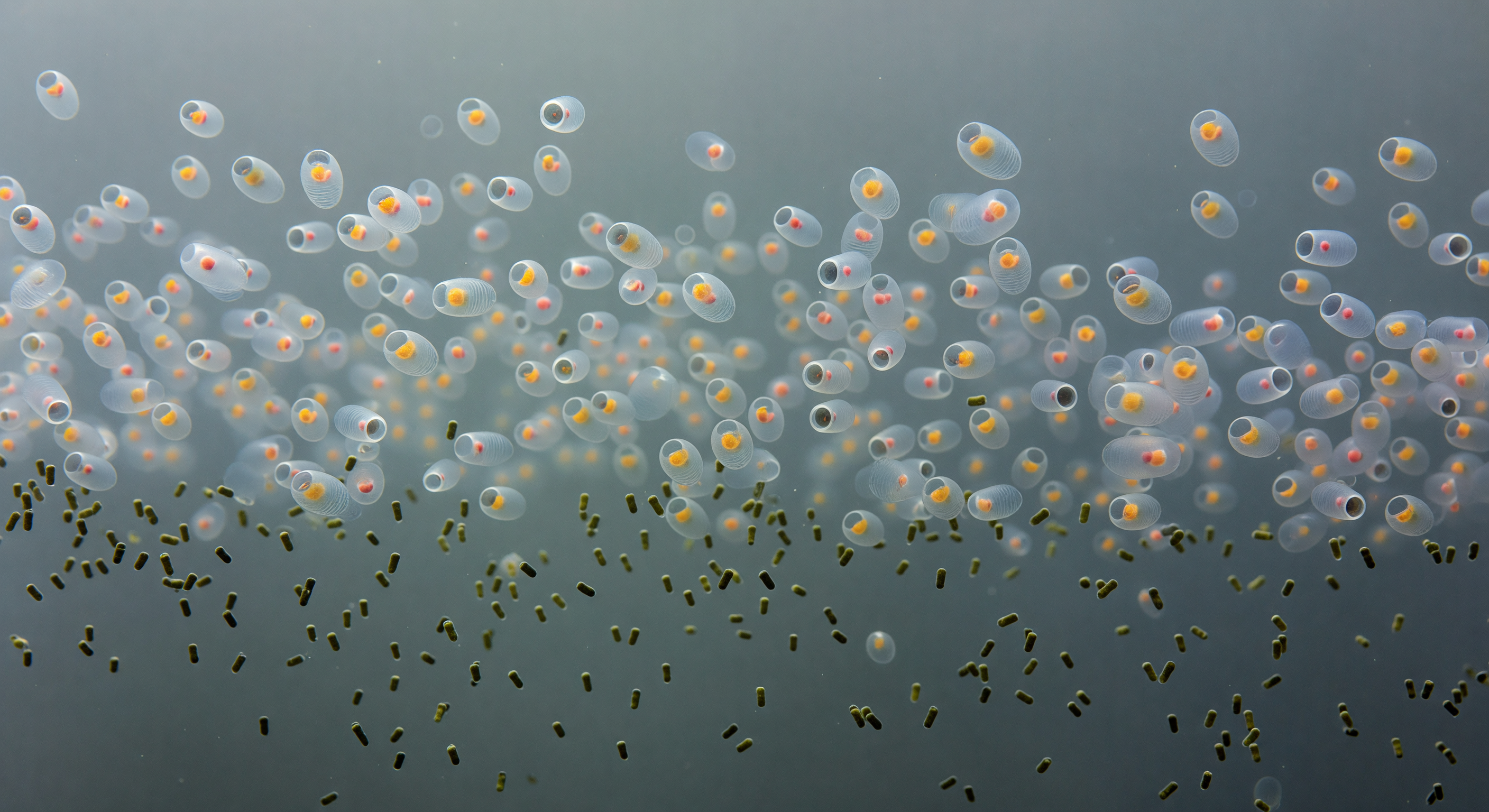
You are suspended inside a living snowstorm that has no edges, no floor, no ceiling — only an endless, pulsating milky interior where every half-meter of vision ends against another body before it can travel further. At one hundred individuals per cubic meter, the sub-Antarctic water column has been colonized so thoroughly by *Salpa thompsoni* that the ocean itself has changed phase: it is no longer transparent but opalescent, each photon arriving from the gray overcast surface scattered again and again by gelatinous cylinders until the light becomes sourceless, cold, and evenly pearl-white, broken only by the warm amber glow of each individual's gut — a concentrated smear of ingested phytoplankton burning like a small interior fire — and the faint coral-pink float of gonads suspended beside them like jewels in a medium that is ninety-six percent seawater. These animals are filter machines of extraordinary efficiency, their circular muscle bands contracting in slow rhythmic pulses at roughly two beats per second, drawing water through a pharyngeal mucous net fine enough to capture bacteria and picoplankton far below the capture threshold of any crustacean zooplankton, and together they are processing the entire illuminated surface layer at a rate capable of stripping it of primary production within days. Crossing your peripheral vision in continuous unhurried procession, dense dark olive-brown fecal pellets — membrane-wrapped cylinders packed with reprocessed phytoplankton — descend in near-vertical trajectories with ballistic purposefulness, each one a compressed parcel of surface carbon beginning its weeks-long journey toward the seafloor, constituting collectively a biological pump so efficient that a single bloom of this scale can transfer more fixed carbon to the deep ocean in one season than would otherwise sink in a year.
Other languages
- Français: Tempête de Floraison Subantarctique
- Español: Tormenta de Bloom Subantártica
- Português: Nevasca de Bloom Subantártica
- Deutsch: Blüten-Schneesturm Subantarktis
- العربية: عاصفة ازدهار شبه القطبية
- हिन्दी: उप-अंटार्कटिक हिमझंझा प्रस्फुटन
- 日本語: 南極海の群生吹雪
- 한국어: 남극해 블룸 눈보라
- Italiano: Tempesta di Bloom Subantartica
- Nederlands: Bloei Sneeuwstorm Subantarctisch