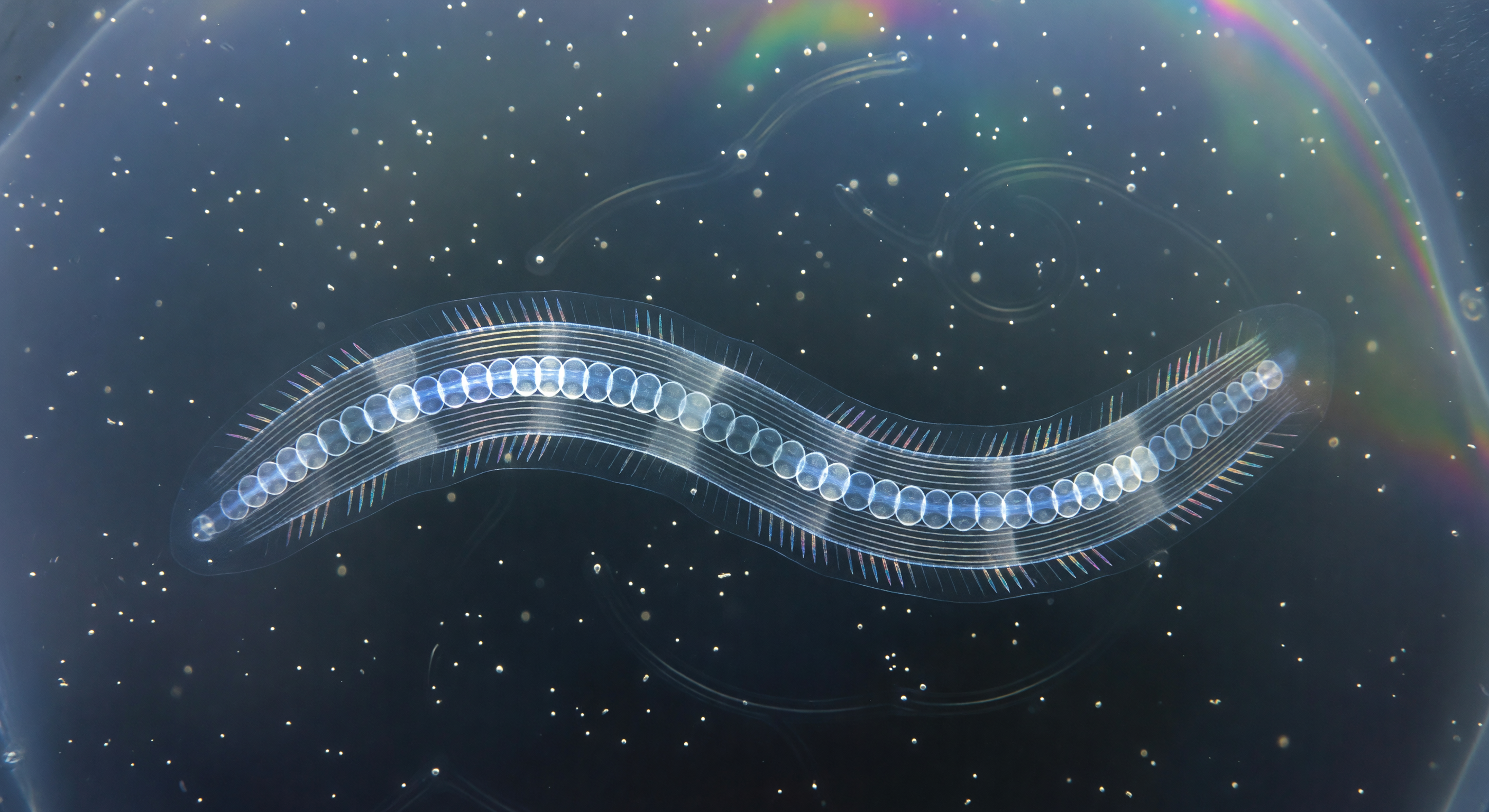
You hover within a universe three millimeters wide, surrounded by the faintly luminous interior of a mucus house, your entire perceptual field claimed by the frozen S-curve of an *Oikopleura dioica* tail suspended in cathedral blue-green light. This tail belongs to a larvacean — a tunicate no larger than a grain of rice — whose continuously beating appendage drives water through the surrounding mucopolysaccharide house, filtering bacteria and colloids smaller than two micrometers from the surrounding ocean while the animal remains anchored within its self-secreted architecture. At the structure's core, the notochord presents as a stacked column of vacuolated biconvex cells, each acting as a tiny fluid lens concentrating the transmitted ambient light into a crisp bright rod, flanked by thin sheets of striated muscle whose cross-banding records the molecular machinery of myosin and actin arrays operating at the scale of individual sarcomeres. The lateral fin membranes — so thin they manifest only as single diffraction fringes of iridescent cold violet and silver — mark the physical boundary between organism and ocean at the very limit of optical resolution, while behind the curved tail, orbital smears traced by suspended food particles ghost the vortex wakes of the last completed beat, hydrodynamic memory written in colloidal amber and gold against blue-black water already relaxing back toward stillness.
Other languages
- Français: Courbe en S stroboscopique
- Español: Cola en S estroboscópica
- Português: Cauda em S estroboscópica
- Deutsch: Stroboskopische Schwanz-S-Kurve
- العربية: منحنى ذيل مضيء
- हिन्दी: स्ट्रोबोस्कोपिक पूंछ एस-वक्र
- 日本語: 閃光照射の尾部S字曲線
- 한국어: 스트로보 꼬리 S곡선
- Italiano: Coda a S stroboscopica
- Nederlands: Stroboscopische staart S-curve