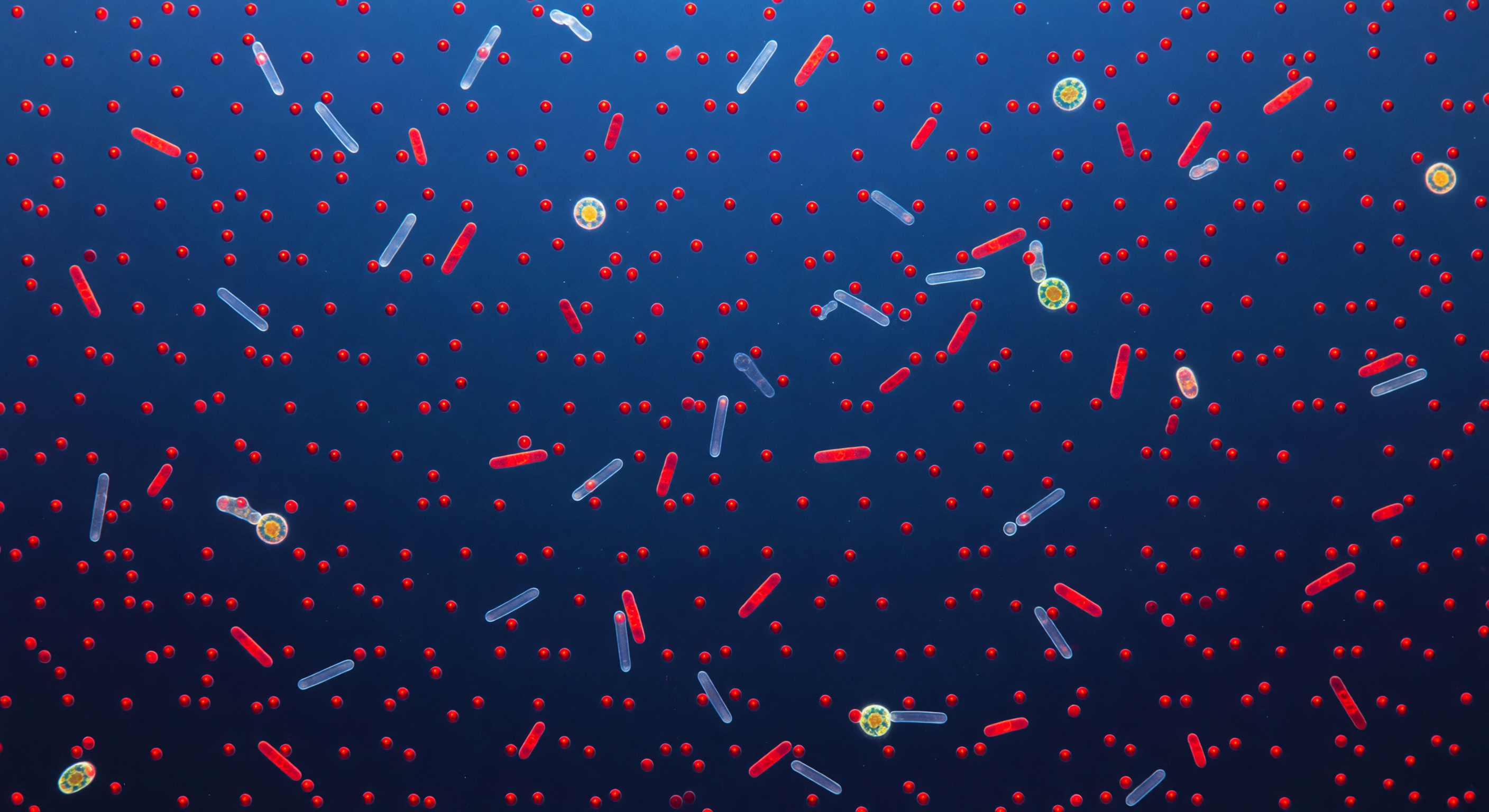
You are suspended inside what appears to be near-perfect emptiness, yet every cubic millimeter of this sunlit subtropical water holds a universe: deep-red *Prochlorococcus* spheres hang at regular intervals like self-luminous rubies in a sapphire medium, each one smaller than a wavelength of the red light it emits, glowing with warm chlorophyll fluorescence against the cold blue transmittance filtering down from the surface fifty meters above. Scattered among them, *Synechococcus* cylinders radiate a slightly warmer orange-red, their phycobilisome pigments giving each tiny capsule a heterogeneous internal blush, while ghostly bacterial rods drift in slow Brownian arcs — visible only as faint prismatic outlines where their membranes refract the ambient blue. This is the oligotrophic gyre at its most paradoxical: among the least productive waters on Earth by conventional measure, yet sustaining the most abundant photosynthetic organisms ever discovered, with *Prochlorococcus* alone reaching densities of 100,000 cells per milliliter and collectively fixing more carbon than any other genus on the planet. Somewhere far above this intimate ruby cosmos, the gelatinous filters of salps and larvaceans are sweeping this very water through mucus meshes finer than half a micron, harvesting these glowing beads one by one and compressing them into dense fecal pellets that will carry their fixed carbon in a single gravitational arc toward the seafloor — the biological pump made visible, its fuel hanging here in three-dimensional perfection.
Other languages
- Français: Cosmos Rubis Picoplancton
- Español: Cosmos Rubí Picoplancton
- Português: Cosmos Rubi Picoplâncton
- Deutsch: Picoplankton Rubin Kosmos
- العربية: كون روبي النانوعوالق
- हिन्दी: पिकोप्लैंकटन रूबी ब्रह्मांड
- 日本語: ピコプランクトン紅宝石宇宙
- 한국어: 피코플랑크톤 루비 코스모스
- Italiano: Cosmo Rubino Picoplancton
- Nederlands: Picoplankton Robijn Kosmos