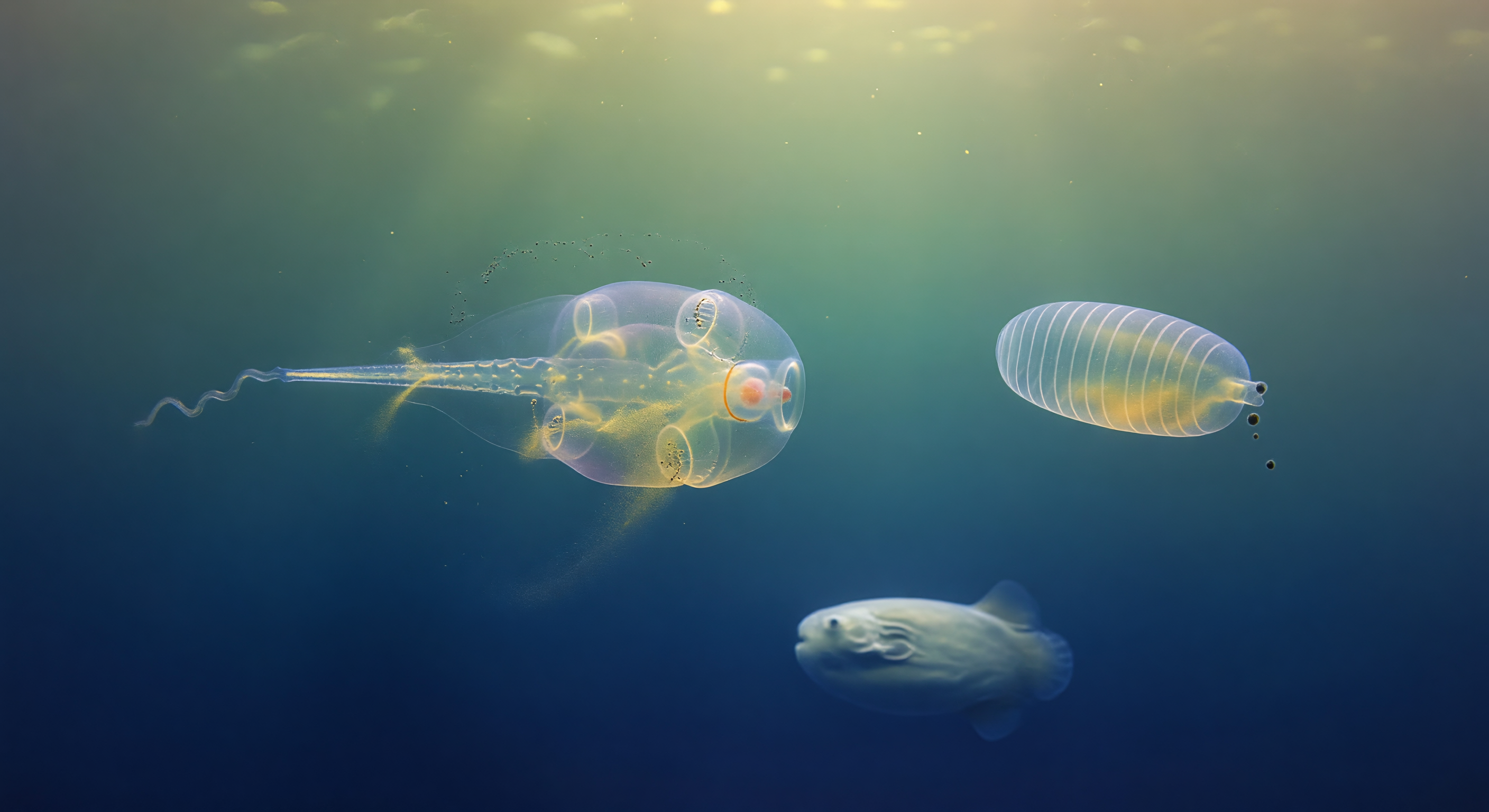
You are suspended at fifty meters in subtropical open ocean, weightless inside a water column that grades from pale jade-green overhead — where invisible picoplankton collectively warm the downwelling light toward something honeyed and sourceless — to an indigo so saturated it becomes its own darkness below. At the center of your visual field, a larvacean house occupies its own private optical universe: not a solid object but a trembling iridescent discontinuity, a soap-film ellipsoid of ellipsoidal chambers and inlet funnels catching oblique light only at its curved surfaces and producing thin interference colors — violet bleeding into gold bleeding into ghost teal — while inside, the animal itself beats its crystalline tail at two or three cycles per second, drawing the golden-green picoplankton shimmer through mucus meshes finer than any manufactured filter, each captured bacterium a link in a trophic chain that has no visible seam. To the right, a solitary salp pulses with slow peristaltic certainty, its eight muscle bands tightening and releasing around a gut glowing amber with captured cells, and at its posterior siphon two dark fecal pellets hang in the instant just after release, already beginning their weeks-long gravitational transit toward the seafloor, carrying fixed carbon downward in a process that moves more organic matter into the deep ocean than any other biological mechanism on Earth. Far below, resolving from the midnight-blue gradient like a silver dining table ascending through fog, the laterally compressed disc of a *Mola mola* rises with its small mouth open toward these translucent intermediaries — the entire alimentary bridge from half-micron cyanobacterium to three-hundred-kilogram fish made architecturally visible only by the ghost-glass bodies hanging between them in the green-gold haze.
Other languages
- Français: Pont Invisible Gradient Trophique
- Español: Puente Invisible Gradiente Trófico
- Português: Ponte Invisível Gradiente Trófico
- Deutsch: Unsichtbare Brücke Trophisches Gefälle
- العربية: الجسر الخفي التدرج الغذائي
- हिन्दी: अदृश्य सेतु पोषण प्रवणता
- 日本語: 透明な橋 栄養段階の勾配
- 한국어: 보이지 않는 다리 영양 기울기
- Italiano: Ponte Invisibile Gradiente Trofico
- Nederlands: Onzichtbare Brug Trofisch Verloop