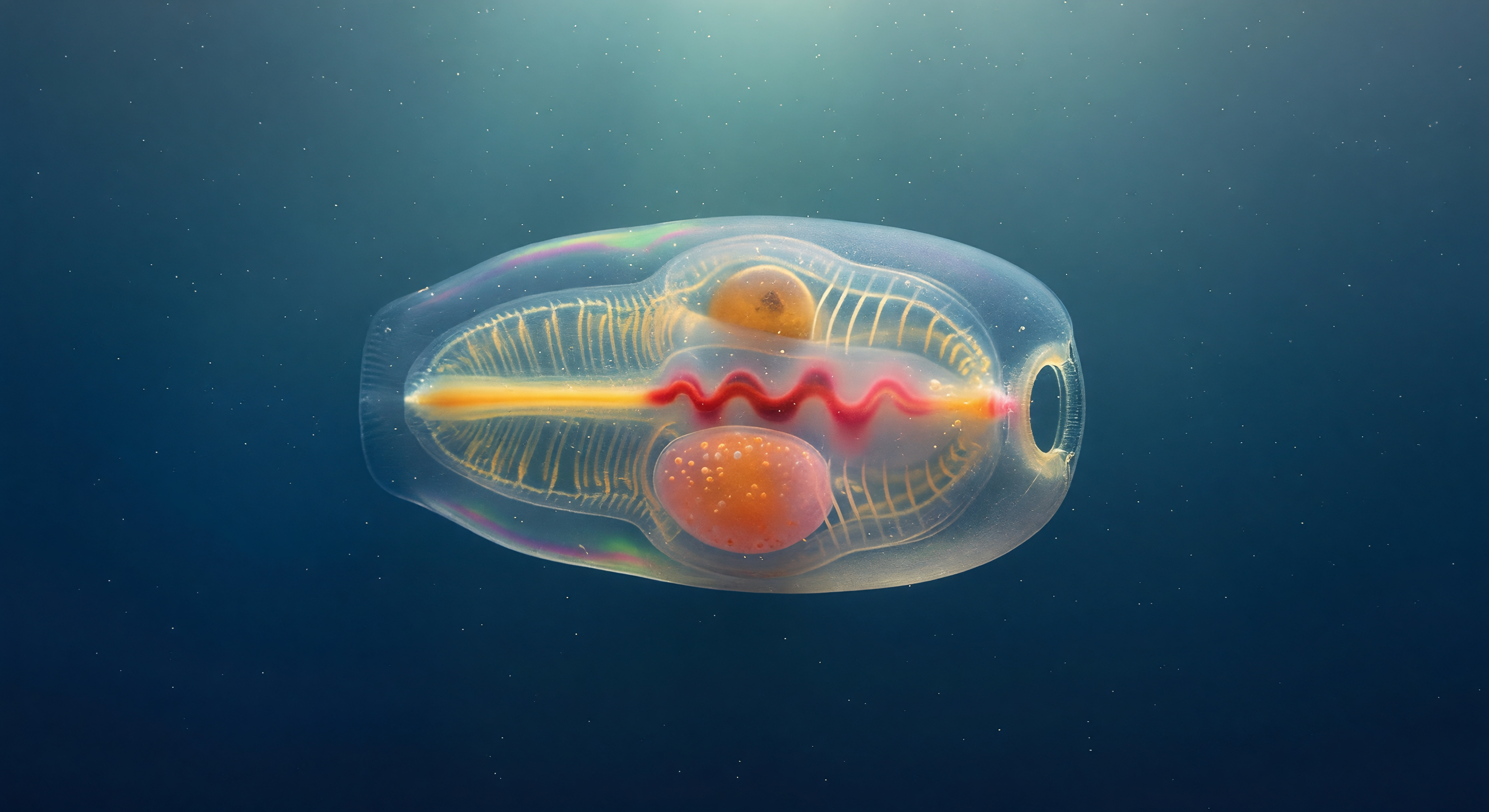
You are suspended two centimeters from the anterior face of a living *Pegea confoederata*, a solitary salp roughly eight centimeters long, drifting at forty meters depth in the tropical Atlantic where diffuse noon light descends as a soft, directionless cathedral radiance from the entire ocean sky above. The tunic wall surrounding you is so nearly identical in refractive index to the seawater itself that it announces its presence only as the faintest curved thickening of space — a skin of biological gel stretched taut and smooth as polished crystal, its boundary perceptible more as a subtle bending of the blue-green background than as any true surface. That backlight passes straight through the organism, converting it into a luminous still life: the pharyngeal basket glows with warm amber-gold iridescence as its continuously secreted mucous net — a filtering silk finer than any human manufacture, capable of capturing bacteria invisible to the naked eye — scatters transmitted light across the full width of the barrel, while the endostyle traces a bright ventral stripe of dense glandular amber from end to end like a vein of warm resin lit from within. At the body's center, three millimeters of crimson heart contracts in slow, perfectly visible peristaltic waves every half-second, its color shifting from dark arterial red at systole to translucent rose at diastole, each pulse propagating a faint ripple of compression through the surrounding gel, and beside it the orange-pink gonad reveals individual pale oocytes as faint translucent spheres embedded in warmer tissue — the entire architecture of a chordate life held in suspension inside a barrel of frozen seawater, organized by evolution into a glowing transparency that is, by any physical measure, almost indistinguishable from the ocean that contains it.
Other languages
- Français: Anatomie Lumineuse Pegea Macro
- Español: Anatomía Translúcida Pegea Macro
- Português: Anatomia Iluminada Pegea Macro
- Deutsch: Durchleuchtete Pegea Anatomie Makro
- العربية: تشريح بيجيا الشفاف مضيء
- हिन्दी: प्रकाशित पेजिया शरीर रचना
- 日本語: 透過光ペゲア解剖マクロ
- 한국어: 역광 페게아 해부 매크로
- Italiano: Anatomia Pegea Controluce Macro
- Nederlands: Doorzichtige Pegea Anatomie Macro