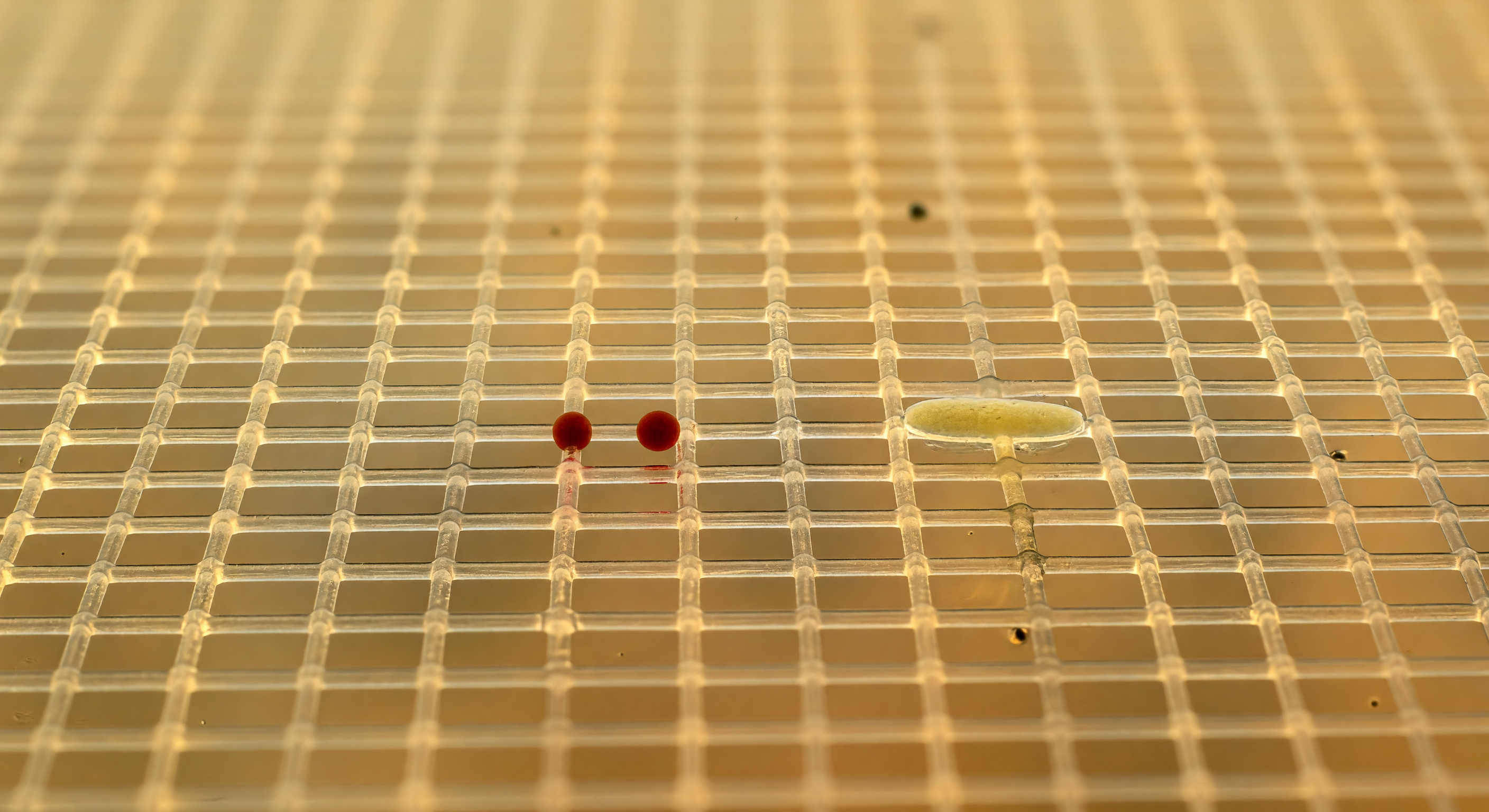
You are suspended inside what can only be described as a cathedral built from light and biological engineering — an infinite orthogonal lattice of mucopolysaccharide fibers stretching in every direction, each glistening strand roughly a bacterium's width in diameter, pulled taut and coated in a viscous near-invisible film that transforms transmitted pharyngeal light into spun amber glass. This is the interior of a salp's pharyngeal mucus net, secreted continuously by the endostyle, a living filter whose rectangular mesh apertures — each barely a micron across — are precisely sized to intercept the ocean's smallest photosynthesizers: *Prochlorococcus* cells, heterotrophic bacteria, viral particles riding the slow invisible current drawn through by muscular jet propulsion. Wedged at the nearest fiber junction, one such *Prochlorococcus* sphere sits like a deep crimson boulder, its 0.6-micron diameter making it proportionally massive here, while a pale bacterial rod adheres lengthwise to an adjacent strand through surface chemistry alone, both cells now committed to digestion by a creature whose tissue is so close in refractive index to seawater that the entire filtering apparatus — pharyngeal basket, mucus net, endostyle, and all — is essentially a ghost of organized biology visible only because amber light catches its geometry. Depth recedes in dissolving planes of gold and ochre, each successive layer of net slightly softer than the last, the lattice fading into warm luminous haze that holds within it the suggestion of more captured particles, more intersections, the whole structure simultaneously a micron-scale mesh and, from within, an endless radiant cosmos.
Other languages
- Français: Réseau Muqueux Pharyngien Intérieur
- Español: Interior de Red Mucosa Faríngea
- Português: Interior da Rede Mucosa Faríngea
- Deutsch: Inneres Pharyngeales Schleimgitter
- العربية: داخل شبكة المخاط البلعومي
- हिन्दी: ग्रसनी श्लेष्म जाल अंतरंग
- 日本語: 咽頭粘液網の内部
- 한국어: 인두 점액망 내부
- Italiano: Interno Rete Mucosa Faringea
- Nederlands: Binnenste Faryngeaal Slijmnet