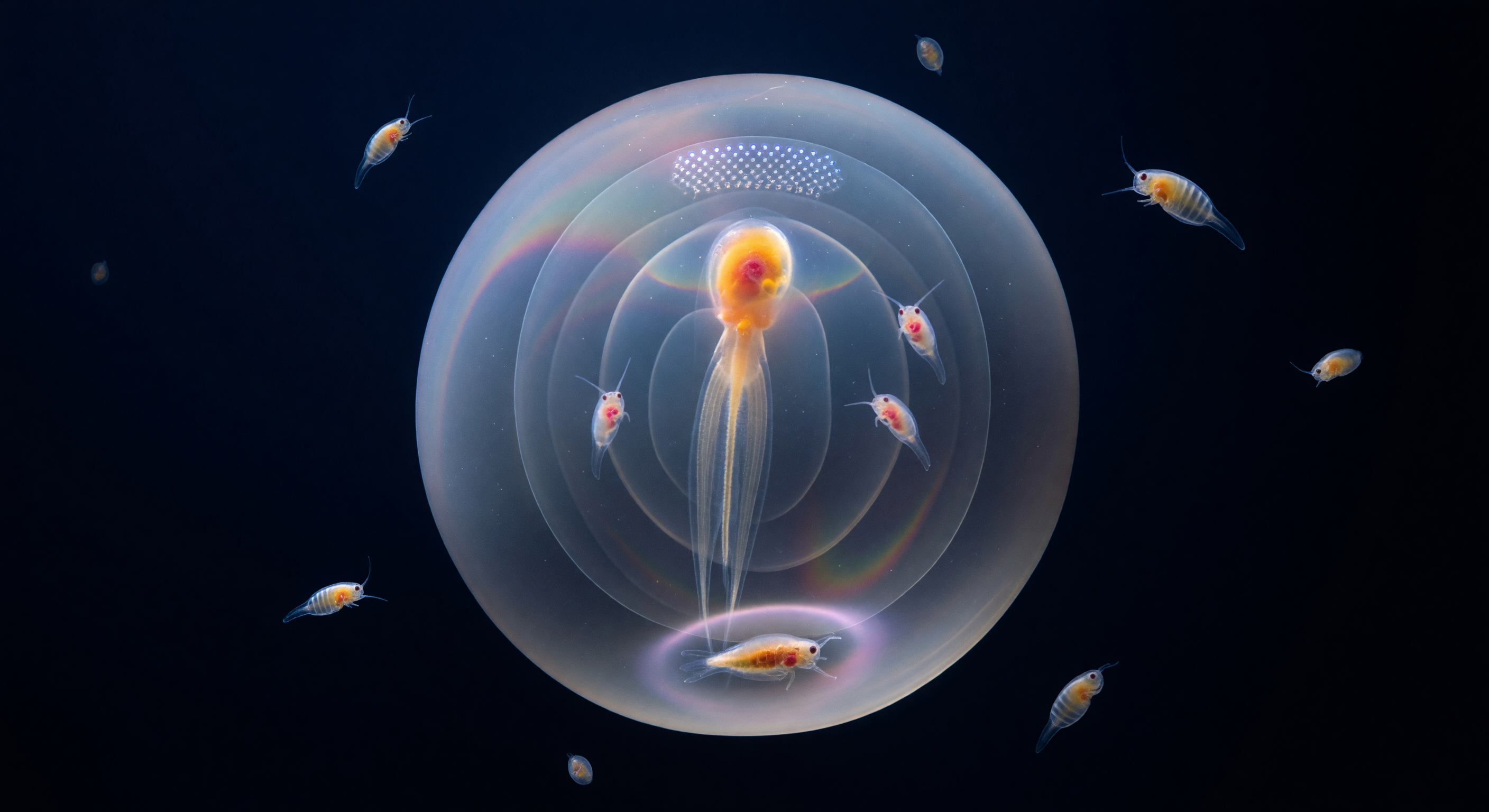
You hover one meter away in the mesopelagic dark, and the object before you occupies nearly your entire field of view: a sixty-centimeter sphere of mucopolysaccharide membrane, tensioned from within like a lung mid-breath, its surface scattering cold LED light into thin-film interference fringes of ice-blue, faint rose, and mother-of-pearl iridescence against water so dark it has no color at all. This is the house of *Bathochordaeus charon*, a giant larvacean — a tunicate no larger than a preserved apricot suspended at the geometric center of its own architectural creation, its ribbon tail beating in slow powerful strokes that drive water through concentric baffle layers of ghost-plane mucus toward the fine-mesh feeding filters at the anterior pole, each hexagonal cell of the inlet grid catching a pinpoint bead of blue-white light like a faceted window sixty microns across. The house itself is not a shell or a case but a living filtration machine, continuously secreted and structurally tuned to capture bacteria and picophytoplankton invisible to the naked eye, yet assembled at a scale that dwarfs most zooplankton in the surrounding water column. At the inlet grid, three copepods hover in cautious suspension — drawn by the feeding current, compound eyes dark ruby against the sphere's glow, bodies transparent enough to read their organs — while an amphipod pressed against the outer membrane leaves a dimple rimmed in pale violet interference light, a reminder that this luminous architecture is, despite all appearances, nothing more than water, protein, and the slow muscular will of a creature smaller than your thumb.
Other languages
- Français: Géant Mésopelagique Bathochordaeus
- Español: Gigante Mesopelágico Bathochordaeus
- Português: Gigante Mesopelágico Bathochordaeus
- Deutsch: Bathochordaeus Mesopelagischer Riese
- العربية: عملاق باثوكورديوس السحيق
- हिन्दी: बाथोकॉर्डेयस मेसोपेलाजिक दानव
- 日本語: バソコルダエウス深海の巨人
- 한국어: 바소코르다에우스 중층해양 거인
- Italiano: Gigante Mesopelagico Bathochordaeus
- Nederlands: Bathochordaeus Mesopelagische Reus